FHI 360
FHI 360 Envision FP Annual Report Year 4
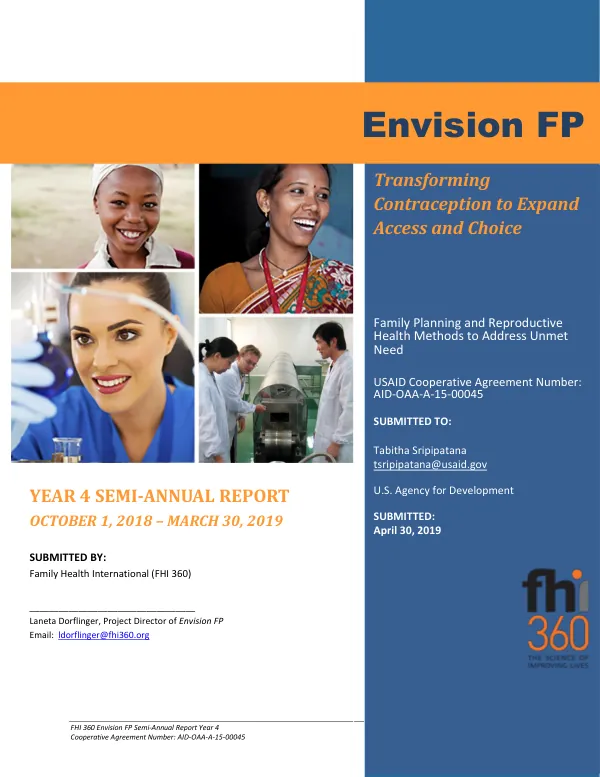
The Envision FP project, led by FHI 360, aims to develop, introduce, and expand understanding of contraceptive technologies and approaches to enhance choice and reduce unmet need.
2019 · 78 pages
Sign in to readA free account is required to download.
Abstract
The project focuses on key challenges and opportunities significant for users and programs in an effort to achieve the overall goal of broadening choice of and access to quality, affordable, and acceptable contraceptives to meet the changing needs and desires of women and girls throughout their reproductive lives. In Year 4, the project implemented a total of twenty activities, including project management and monitoring and evaluation. Among these activities, two were new in Year 4, and one closed in Year 4. Two ongoing activities were co-funded by USAID/Office of HIV and AIDS (OHA), and one activity was funded by OHA in Year 4. Two activities were co-funded by an Interagency Agreement (IAA) from the National Institute of Child Health and Development (NICHD), and one ongoing activity was fully-funded by NICHD and implemented by the World Health Organization (WHO). The project's objective is to refine existing methods, respond to product-related issues that arise from the field and impact provision, and develop new methods to fill gaps. In Year 4, the project made significant progress in achieving these objectives. The Evidence for Contraceptive Options and HIV outcomes (ECHO) Study provided new and high-quality data showing no substantial difference in the risk of acquiring HIV among users of three contraceptive methods: depo-medroxyprogesterone acetate (DMPA), the copper IUD, and LNG implants. This data was reviewed by the WHO-convened Guideline Development Group (GDG) in July 2019, and based on the GDG recommendations, WHO updated the MEC for women at high risk of HIV, changing progestogen-only injectables and IUDs from a Category 2 to a Category 1. The development of a microneedle patch to expand user-initiated contraceptive options also advanced significantly in Year 4. The project's focus on key challenges and opportunities significant for users and programs has helped to achieve the overall goal of broadening choice of and access to quality, affordable, and acceptable contraceptives to meet the changing needs and desires of women and girls throughout their reproductive lives. The project's implementation is on track, with only minor changes or delays in activities. An external project evaluation of Envision FP was conducted in August 2019, and the evaluation team provided thorough feedback on the project. The project's results and accomplishments in Year 4 include the provision of new and high-quality data on the risk of acquiring HIV among users of three contraceptive methods, the development of a microneedle patch to expand user-initiated contraceptive options, and the update of the MEC for women at high risk of HIV. The project's financial information is provided in Appendix 1, and additional reporting pertaining to Year 4 can be found in the sections on outcome map progress (Appendix 2), indicators reporting (Appendix 3), and the environmental monitoring and mitigation report (EMMR; Appendix 4). The previously submitted Year 4 Management Review (Appendix 5) and Key Results Review (Appendix 6) are also included. The development of a contraceptive microneedle patch is a key area of focus for the Envision FP project. The project aims to develop a microneedle patch that can be used to deliver a contraceptive hormone, providing women with a new and convenient option for birth control. The development of this technology has the potential to expand access to contraceptive options and improve reproductive health outcomes for women around the world. The project's technical assistance for FP-HIV integration, ECHO continuation, and WHO's continuous identification of research evidence (CIRE) are also key areas of focus. The project's technical assistance for FP-HIV integration aims to improve the integration of family planning and HIV services, while the ECHO continuation project aims to provide ongoing support for the Evidence for Contraceptive Options and HIV outcomes (ECHO) Study. The CIRE project aims to identify and disseminate research evidence on contraceptive options and HIV outcomes. Overall, the Envision FP project has made significant progress in achieving its objectives in Year 4. The project's focus on key challenges and opportunities significant for users and programs has helped to achieve the overall goal of broadening choice of and access to quality, affordable, and acceptable contraceptives to meet the changing needs and desires of women and girls throughout their reproductive lives.