USAID DEC
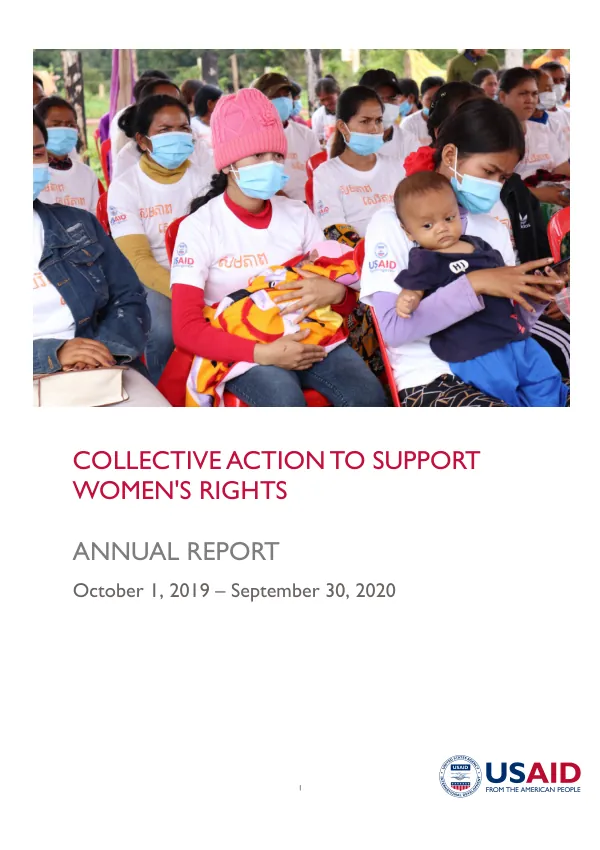
Collective Action to Support Women's Rights Annual Report 2019 - 2020
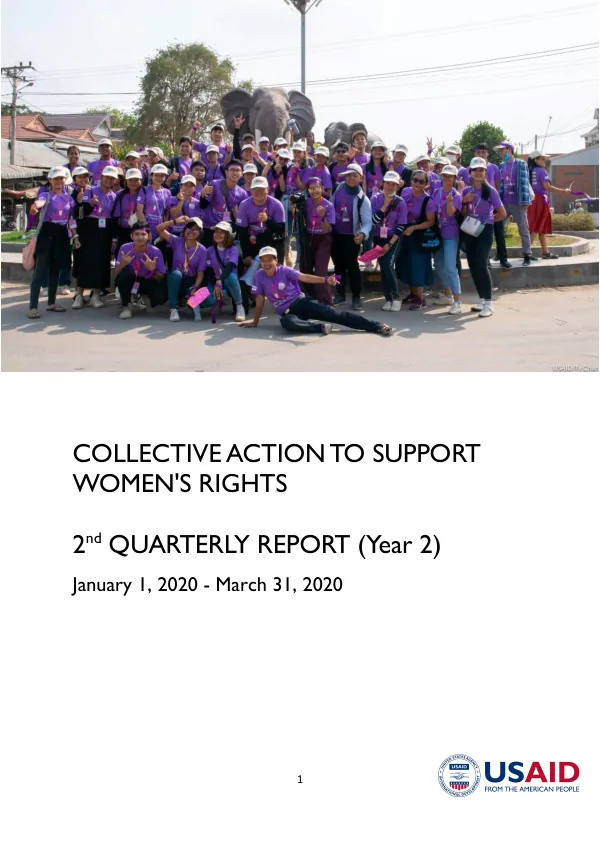
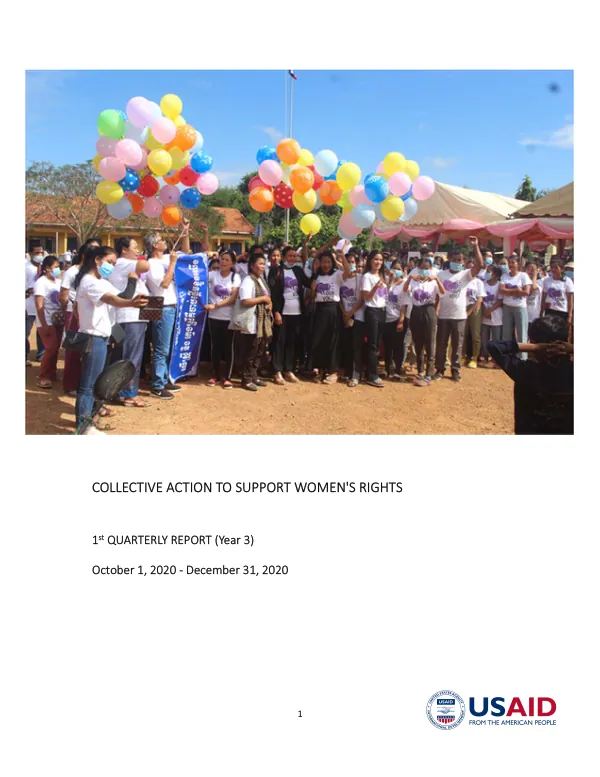
The Collective Action to Support Women's Rights project is a two-year and nine-month initiative led by Gender and Development for Cambodia (GADC) with three co-implementing partners, AMARA, Alliance for Conflict Transformation (ACT), and Women Peace Makers (WPM).
2020 · 12 pages
Sign in to readA free account is required to download.
Abstract
The project aims to link communities and civil society to the government by increasing women and youth participation and leadership in decision-making processes in Cambodia. The project focuses on three main outcome areas: empowerment of women and youth to positively transform traditional practices in societal and political institutions to further gender equality, enrichment of an enabling environment for the participation and leadership of women and youth in decision-making and political processes, and development of a stronger and better mobilized network of women, youth, and gender NGOs with evidence-based advocacy. The project is being implemented in six provinces, Battambang, Pursat, Kampong Chhnang, Kampong Speu, Kampot, and Mondulkiri, with a total of 33 communes. The project targets women, men, youth, indigenous people, minority groups, persons with disabilities, LGBTQTI, and the communities of the six provinces. The project aims to reach at least 20,000 people, active youth, and outstanding community members with at least six Community Capacity Building Teams (CCBTs), 120 youth core groups, and 330 commune core groups in the six provinces as direct beneficiaries. During the period from October 1, 2019, to September 30, 2020, the project made significant progress. Community Capacity Building Teams (CCBTs) conducted training on "Gender concept and Leadership for Gender Equality" with a total number of 172 trainees, including 159 women. The training focused on self-identity, gender & social expectation, social norm, leadership, gender equality, basic gender concepts, and gender stereotypes. Participants gained new knowledge on the concept of gender, sex, and other traditional restrictions on women's life. CCBTs also organized a refresher training on "Leadership for Gender Equality" with a total number of 22 attendees, including 17 women. The purpose of the training was to share knowledge on facilitation skill, GBV mechanism in preventing domestic violence against women, and action plan for further training of CCBT to core group. Youth groups from CCBT facilitated 119 meetings, which participated by 2,460 attendees, including 1,784 female participants. Those meetings provided a great opportunity for all participants to discuss gender concepts, gender stereotypes, challenges, social norms, and traditional practices. CCGs facilitated 210 meetings, participated by 4,782 people, including 3,653 female participants. Those meetings were a great opportunity for all participants to discuss and share their experiences in practicing social norms. Community Facilitators provided 12 mentoring and coaching to targeted groups and CCBTs, with a total number of 132, including 111 women. In addition, four virtual trainings on "Man-dialogue" were organized by GADC with 12 men participants. The project also cooperated with a video production team to produce a song called "Chamnorng or Invisible Knot" to raise awareness on gender-based violence against women, especially during the Covid-19 pandemic. CASWR supported 206 CCBTs, including 155 women, and 49 CCGs, including 35 women, to attend 80 different monthly commune meetings. The 16-day WRC was organized to encourage women and youth's participation in leadership and political processes, and the 109th IWD was celebrated in March 2020 to promote women's rights and amplify their voices. Despite the challenges faced by the project, including financial process issues, coordination of monthly community meetings with CCB and CCG members during the harvest season, and CCBTs and CCG members' movement, the project staff worked their best to address these problems. The COVID-19 outbreak also posed a significant challenge to the project implementation, but the project staff adapted to the situation by holding virtual meetings and implementing activities in some areas with strictly precautionary methods. The project also provided a series of mentoring and coaching on gender knowledge and facilitation skill to build project staff's capacity. Another challenge faced by the project was the difficulties of traveling during the rainy season, unstable phone service in some remote areas, and the updates on CIP process from each commune. However, the project staff continued to work on the project implementation, and a series of internal capacity building was provided to improve knowledge and skills for all project staff during the COVID-19 outbreak.