USAID. MISSION TO ZAIRE
Combatting childhood communicable disease project
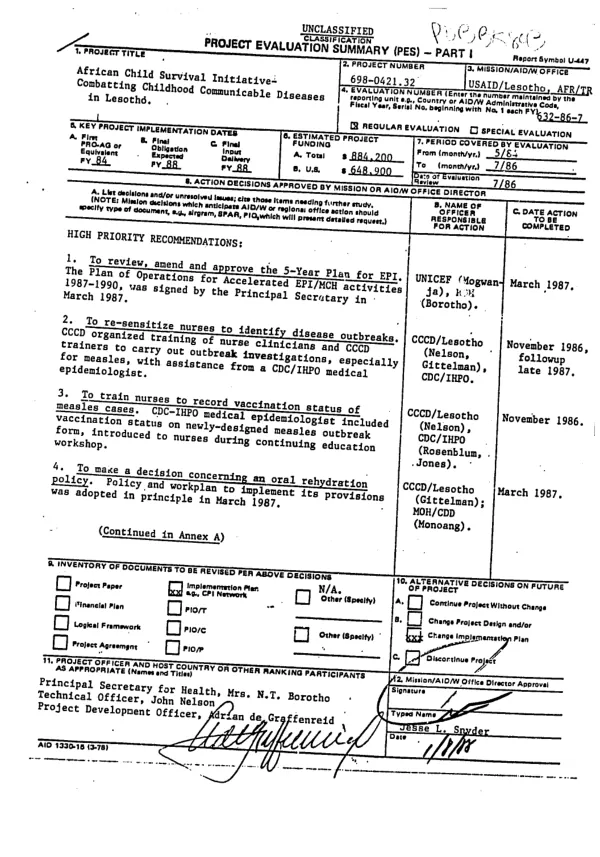
Presents PES facesheet for an unattached external evaluation (PD-AAU-035) of the Congo component of the Combating Childhood Communicable Diseases (CCCD) project.
Awantang, Felix; Harvey, Mary L. · 1986
Sign in to readA free account is required to download.
Abstract
The evaluation covered the period 5/84-4/86. Action decisions to be implemented by 7/87 are as follows. (1) To help the Government of the Congo (GOC) assume full responsibility for all costs by the project"s end, documentation of expenditures for local purchases will be transferred to the Ministry of Health and Social Affairs (MHSA); new bookkeeping records will be kept for this purpose. The Director of Preventive Medicine (DPM) will establish a financial reporting system to inform each partner of the use of all program funds, and an auto-financing system based on user fees will be implemented. (2) Delivery of oral rehydration solution and chloroquine will be integrated into the Expanded Program of Immunization (EPI) distribution system. Supervision of these activities will be combined as much as possible at the regional level, and trimestrial supervisory visits to regions will be made by technical personnel, accompanied by the CCCD program manager or coordinator. An oral rehydration therapy and training unit will be established in Loubomo and Point-Noire. (3) A consultant from the Centers for Disease Control, with help from the Regional Epidemiologist in Kinshasa, will work to establish a nationally standardized health information system. (4) A full-time training coordinator will be appointed. (5) Health educators for EPI, malaria, and diarrheal disease will be assigned to work full-time with the CCCD Health Education (HE) Coordinator, and Central HE personnel will be trained as facilitators for regional training efforts. (6) Priority activities will be chosen from the action plan and given full financial, material, and technical support. Other action decisions are that: (1) A.I.D. continue supporting CCCD, but at a level consistent with GOC funding (the GOC has still not deposited its 1986 contribution); (2) Phase II be delayed until CCCD activities are well established in Phase I regions; (3) new vehicles be assigned to areas outside Brazzaville, where lack of transportation is a binding constraint; (4) to ensure the use of standardized treatment methods, national policies for EPI, diarrheal disease control, and malaria be established; (5) given the MHSA"s existing structures, national coordination of CCCD activities remain with the DPM, as called for in the Pro-Ag (if the Pro-Ag is to be modified, project participants should be consulted in advance); (6) the CCCD HE and Training Coordinators work together to assure the integration of HE with regional training.