USAID DEC
Combination of traits at two developmental stages under salt stress as a measure of tolerance in a reciprocally crossed rice (Oryza sativa) population
Sign inUSAID DEC
Combination of traits at two developmental stages under salt stress as a measure of tolerance in a reciprocally crossed rice (Oryza sativa) population
Rice (Oryza sativa L.)
2020 · 1 pages
Sign in to readA free account is required to download.
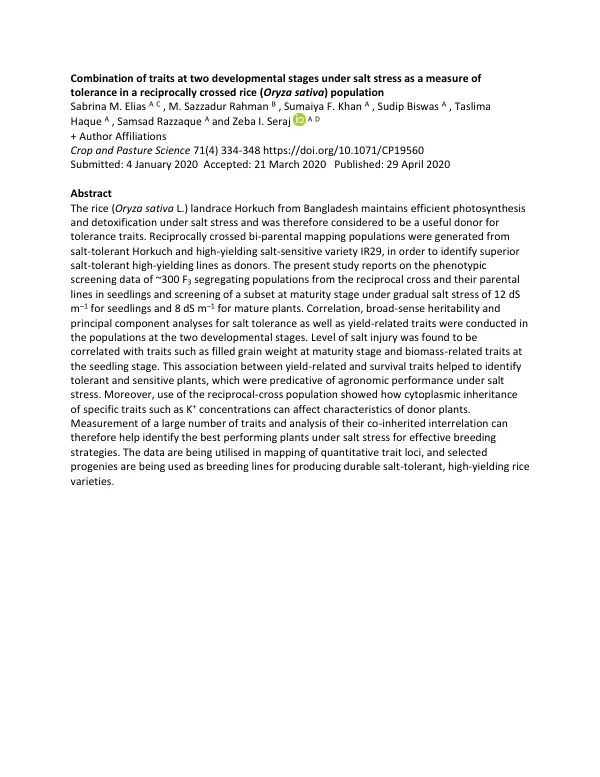
Abstract
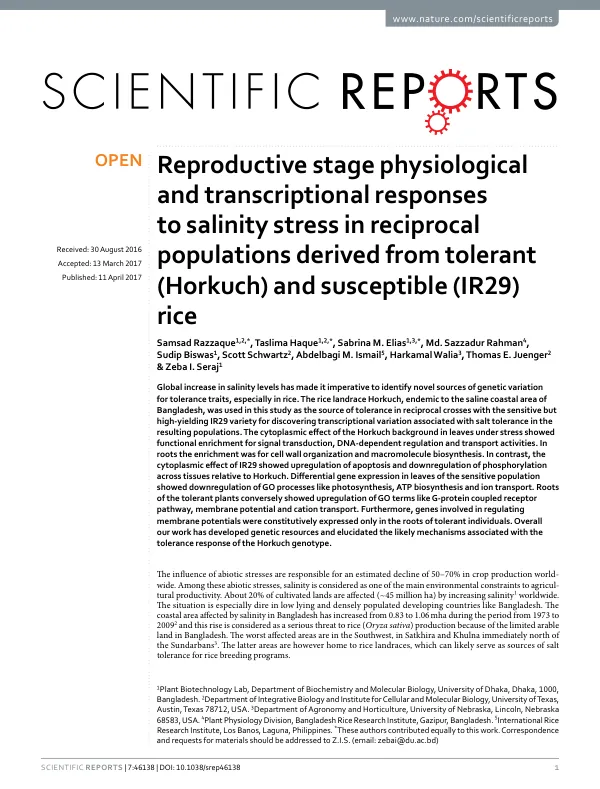
landrace Horkuch from Bangladesh exhibits efficient photosynthesis and detoxification under salt stress, making it a valuable donor for tolerance traits. To identify superior salt-tolerant high-yielding lines, reciprocally crossed bi-parental mapping populations were generated from salt-tolerant Horkuch and high-yielding salt-sensitive variety IR29. The study reports on the phenotypic screening data of approximately 300 F3 segregating populations from the reciprocal cross and their parental lines at two developmental stages: seedlings and mature plants. Phenotypic screening was conducted under gradual salt stress of 12 dS m–1 for seedlings and 8 dS m–1 for mature plants. Correlation analysis revealed a significant association between salt injury and traits such as filled grain weight at maturity stage and biomass-related traits at the seedling stage. This association helped identify tolerant and sensitive plants, which were predictive of agronomic performance under salt stress. Principal component analysis was also conducted to examine the relationship between salt tolerance and yield-related traits. The study found that cytoplasmic inheritance of specific traits, such as K+ concentrations, can affect the characteristics of donor plants. The use of reciprocal-cross populations allowed for the examination of the co-inherited interrelation of a large number of traits. This information can be used to identify the best-performing plants under salt stress for effective breeding strategies. The data collected are being utilized in the mapping of quantitative trait loci, and selected progenies are being used as breeding lines for producing durable salt-tolerant, high-yielding rice varieties. The results of this study have significant implications for rice breeding programs aimed at developing salt-tolerant varieties. The identification of tolerant and sensitive plants at two developmental stages provides valuable information for selecting the best-performing lines for breeding. The use of reciprocal-cross populations and the analysis of co-inherited interrelation of traits can help breeders develop more effective breeding strategies for producing salt-tolerant, high-yielding rice varieties. The study's findings can contribute to the development of more resilient rice varieties that can thrive in salt-affected environments.