USAID DEC
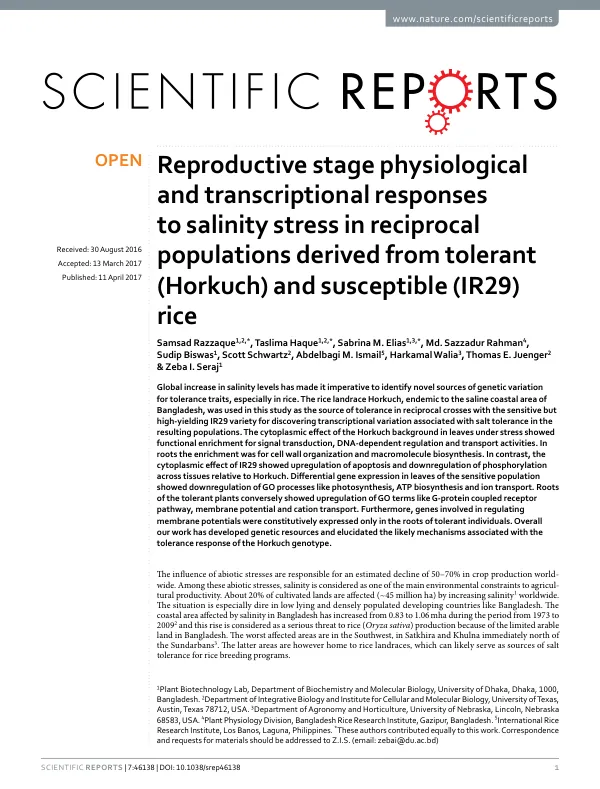
Reproductive stage physiological and transcriptional responses to salinity stress in reciprocal populations derived from tolerant (Horkuch) and susceptible (IR29) rice
Sign inUSAID DEC
Reproductive stage physiological and transcriptional responses to salinity stress in reciprocal populations derived from tolerant (Horkuch) and susceptible (IR29) rice
Rice is the most important cereal crop but is highly salt-sensitive among major cereals.
2017 · 16 pages
Sign in to readA free account is required to download.
Abstract
This sensitivity is variable at different stages of its growth period. Rice plants are most sensitive at the young seedling and reproductive stages but relatively tolerant at seed germination. Moreover, seedling and reproductive stage tolerances are poorly correlated, suggesting separate sets of genes may be involved at different developmental stages in overcoming salt stress. Some genetic mechanisms of salinity tolerance in cereal crops have been identified and include genes like NHX, SOS, HKT, NAC, bZIP, Hardy, PDH45, glyoxalases, chaperones, and various antioxidants that respond to salinity stress at the transcriptional level. The identification of these genes has been primarily through their sequence similarity with proteins of known functions in salt tolerance in model species. Some of these genes have been reported to play important roles in protecting plants from salinity stress through perception, signal transduction, and transcriptional regulatory networks in cellular responses. In salt-affected areas, farmers are known to have adopted the use of rice landraces for generations even though these generally have poor agronomic traits including tall plant stature, long growth duration, low yield, and poor grain quality. These traditional varieties, however, show significant tolerance to salt stress by a complex set of physiological mechanisms which include sodium exclusion, compartmentation into vacuoles, stomatal responsiveness, and upregulation of metallothionein-like protein. Upregulation of the antioxidant machinery and other necessary genes including transcription factors associated with salt tolerance in a number of rice genotypes has also been reported. The rice landrace Horkuch, endemic to the saline coastal area of Bangladesh, was used in this study as the source of tolerance in reciprocal crosses with the sensitive but high-yielding IR29 variety for discovering transcriptional variation associated with salt tolerance in the resulting populations. The cytoplasmic effect of the Horkuch background in leaves under stress showed functional enrichment for signal transduction, DNA-dependent regulation, and transport activities. In roots, the enrichment was for cell wall organization and macromolecule biosynthesis. In contrast, the cytoplasmic effect of IR29 showed upregulation of apoptosis and downregulation of phosphorylation across tissues relative to Horkuch. Differential gene expression in leaves of the sensitive population showed downregulation of GO processes like photosynthesis, ATP biosynthesis, and ion transport. Roots of the tolerant plants, conversely, showed upregulation of GO terms like G-protein coupled receptor pathway, membrane potential, and cation transport. Furthermore, genes involved in regulating membrane potentials were constitutively expressed only in the roots of tolerant individuals. Overall, the study has developed genetic resources and elucidated the likely mechanisms associated with the tolerance response of the Horkuch genotype.
Related documents
Documents in this collection
 2021
2021USAID DEC
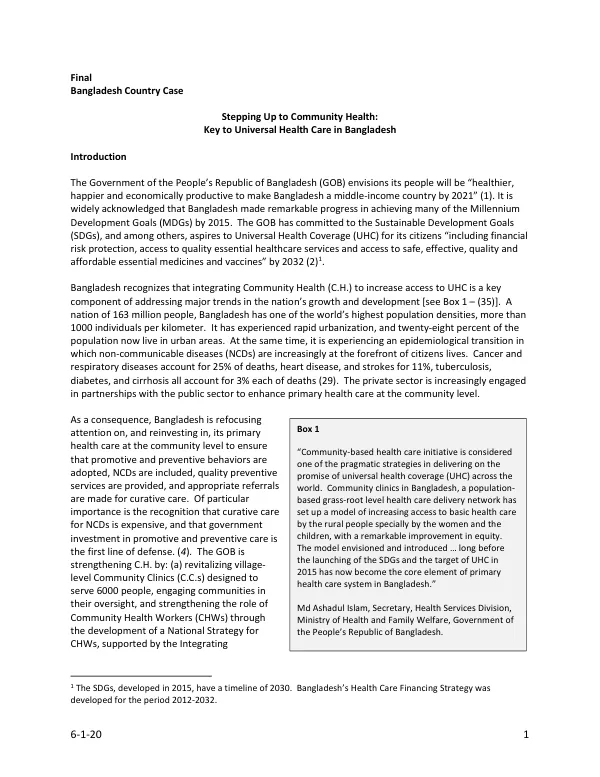
Stepping Up to Community Health: Key to Universal Health Care in Bangladesh
Open record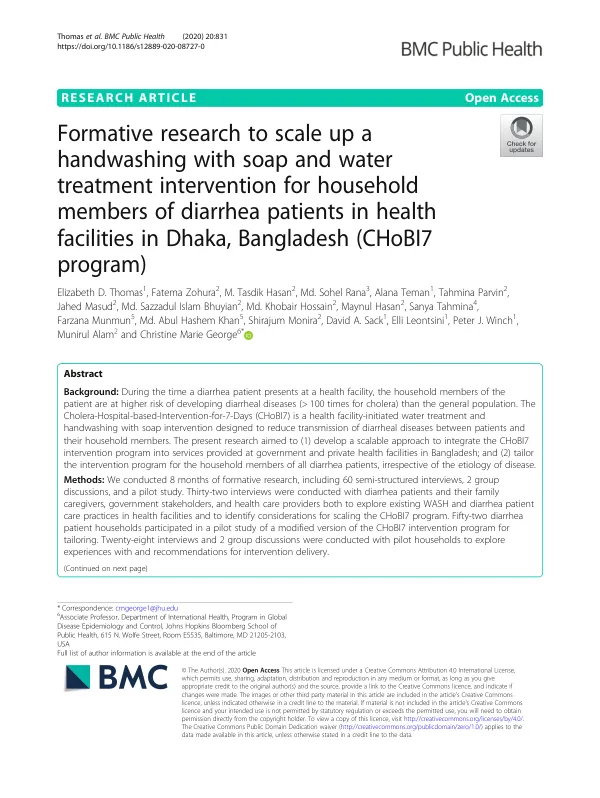 2020
2020USAID DEC
Formative research to scale up a handwashing with soap and water treatment intervention for household members of diarrhea patients in health facilities in Dhaka, Bangladesh (CHoBI7 program)
Open record