POPULATION SERVICES INTERNATIONAL/DKT INTERNATIONAL
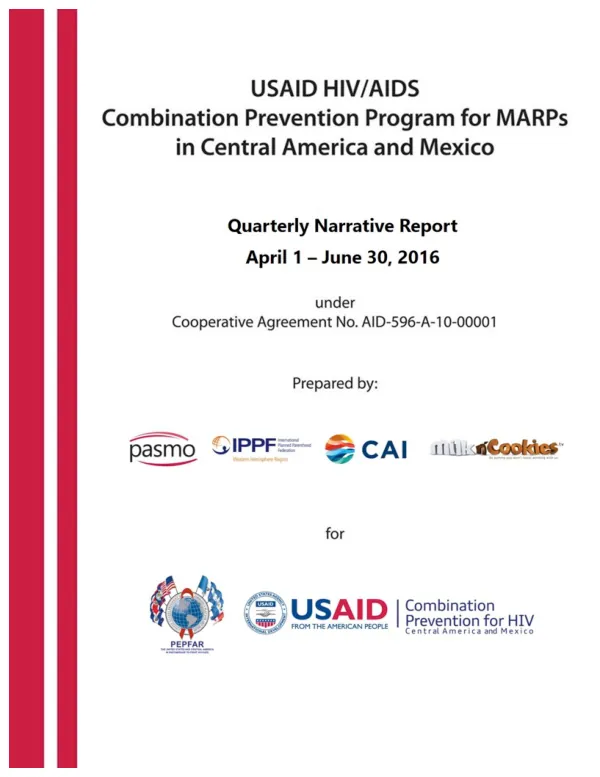
Combination Prevention Program for HIV Quarterly Narrative Report, Q3 FY2016
The Combination Prevention Program for HIV is a USAID-funded initiative aimed at increasing access to HIV prevention interventions among key populations at greater risk for HIV (KPs) in Central America.
2016 · 40 pages
Sign in to readA free account is required to download.
Abstract
The program is implemented by PSI, in partnership with its network member, the Pan-American Social Marketing Organization (PASMO), and other community/faith-based, nongovernmental, public, and private sector partners. During the third quarter of fiscal year 2016, the program achieved several key results. Component 1 – Social Behavior Change (SBC) continued to implement a redefined essential or minimum package of interventions and services, targeting men who have sex with men (MSM), transgender women (TW), and people living with HIV (PHIV). The program also implemented strategies and activities through restructured HIV tactical teams, conducted ongoing mapping exercises, and received deliverables from INSPIRA. The program's yield rates for the quarter include 70% of individuals reached and those who received program HIV testing and counseling (HTC), 5% of individuals who received program HTC and had a reactive result, and 49% of reactive cases linked to services. The program also continued to focus outreach with PHIV through patient advocates for support along the continuum of care, expanding the number of activities including outreach sessions, home visits, follow-up, and reminders. In addition, the program expanded coverage of online outreach and referrals to HTC through cyber-educators, reaching a total of 3,684 MSM and 50 TW in the region. The program also provided ongoing follow-up to people living with HIV through online patient advocates (OPAs) in applicable countries, using tools such as WhatsApp, short message system (SMS) text messages to mobile phones, among others. The program also trained a new team of cyber-educators in Honduras, conducted the second generation of the Formal Course to specialize support group facilitators in El Salvador, Nicaragua, Panama, and Guatemala, and implemented a technical assistance strategy in El Salvador and Nicaragua. The program also printed and began the dissemination of the journal/logbook material in addition to the mobile phone app for PHIV, and carried out a multiple-session hackathon in Guatemala. The program's management information system (MIS), entitled System of Applied Monitoring (SAM), is being integrated into the DHIS2 system. The program also continued to use the Unique Identifier Code (UIC) as part of efforts to strengthen and systematize quality control of program interventions. The program's geographic focus is on Central America, with a specific emphasis on key populations at greater risk for HIV, including MSM, TW, and PHIV. The program's timeframes are quarterly, with a focus on achieving specific results and outcomes during each quarter. The program's implementation details include the use of a redefined essential or minimum package of interventions and services, the implementation of strategies and activities through restructured HIV tactical teams, and the use of online outreach and referrals to HTC through cyber-educators. The program also uses a variety of tools and technologies, including WhatsApp, SMS text messages, and mobile phone apps, to provide ongoing follow-up to people living with HIV and to support PHIV along the continuum of care. The program's recommendations for future implementation include continued focus on key populations at greater risk for HIV, including MSM, TW, and PHIV, and the use of a variety of strategies and activities to reach and engage these populations. The program also recommends continued use of online outreach and referrals to HTC through cyber-educators, and the use of tools and technologies such as WhatsApp, SMS text messages, and mobile phone apps to provide ongoing follow-up to people living with HIV and to support PHIV along the continuum of care.
Related documents