USAID DEC
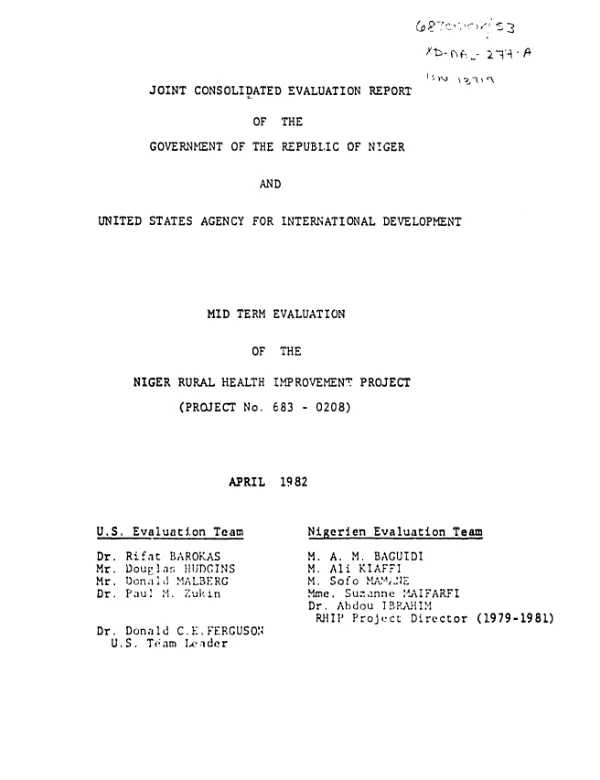
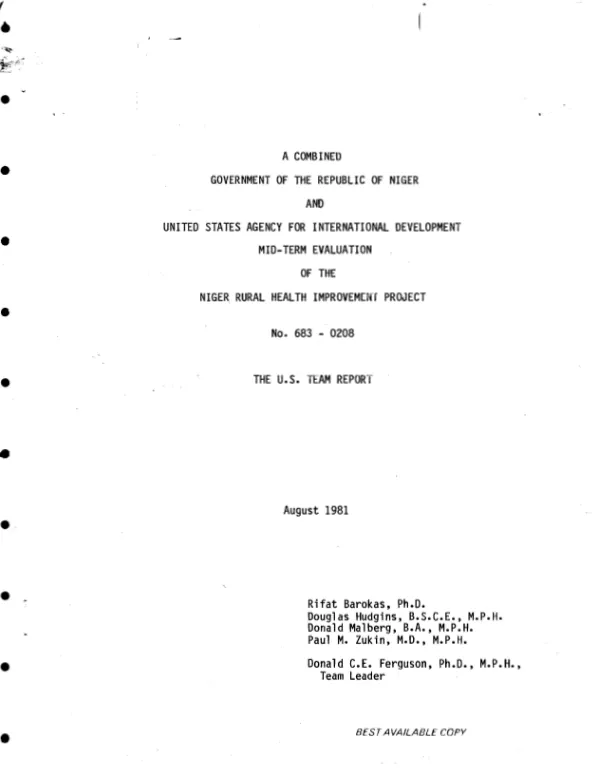
Combined government of the republic of Niger and USAID midterm evaluation of the Niger rural health improvement project
Sign inUSAID. BUR. FOR SCIENCE AND TECHNOLOGY. OFC. OF HEALTH
Combined government of the republic of Niger and USAID midterm evaluation of the Niger rural health improvement project
Evaluates rural health improvement project in Niger.
Barokas, Rifat|Hudgins, Douglas · 1981
Sign in to readA free account is required to download.
Abstract
Special evaluation covers the period 1/79-4/81 and is based on document review, site visits, and interviews with project officials. Although the project has substantially improved rural health services delivery, several implementation problems have been encountered. The project's position within the administrative structure of the Ministry of Health (MOH) does not reflect its supra-divisional nature; the resulting bureaucratic delays and inter-agency conflicts have hampered progress. In regard to rural health services, important gaps exist in the control of malaria, immunization for measles, treatment of diarrheal diseases, and sterilization of needles and syringes. With respect to rural water supply, the installation of reinforced concrete open wells alone cannot provide a safe protected water source; adoption of a lifting device offers a low-cost easily adaptable means of improving open well sanitation. The training program for sanitary agents meets project goals but must be expanded to meet future needs. Although incomplete, the MOH data system is sufficient for establishing major health priorities. Data system deficiencies stem from the lack of an ability to monitor health-related interventions. A construction program for seven dispensaries and two departmental centers risks failure because of faulty construction and inadequate water supply and sanitation systems. Funds allocated for sanitary improvements to existing medical units are insufficient. Major resupply problems could occur if the expansion of the village health team network increases at a faster rate than the supervisory staff. Minor improvements in the design and content of medical kits are needed. Good progress has been made in the training of village health team members; 1,235 secouristes (41% of target) and 926 matrones (31% of target) have completed training. It is recommended that the project be extended until 12/84. Further detailed recommendations are made regarding the project's administrative structure (10), rural health services (8), rural water supply (8), sanitation (15), the MOH data system (5), institutional development and logistical support (11), and manpower development (10).