USAID DEC
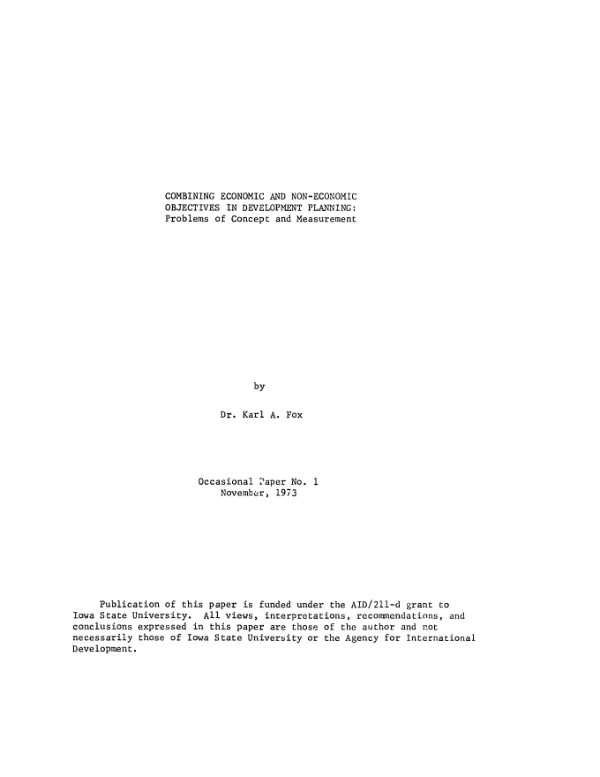
Combining economic and non-economic objectives in development planning, problems of concept and measurement
Sign inIOWA STATE UNIVERSITY OF SCIENCE AND TECHNOLOGY
Combining economic and non-economic objectives in development planning, problems of concept and measurement
The gross national product (GNP) is the principal measure of economic progress.
Fox, K. A. · 1970
Sign in to readA free account is required to download.
Abstract
It enables us to make reproducible quantitative statements about the same economy at different points in time and about different economies at the same point in time. Operational methods for measuring GNP flow directly from the theory of general economic equilibrium. GNP describes the performance of an economy. However, political leaders must be concerned about the performance of a society. The absence of accepted measures of societal performance (in addition to GNP) inhibits scientific discussion of social objectives. The current interest in "social indicators" and measures of "the quality of life" is directed toward bringing some order into this discussion. In this paper the author suggests the extension of general equilibrium theory to all outputs of a society. This leads us to the concept of a gross social product or GSP which includes the GNP and gives symmetrical treatment to economic and noneconomic societal outputs. Such a measure (GSP) facilitates the task of combining economic and noneconomic objectives in development planning. It also facilitates intersocietal comparisons at a given time. The extension from GNP to GSP involves more than a notational exercise. The author introduces some concepts from sociological theory (Talcott Parsons), from individual and social psychology (Eric Berne), and from ecological psychology (Roger Barker) and comments on some practical problems of measuring the noneconomic components of the gross social product.
Related documents