MOMENTUM ROUTINE IMMUNIZATION TRANSFORMATION AND EQUITY PROJECT
Commitment to Immunizing Zero-Dose Children
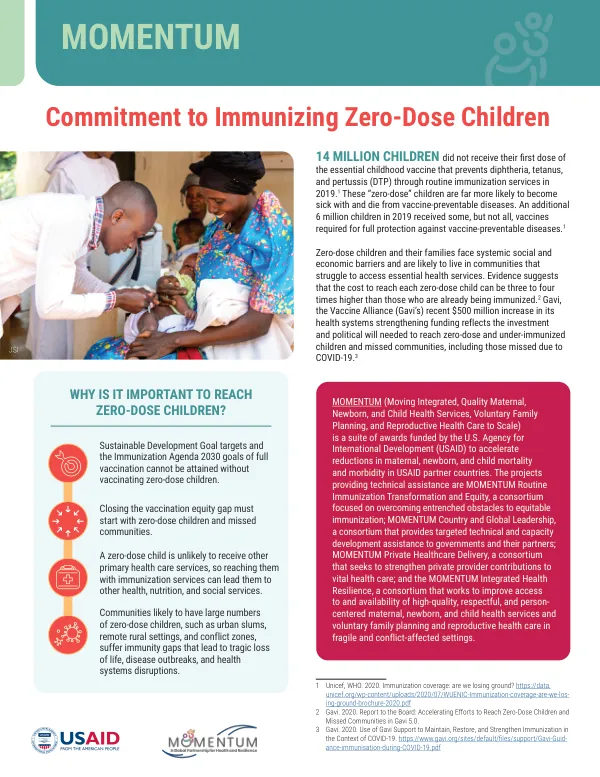
The commitment to immunizing zero-dose children is crucial for achieving Sustainable Development Goal targets and the Immunization Agenda 2030 goals of full vaccination.
2021 · 2 pages
Sign in to readA free account is required to download.
Abstract
Zero-dose children are unlikely to receive other primary health care services, making immunization services a critical entry point for reaching them with other health, nutrition, and social services. Communities with large numbers of zero-dose children, such as urban slums, remote rural settings, and conflict zones, suffer immunity gaps that lead to tragic loss of life, disease outbreaks, and health systems disruptions. In 2019, 14 million children did not receive their first dose of the essential childhood vaccine that prevents diphtheria, tetanus, and pertussis (DTP) through routine immunization services. These zero-dose children are far more likely to become sick with and die from vaccine-preventable diseases. An additional 6 million children in 2019 received some, but not all, vaccines required for full protection against vaccine-preventable diseases. Zero-dose children and their families face systemic social and economic barriers and are likely to live in communities that struggle to access essential health services. The cost to reach each zero-dose child can be three to four times higher than those who are already being immunized. The MOMENTUM initiative, funded by the U.S. Agency for International Development (USAID), aims to accelerate reductions in maternal, newborn, and child mortality and morbidity in USAID partner countries. MOMENTUM's suite of awards includes the Routine Immunization Transformation and Equity, Country and Global Leadership, Private Healthcare Delivery, and Integrated Health Resilience consortia. These projects provide technical assistance to overcome entrenched obstacles to equitable immunization, strengthen private provider contributions to vital health care, and improve access to and availability of high-quality, respectful, and person-centered maternal, newborn, and child health services and voluntary family planning and reproductive health care in fragile and conflict-affected settings. The COVID-19 pandemic has disrupted immunization services, and even more children were not vaccinated in 2020 compared to 2019. Combined with increased food insecurity, lost income, and other shocks, millions of children are at-risk of becoming sick or dying. MOMENTUM aims to reduce the number of zero-dose children in its national and sub-national project areas by conducting analyses to define the reasons and root causes for zero-dose and under-vaccination, working with marginalized communities to co-design and apply solutions, strengthening the capacity of national and sub-national partners, and identifying and sharing what works to reach zero-dose children. MOMENTUM will build upon Gavi's framework for reducing the number of children who have never been immunized: Advocate, Identify, Reach, and Measure and Monitor. This framework includes advocating for overcoming gender barriers and other systemic obstacles, supporting national and sub-national budgeting to reach zero-dose children, strengthening capacity of managers to characterize entrenched obstacles to utilizing services, and developing tailored strategies to overcome barriers. MOMENTUM will also strengthen immunization supply chains to reach remote communities, improve tools to track vaccinations, and share lessons learned.
Related documents
Documents in this collection
 2019
2019USAID DEC
Emergency Assistance for Zika: USAID Supported Activities Overseas but Could Improve Funds Tracking and Response Planning
Open record 2017
2017USAID DEC