USAID DEC
The SBCC Emergency Helix: A Framework for Strengthening Public Health Emergency Programs with Social and Behavior Change Communication
Sign inTHE JOHNS HOPKINS UNIVERSITY, CENTER FOR COMMUNICATIONS PROGRAMS
The SBCC Emergency Helix: A Framework for Strengthening Public Health Emergency Programs with Social and Behavior Change Communication
Public health emergencies are changing, and the response must adapt accordingly.
2017 · 11 pages
Sign in to readA free account is required to download.
Abstract
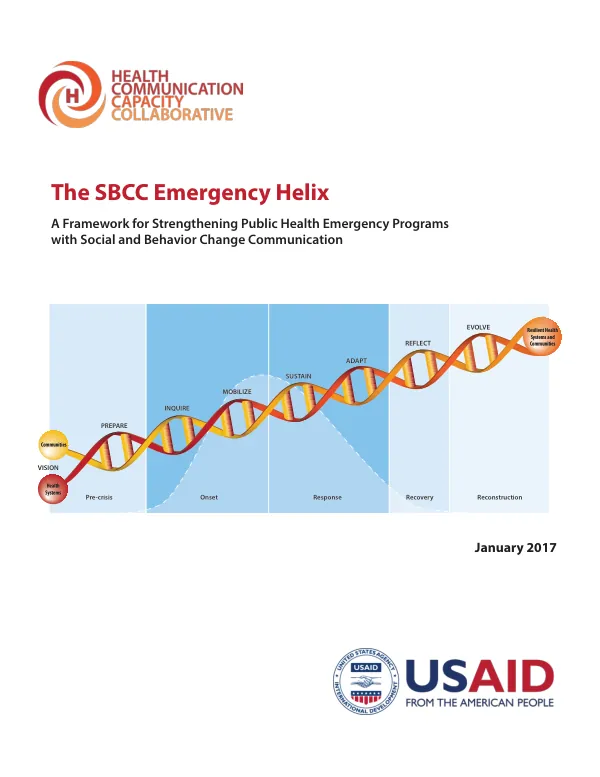
Countries face ongoing emergencies that overlap in time and place, with numerous global outbreaks of communicable diseases in recent years. Climate change is also a slow-moving emergency that poses significant challenges. The question surrounding the next health emergency is not "if," but "when." As a result, public health emergency responses need to prioritize long-term development and strengthening of healthy communities. Effective responses often depend on behavioral changes at the individual, household, or community level, which require robust and trustworthy communication. Communities do not accept emergency response activities passively but rather react according to their social structures and values. If people cannot find a real advantage in complying with a public health initiative or emergency response, they may refuse to cooperate or engage in behaviors that worsen the crisis. Social and behavior change communication (SBCC) is a powerful approach to address these issues. SBCC builds on an understanding of social determinants that affect people's behaviors and shapes these behaviors into collectively protective actions. It is deeply human-centered, addressing not only intellectual needs for factual information but also emotional drivers associated with behavior. When integrated into emergency preparedness and response, SBCC bridges health systems with the communities they serve and can change the course of an emergency. The Health Communication Capacity Collaborative (HC3) developed the SBCC Emergency Helix, a framework for strengthening public health emergency programs with SBCC. The framework highlights the essential role of SBCC throughout an emergency, from preparedness to reconstruction. The structure of the SBCC Emergency Helix is designed to ensure stability over long periods while allowing for adaptation to changing environments. The framework presents seven strategic SBCC objectives and four underlying principles that apply to most types of emergencies. However, each emergency merits a communication plan adapted to the situation, and some SBCC objectives may need to be prioritized multiple times or activated in a nonlinear fashion. The SBCC Emergency Helix is best understood as a repetitive unit strengthening emergency communication with each cycle of emergency preparedness, response, recovery, and reconstruction, with communities at the center. The framework was conceptualized through periodic discussions among HC3 staff and programming partners, as well as a review of research articles and policy documents. The evidence revealed a gap in current communication approaches for public health emergencies and the promise SBCC held for influencing health behaviors in these emergencies. The team consulted existing emergency management frameworks, including the Crisis and Emergency Risk Communication (CERC) emergency lifecycle and the Cluster approach, as well as communication concepts from the P-Process. The foundational concept in the framework is the relationship between health systems and communities. Achieving coordinated emergency preparedness and building resilience is possible when all stakeholders share a commitment to use participatory community engagement to determine medically safe, yet culturally appropriate, emergency interventions acceptable to all stakeholders. The PREPARE objective of the SBCC Emergency Helix focuses on strengthening the communication foundation before an emergency, including setting up or strengthening the communication response pillar within the national emergency response committee. The communication response pillar serves as the central coordinating body for all emergency communication response, ensuring harmonization and coordination across multiple partners and other emergency pillars. The pillar conducts a rapid landscaping analysis before an emergency to assess systems that can support SBCC, develops emergency preparedness protocols and action plans, and identifies leads and stakeholders that can deploy rapidly. Subcommittees and task forces can be established for message review, research, and other purposes.