USAID DEC
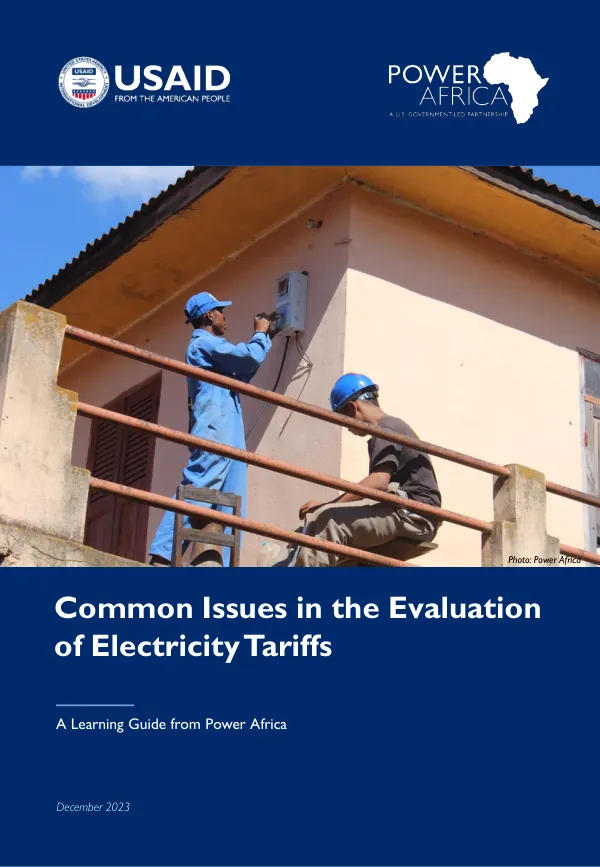
Common Issues in the Evaluation of Electricity Tariffs: A Learning Guide from Power Africa
Sign inDELOITTE CONSULTING, LLP
Common Issues in the Evaluation of Electricity Tariffs: A Learning Guide from Power Africa
The primary function of a rate case is to evaluate a utility's revenues and expenses across all sources.
2023 · 23 pages
Sign in to readA free account is required to download.
Abstract
These evaluations are meant to ensure that the utility's rates are set fairly for utilities and electricity consumers alike. Rates should enable the utility to cover its reasonable costs and make a reasonable return on the capital invested by the utility's owners, taking into account consumers' ability to pay. The ultimate goals for rate cases are to balance the interests of utilities and consumers, send proper price signals, promote sustainable growth, and provide incentives for utility improvement. Rate cases aim to achieve these goals by setting rates that are fair to both utilities and consumers, while also ensuring that the utility has sufficient revenues to cover its costs and make a reasonable return on investment. Key terms and definitions pertaining to tariff evaluations include the rate, revenue requirement, regulatory asset base, weighted average cost of capital, depreciation, operating expenses, and taxes. The revenue requirement is the amount of money a utility must collect to cover its costs, including its cost of capital, and is determined by the regulatory authority using a formula that takes into account the regulatory asset base, weighted average cost of capital, depreciation, operating expenses, and taxes. Regulatory authorities play a crucial role in setting rates and overseeing the utility's operations. Their role is not to manage the utility but to ensure that it provides safe and reliable service at reasonable rates. Regulatory authorities should encourage the utility to provide services that are safe and reliable and provide incentives to achieve public policy goals. Core rate case concepts include the regulator's roles and responsibilities, revenue requirements, and rate design. The regulator's role is to set rates that balance the interests of utilities and consumers, while also ensuring that the utility has sufficient revenues to cover its costs and make a reasonable return on investment. Revenue requirements are determined by the regulatory authority using a formula that takes into account the regulatory asset base, weighted average cost of capital, depreciation, operating expenses, and taxes. Service quality programs are also an important aspect of rate cases. A strong quality of service program should include elements such as reliability, safety, and customer service. Program implementation should be designed to improve service quality and provide incentives for utilities to operate more efficiently. In evaluating changes in tariffs, regulatory authorities should consider the following common issues: balancing interests, sending proper price signals, promoting sustainable growth, and providing incentives for utility improvement. Regulatory authorities should also consider the impact of tariffs on consumers and the utility's ability to cover its costs and make a reasonable return on investment. The Southern Africa region has been a focus area for Power Africa's work in supporting regulatory authorities in evaluating tariff applications. Power Africa has delivered new or improved electricity to nearly 180 million people across sub-Saharan Africa and connected more than 37.5 million homes and businesses to on- and off-grid energy solutions. In the context of the Southern Africa region, regulatory authorities have faced challenges in evaluating tariff applications, including balancing the interests of utilities and consumers, sending proper price signals, promoting sustainable growth, and providing incentives for utility improvement. Regulatory authorities have also faced challenges in determining revenue requirements, rate design, and service quality programs. Power Africa has produced a learning guide to help regulatory authorities in the Southern Africa region evaluate tariff applications and address common issues. The guide provides practical insights, case studies, and topic-specific supporting documents to help energy stakeholders across the region and beyond.