USAID. MISSION TO BOLIVIA
Community and child health project
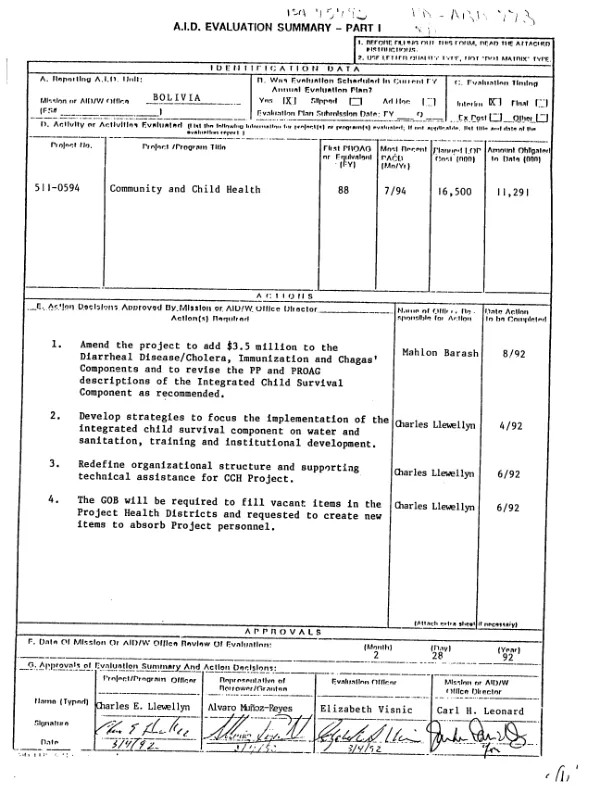
Summarizes mid-term evaluation (XD-ABI-211-A) of the a project to reduce infant, child, and maternal mortality in Bolivia through an integrated package of child survival interventions, institutional development, and community participation.
1994
Sign in to readA free account is required to download.
Abstract
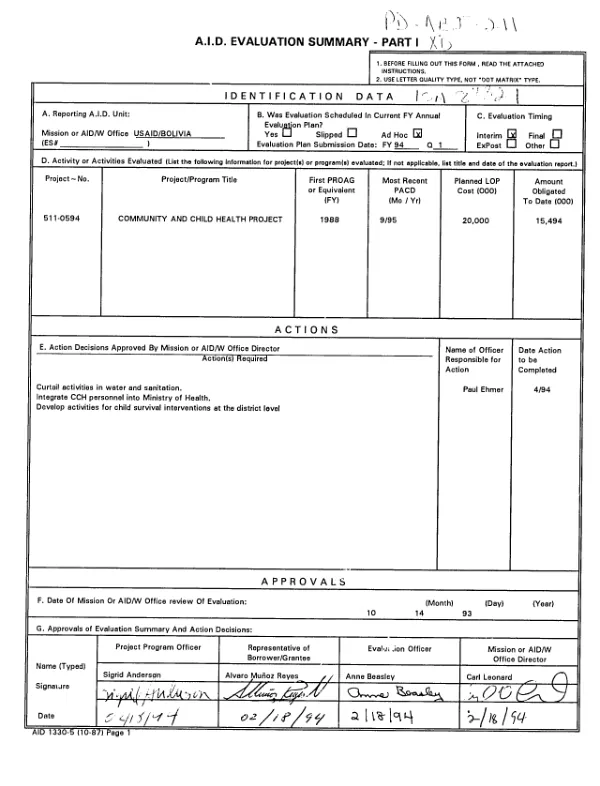
Evaluation covers the period 1988-10/93. The focus of the project to date has been mainly on the Central La Paz office and the regional offices; approximately 50% of the budget has been used to cover administrative costs, and there are 101 salaried project employees -- a bureaucracy in many ways parallel to the Ministry of Health (MOH). Accordingly, the task of integrating staff into the MOH should be a priority. In addition, a substantial portion of the budget has been used for commodities, including computers for the central, regional, and district offices, which are used for project monitoring and staff training, and equipment needed to construct water and sanitation systems. The real challenge for the remaining life of project will be to reach rural populations. Emphasis should be placed on preparing district level personnel in community outreach; improving the distribution of medical supplies and pharmaceuticals to outlying areas; designing culturally sensitive health interventions through interactive planning with local health workers and communities; and implementing pilot activities that upgrade the quality of child survival interventions. The project should also focus on integrating its bureaucracy with that of the MOH, which is very similar to its own. The following lessons were learned. (1) A complex project with many components may be difficult to implement. The project should limit its activities to areas in which USAID has a comparative advantage, i.e., communications and social marketing, policy, health care financing and sustainability, commodities and logistics systems, training, information systems, service utilization and quality of care, and research. (2) Higher utilization of health facilities lowers unit costs and increases cost recovery. Improved access to and quality of health care will increase utilization. (3) Sustainable training for health workers in the public sector assumes that the personnel will remain in their institutions after the training. In Bolivia, the lack of a civil service and personnel changes resulting from changes in government have compromised the impact of sustainable training. (4) In projects designed to strengthen capacities at many levels (i.e., central, regional, district, and in outlying areas), all levels should receive a substantial share of the project"s total resources. In this case, the project"s chances for meeting its targets in outlying areas has been reduced since most resources have been devoted to central level, administrative purposes.