USAID. MISSION TO SENEGAL
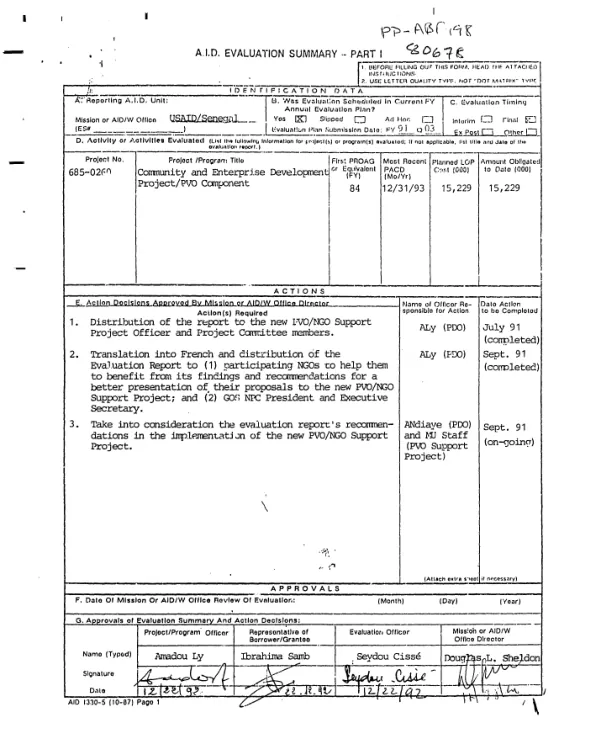
Community and enterprise development project
Summarizes attached evaluation of a project to strengthen village organizations and small-scale enterprises (SSE"s) in Senegal.
1987
Sign in to readA free account is required to download.
Abstract
Midterm evaluation covered the period 9/85-6/87 and was based on site visits, document review, and interviews with project personnel, beneficiaries, and bank and regional government officials. The SSE component has been a success. It has made 95 loans, totaling over 120 million CFA ($400,000); has had no loan defaults and only four late payments; and is strengthening the recipient firms. The component"s success is due to the use of sound business principles and to very thorough implementation by the SSE specialist. The village organization component, which is implemented through PVO"s, has been plagued with administrative delays caused by PVO managerial and operational weaknesses and by the long approval process of the National Project Committee (NPC). The NPC has approved four grants to assist 42 village organizations. Both components, however, are at a stage at which they must revise basic strategies if they are to achieve their objectives. The SSE component can become profitable and self-sustaining if it expands its target group and refines its strategy to attract a parent banking organization in order to ensure institutionalization. The PVO component must reduce its numerical target to 6-8 potentially viable PVO"s. Also, as PVO weakness have been greater than expected, the Management Unit (MU) has not had the personnel resources to fulfill all PVO training needs. The following lessons have been learned. (1) In pilot projects, organization and staffing must be given top priority in the design phase to permit experimentation and creativity, while ensuring a sharp focus on the project"s ultimate objectives; proper staffing is particularly important. (2) A team effort, i.e., the development of links between the SSE and PVO components (which have thus far functioned separately), is vital to project success. (3) The minimalist approach does not always work, nor is it always appropriate. Management alternatives should be carefully assessed. Action decisions for the SSE component are to: amend lending criteria to expand the target group and raise loan ceilings; provide another $350,000 to the credit fund to ensure adequate capitalization; study the feasibility of various options for institutionalization; and develop computerized management information systems. Action decisions for the PVO component are to: limit the number of participating PVO"s to 6-8; develop the necessary skills within the MU in credit and organizational development to carry out new requirements for training and follow-up; and develop specific plans for institutional development of participating PVO"s. (Author abstract, modified)