WINROCK INTERNATIONAL. INSTITUTE FOR AGRICULTURAL DEVELOPMENT
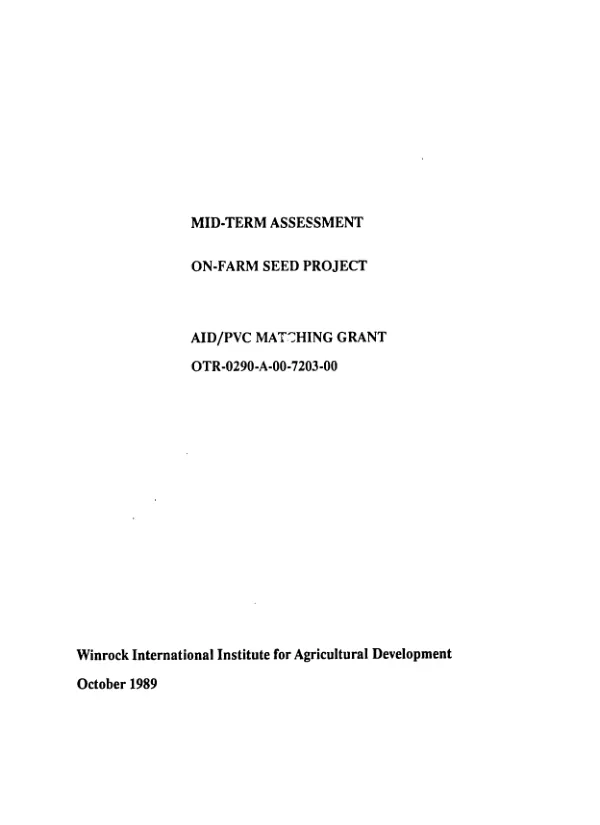
Mid-term assessment : on-farm seed project
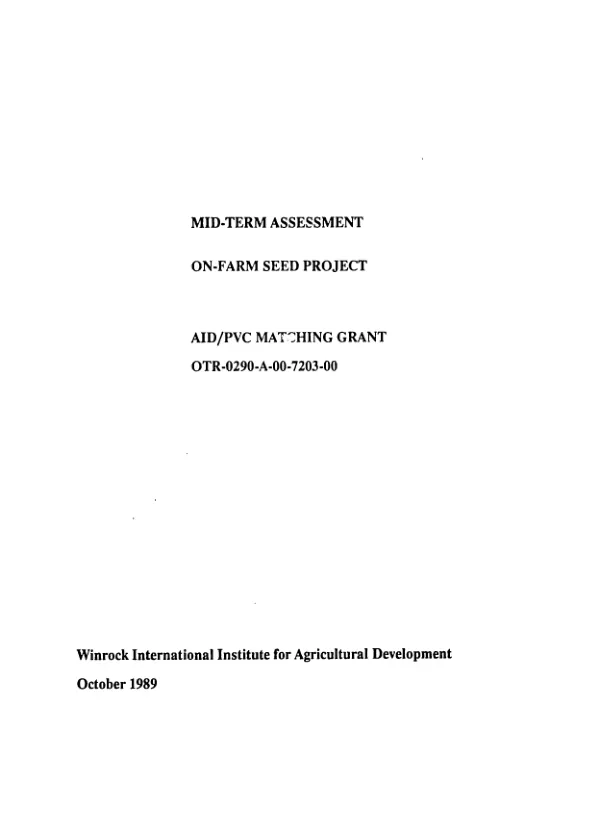
The Mid-term Assessment of the matching grant to Winrock International for the On-Farm Seed Project (OFSP) in Senegal and The Gambia primarily addresses the institutional aspects of the project.
Smith, David A. · 1989
Sign in to readA free account is required to download.
Abstract
The OFSP is seen by both A.I.D. and Winrock as a pilot effort to derive useful models for bringing the essential agricultural technologies "downstream," to small African farmers. The potential lessons motivated A.I.D. to support the OFSP despite the "high risk" nature of its collaborative design. Among the significant conclusions or lessons that can be derived from the assessment are that: (1) the OFSP is providing a valued service to small farmers; (2) the participatory process approach can be used to transfer a range of agricultural technologies to small farmers; (3) there is reason to believe the on-farm model has application elsewhere in Africa; (4) there is a strong likelihood the on-farm model will achieve sustainability in Senegal and The Gambia. The innovative and experimental nature of the OFSP extends beyond its field impact. It also is significant in the context of the changing roles of U.S. PVO's. It explores transfer of state-of-the-art technological resources from highly respected Northern institutions with minimum operational presence. Though the complex collaborative arrangement among Winrock, Mississippi State, and The PVO Center has not been without its problems, both the OFSP's success and its failures provide useful lessons. The most important is that the low-profile technology transfer design requires a preliminary phase of systematic and participatory planning involving all the potential partners in the field and in the U.S. In the long-term, such planning will result in a more integrated, efficient, and cost-effective use of the institutional resources of all participating organizations. The initial OFSP design did not adequately anticipate the need for planning. Another important lesson, based on conversations with local informants in The Gambia and Senegal, is that the OFSP and indeed PVO activities in general, must increasingly judge their work by how well and how quickly they are creating conditions where host country institutions are able to solve their own problems using their own expertise. This is the central challenge for the OFSP in the ensuing two-and-one-half years. Certain critical elements have contributed to the success OFSP has enjoyed in The Gambia and Senegal. Four appear to be essential: (1) "on-farm" point of entry; (2) collaborative, participatory, non-operational modality; (3) solid expertise; (4) minimal staffing. These are best summarized as minimal design. The OFSP promotes low input appropriate farming technology to the end user and makes use of existing institutional resources rather than duplicates them. It is very significant that the lean administrative structure of the model acts as a natural brake on the institutional tendency do the job rather than transfer skills. The OFSP is up and running. With judicious attention to anchoring the concept of on-farm technology transfer model organically into the development structures of the host countries, there is every reason to expect it will provide a permanent and valuable new TA resource to small farmers and their support institutions. The evolution of the project also will continue to provide important points of reference to the U.S. PVO community as it seeks to make itself more relevant and effective in a changing development environment. (Author abstract)
Related documents