USAID DEC
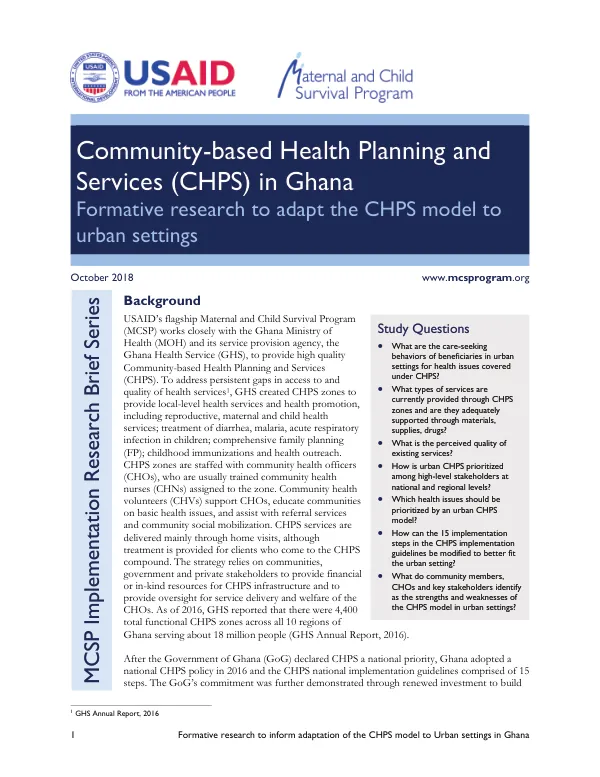
Community-based Health Planning and Services (CHPS) in Ghana: Formative research to adapt the CHPS model to urban settings
Sign inGHANA HEALTH SERVICE
Community-based Health Planning and Services (CHPS) in Ghana: Formative research to adapt the CHPS model to urban settings
The Community-based Health Planning and Services (CHPS) model in Ghana was originally designed for rural settings, but with the country's increasing urbanization, there is a growing need to adapt the model to urban contexts.
2018 · 8 pages
Sign in to readA free account is required to download.
Abstract
As of 2010, more than 50% of Ghana's population lived in urban settings, a number that has steadily increased over the last forty years and continues to rise. The CHPS model relies on communities, government, and private stakeholders to provide financial or in-kind resources for CHPS infrastructure and to provide oversight for service delivery and welfare of the community health officers (CHOs). CHPS zones are staffed with CHOs, who are usually trained community health nurses (CHNs) assigned to the zone, and community health volunteers (CHVs) who support CHOs, educate communities on basic health issues, and assist with referral services and community social mobilization. A mixed-methods cross-sectional study was conducted in March 2018 in 14 urban CHPS zones in seven regions of Ghana to inform the adaptation of the CHPS model to urban settings. The study aimed to validate and add to the findings of previous pilot projects, which identified key differences in urban contexts and called for additional review, research, and adaptation of the model. The study found that urban CHPS zones are conducive to providing a wide range of health services, including weighing and immunizing children, counselling and provision of selected family planning services, rapid diagnostic testing and treatment for malaria, antenatal care, treatment for minor childhood ailments, child nutrition, adolescent health, and school health. Some urban CHPS zones also provide safe emergency delivery services for childbirth. The study also found that existing community groups and structures in urban settings, such as religious organizations, mothers' groups, and social centers, can be leveraged to support CHPS activities and reach more people with health promotion and services. CHPS staff can reach out to community members through churches or professional groups, and services provided by CHPS staff during outreach activities are important functions for the community. However, the study also identified barriers to trust and community engagement, including the fact that most CHPS staff in urban settings do not live in the CHPS zone in which they serve, and some clients do not welcome CHPS staff into their houses due to lack of trust. Increased awareness of the CHPS concept could increase attendance and improve health outcomes in the communities, and CHPS staff can rely on information centers and urban community radios to mobilize and engage communities. The study's findings suggest that the CHPS model can be adapted to urban settings, but it will require modifications to the 15 implementation steps outlined in the CHPS implementation guidelines. The study's recommendations include leveraging existing community structures and increasing awareness of CHPS in urban settings, as well as addressing the barriers to trust and community engagement.
Related documents
Documents in this collection
 2019
2019USAID DEC
Community Mobilization and Home Visits: Key Pillars of the Community-Based Health Planning and Services (CHPS) Program in Ghana
Open record 2019
2019USAID DEC