USAID DEC
Financial Analysis to Inform the Scale-up and Sustainability of Reproductive, Maternal, Neonatal, and Child Health Interventions and Services
Sign inGHANA HEALTH SERVICE
Financial Analysis to Inform the Scale-up and Sustainability of Reproductive, Maternal, Neonatal, and Child Health Interventions and Services
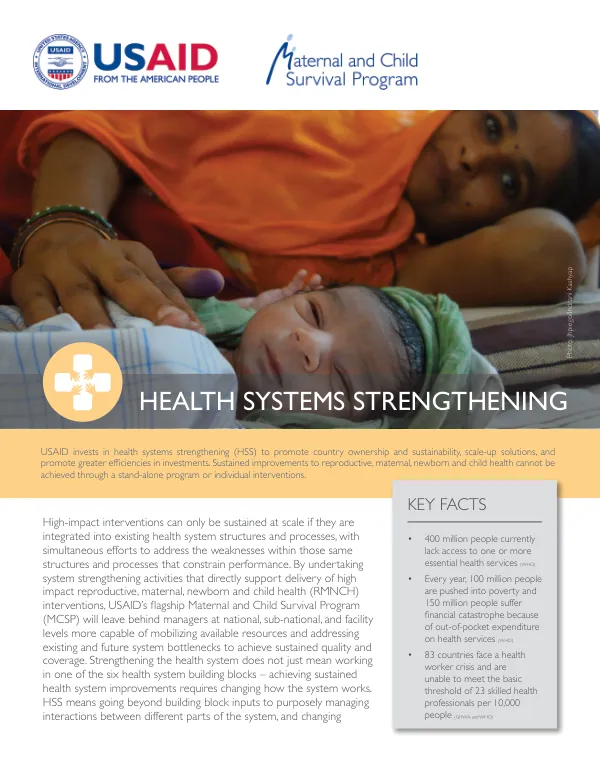
The Maternal and Child Survival Program (MCSP) has supported governments in select countries to analyze the costs of scaling up high-impact reproductive, maternal, newborn, and child health (RMNCH) interventions.
2019 · 6 pages
Sign in to readA free account is required to download.
Abstract
These country-led efforts to generate evidence inform advocacy and planning for greater domestic investment in RMNCH, accelerating a country's journey to self-reliance. MCSP worked closely with governments, implementing partners, and other stakeholders to define a scalable unit and intervention package for RMNCH services. The program identified the intended audience and perspective for analysis outputs, using government cost norms to generate cost estimates that support the approach's sustainability. MCSP ensured that the analysis showed costs by standard cost categories, cost drivers, and one-time versus recurring or maintenance costs. Flexible cost models or tools were developed to show costs under multiple scenarios, helping in planning and discussions of the appropriate form for the package. MCSP also presented costs in relation to programmatic outputs or the larger fiscal context, allowing governments to assess an intervention's feasibility or sustainability. The program's approach to costing included using analysis findings to create clear dissemination and advocacy plans for the scale-up process. In Ghana, MCSP worked with the Ghana Health Service to develop estimates of the average start-up and operating costs of a Community-based Health Planning and Services (CHPS) compound. The costing exercise found that the average start-up cost to develop a CHPS compound was USD 18 per capita, with approximately USD 8 per capita per year to maintain the compound. These maintenance costs represent 14% of Ghana's per capita total health expenditure of USD 58 in 2014. The MCSP Costing Tool was developed in 2017 to support national and subnational implementers to plan for establishment, refurbishment, and annual operations and maintenance costs of a CHPS compound. The tool allowed implementers to cost their own plans and compare them against their existing budget or against the CHPS National Implementation Guidelines costs, and identify funding gaps. The Ghana Health Service formally adopted the tool and rolled it out to regional administrators. In Rwanda, MCSP worked with the Ministry of Health to roll out a new integrated Helping Babies Breathe/Essential Newborn Care (HBB/ENC) practice improvement package for clinical management of newborns with birth asphyxia. The package was initially introduced in four priority districts and later scaled to an additional six districts. The HBB/ENC practice improvement package includes low-dose, high-frequency training and mentoring of health care workers, and focused quality improvement activities. Results from the initial pilot indicated that the package improved provider capacity and clinical practices, and reduced fresh stillbirths and newborn deaths due to birth asphyxia. Based on the cost inputs required to implement the initial pilot, MCSP developed a flexible cost model to project the costs of scaling up the HBB/ENC practice improvement package to the national level. The analysis focused on activities to improve clinical practice, not necessarily the direct service costs at facility levels. Across the cost components of the practice improvement package (and start-up) activities, mentorship represented the largest cost driver of the overall intervention, followed by initial and refresher LDHF trainings. After achieving full scale-up to all 30 districts, the estimated total annual costs to implement the HBB/ENC practice improvement package was approximately RF 370 million (USD 438,000) per year or RF 35 per capita per year (USD 0.05). This annual cost represented less than 1% of the government's domestic health spending, suggesting it is a relatively low-cost clinical practice strengthening intervention with potential for high impact. In Rwanda, as of 2015, 51% of women who were less than 2 years postpartum wanted to delay or stop having children but were not using any form of contraception. MCSP worked with the Ministry of Health to introduce an integrated postpartum family planning (PPFP) package in four districts, later scaling up to an additional six districts. The clinical practice strengthening package includes training on voluntary family planning methods counseling, PPFP clinical skills, mentoring, and focused quality improvement activities. Based on the cost inputs required to implement the pilot, MCSP developed a flexible cost model to project the costs of scaling up the PPFP package to the national level. The analysis generated estimates of what it would cost the Government of Rwanda to scale and sustain the intervention, using the district as a unit of scale-up; however, it did not include direct PPFP service delivery costs (e.g., cost of contraceptives) since the focus was the costs of the intervention. Across the main components of the PPFP package (and start-up activities), mentorship constituted the largest cost driver for the overall intervention, followed by initial and refresher FP counseling and PPFP clinical skills trainings. The estimated total annual cost for implementing the PPFP package in all 30 districts increases through the first 4 years of scale-up; however, it decreases to an average total annual maintenance cost of approximately RF 305 million (USD 360,000)