GHANA HEALTH SERVICE
Early Childhood Development 0–3 Program in Ghana
Early childhood development (ECD) plays a crucial role in supporting young children's holistic development across physical, cognitive, language, and socio-emotional domains.
2018 · 2 pages
Sign in to readA free account is required to download.
Abstract
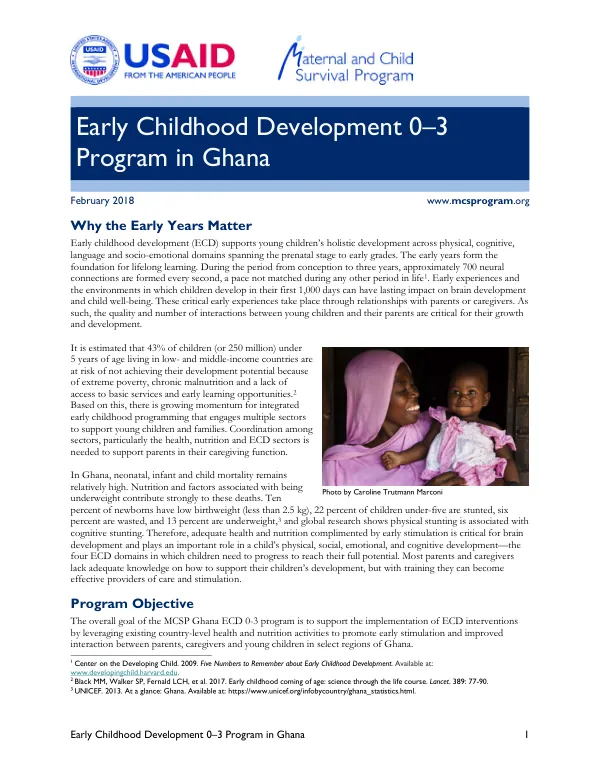
The early years form the foundation for lifelong learning, with approximately 700 neural connections formed every second during the prenatal stage to early grades. Early experiences and environments in which children develop in their first 1,000 days can have a lasting impact on brain development and child well-being. These critical early experiences take place through relationships with parents or caregivers, making the quality and number of interactions between young children and their parents critical for their growth and development. In low- and middle-income countries, approximately 43% of children under 5 years of age are at risk of not achieving their development potential due to extreme poverty, chronic malnutrition, and a lack of access to basic services and early learning opportunities. Integrated early childhood programming that engages multiple sectors is gaining momentum to support young children and families. Coordination among sectors, particularly the health, nutrition, and ECD sectors, is needed to support parents in their caregiving function. In Ghana, neonatal, infant, and child mortality remains relatively high, with nutrition and factors associated with being underweight contributing strongly to these deaths. Ten percent of newborns have low birthweight, 22 percent of children under-five are stunted, six percent are wasted, and 13 percent are underweight. Adequate health and nutrition, complemented by early stimulation, is critical for brain development and plays an important role in a child's physical, social, emotional, and cognitive development. Most parents and caregivers lack adequate knowledge on how to support their children's development, but with training, they can become effective providers of care and stimulation. The MCSP Ghana ECD 0-3 program aims to support the implementation of ECD interventions by leveraging existing country-level health and nutrition activities to promote early stimulation and improved interaction between parents, caregivers, and young children in select regions of Ghana. The program's overall goal is to support the development of a set of generic early child development materials concentrating on early childhood stimulation and responsive parenting for children under 3 years and adapt to the Ghana country context. The program has achieved several key accomplishments to date, including assessing and monitoring the ability of community health workers (CHWs) to integrate early childhood stimulation and responsive parenting information with their regular health and nutrition activities. The program has also adapted and aligned a set of global ECD materials to the Ghana context, conducted trainings for CHWs and community health volunteers, and commenced qualitative and quantitative assessments to evaluate changes in CHWs' knowledge and perceptions of early stimulation practices. The program is leveraging the existing structures of the Family Health Division of the Ghana Health Service and has built the capacity of CHPS workers in the GHS to implement and facilitate future ECD training.
Related documents