UNICEF
Community-Based Strategies for Promoting Child Survival
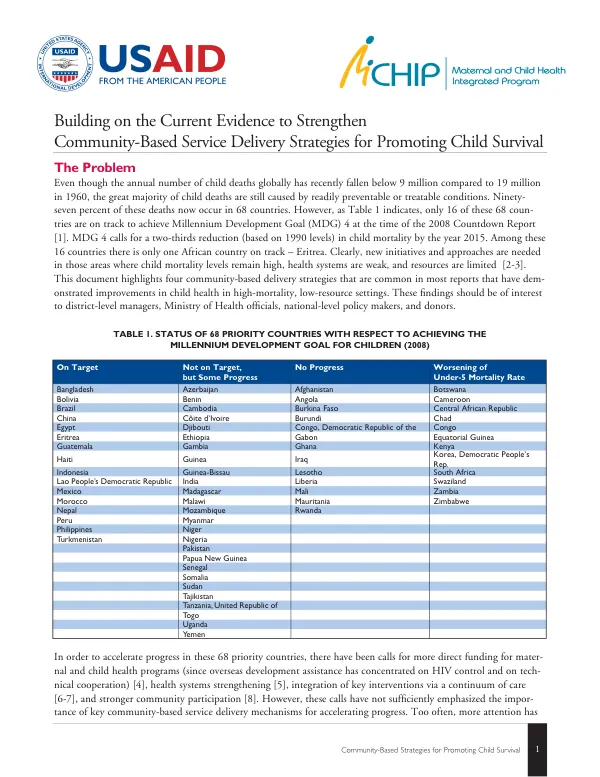
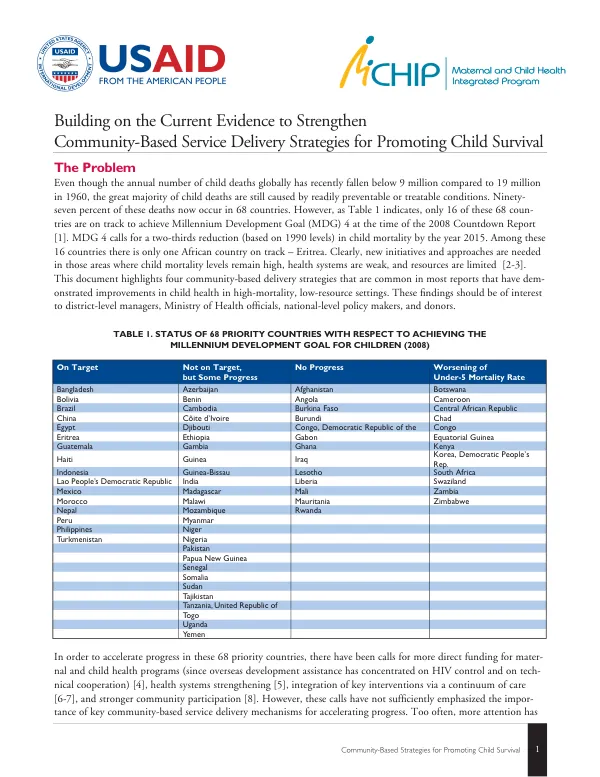
The annual number of child deaths globally has recently fallen below 9 million compared to 19 million in 1960.
2011 · 13 pages
Sign in to readA free account is required to download.
Abstract
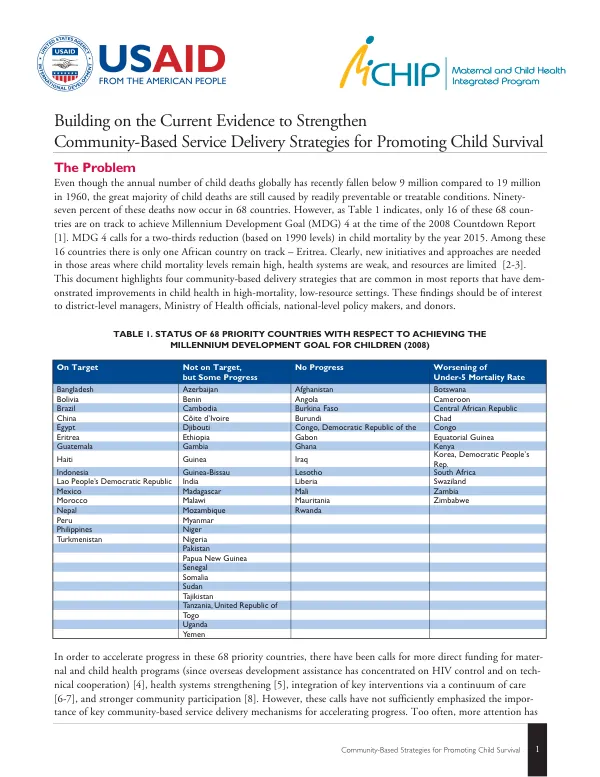
However, the great majority of child deaths are still caused by readily preventable or treatable conditions. Ninety-seven percent of these deaths now occur in 68 countries. Only 16 of these 68 countries are on track to achieve Millennium Development Goal (MDG) 4 at the time of the 2008 Countdown Report. MDG 4 calls for a two-thirds reduction (based on 1990 levels) in child mortality by the year 2015. Among these 16 countries, there is only one African country on track – Eritrea. Clearly, new initiatives and approaches are needed in those areas where child mortality levels remain high, health systems are weak, and resources are limited. A recent comprehensive review of the effectiveness of community-based primary health care in improving child health has identified four key community-based service delivery mechanisms that are common to virtually all successful health programs that have documented improvements in geographically defined populations of children in developing countries. These mechanisms include routine systematic visitation of all homes, facilitator-led participatory women's groups, recognition, referral, and treatment of serious childhood illness by mothers and/or trained community agents, and health service provision at outreach sites. Routine systematic visitation of all homes makes it possible to identify those in need of basic services and to provide everyone in the program population with essential health education and selected key services, particularly during pregnancy and the early neonatal period. Home visitation by community-based workers can identify pregnant women and mothers of young children, provide education to them and other family members, recognize danger signs during pregnancy and childhood illness, encourage referral when danger signs are present, and provide treatment for certain conditions such as growth faltering, diarrhea, pneumonia, and malaria. Facilitator-led participatory women's groups provide the opportunity for further empowerment and education about healthy behaviors, danger signs of serious illness, proper care of the newborn, and non-health issues that are a priority to the community and may have an indirect effect on health. These groups also provide a vehicle for counseling about breastfeeding, birth spacing, infant feeding, hand washing, prevention and treatment of diarrhea, signs of childhood pneumonia, and danger signs during pregnancy and childbirth. Women's groups are also effective for assisting mothers to rehabilitate malnourished children detected through growth monitoring. Recognition, referral, and treatment of serious childhood illness by mothers and/or trained community agents is a critical component of effective community-based primary health care. Community-based workers can learn to recognize the signs and symptoms in children of neonatal sepsis, malaria, pneumonia, severe diarrhea, and severe malnutrition, and they can teach these signs and symptoms to mothers. Successful programs have been identified in which community health workers treated these conditions or even taught mothers how to treat these conditions. Health service provision at outreach sites is another key component of effective community-based primary health care. This can include providing basic health services such as vaccinations, maternal and child health care, and family planning services to communities that may not have access to these services through traditional health facilities. Health service provision at outreach sites can also include providing education and counseling on healthy behaviors, disease prevention, and management of common illnesses.
Related documents