GOVERNMENT OF THE REPUBLIC OF ZAMBIA
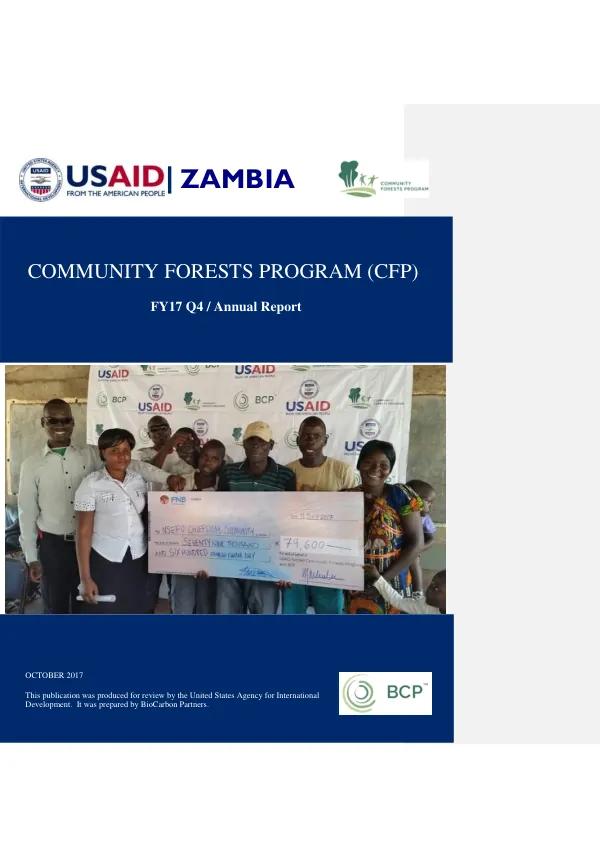
Community Forests Program (CFP) FY17 Q4 / Annual Report
The Community Forests Program (CFP) in Zambia began in 2014 with funding from the United States Agency for International Development (USAID).
2017 · 54 pages
Sign in to readA free account is required to download.
Abstract
The program aims to reduce emissions from deforestation through participatory natural resource management of globally biodiversity significant forested landscapes. The main objectives of the CFP are to reduce poverty through improvements in smallholder farmer agricultural productivity, development of non-timber forest products, and expansion of markets and value chains. The CFP is designed to support the Government of Zambia's (GRZ) Reducing Emissions from Deforestation and Degradation (REDD+) strategy by establishing the largest REDD+ program to-date in Zambia. The program aims to establish REDD+ project areas across a minimum of 700,000 hectares within the Zambezi and Luangwa Valley ecosystems, and in so doing, to support deforestation mitigation activities taking place on a total of up to 2 million hectares, involving up to 10,000 households. The CFP is jointly implemented by the Forestry Department (FD), Department of National Parks and Wildlife (DNPW), and BioCarbon Partners (BCP). The program is organized into three core technical components: Zambian Institutional and Community Capacity for REDD+ and Forest Management, Joint management of natural resources, particularly forests, improved, and Livelihoods in forest dependent communities improved. In the fourth quarter of Fiscal Year 2017 (FY17 Q4), the CFP underwent a staff downsizing exercise due to budget constraints. The exercise was necessary to ensure that BCP had sufficient operating funds to continue implementing the program. The downsizing was carried out in accordance with applicable laws, and BCP consulted with the Department of Labor, legal counsel, and a labor consultant to ensure a fair resolution for the staff that were downsized. The CFP has made significant progress in achieving its objectives, particularly in the areas of institutional and community capacity building, joint management of natural resources, and livelihood improvement. The program has established a strong partnership with the GRZ, and has made significant contributions to the development of policies and plans for REDD+ and Low Emission Development Strategies (LEDS). The CFP has also made progress in implementing its technical activities, including the establishment of REDD+ project areas, development of non-timber forest products, and expansion of markets and value chains. The program has worked closely with local communities, civil society organizations, and other stakeholders to ensure that the benefits of the program are shared equitably. The CFP has also made significant progress in reducing emissions from deforestation, with a total of 38,800 hectares of community forest protected through community-based REDD+ activities. The program has also supported the development of a legal framework and pilot project to demonstrate the viability of REDD+ as a replicable forest management strategy. Overall, the CFP has made significant progress in achieving its objectives, and has contributed to the development of a sustainable and equitable forest management strategy in Zambia. The program has also demonstrated its ability to adapt to changing circumstances, including budget constraints, and has continued to make progress in achieving its objectives despite these challenges.