USAID DEC
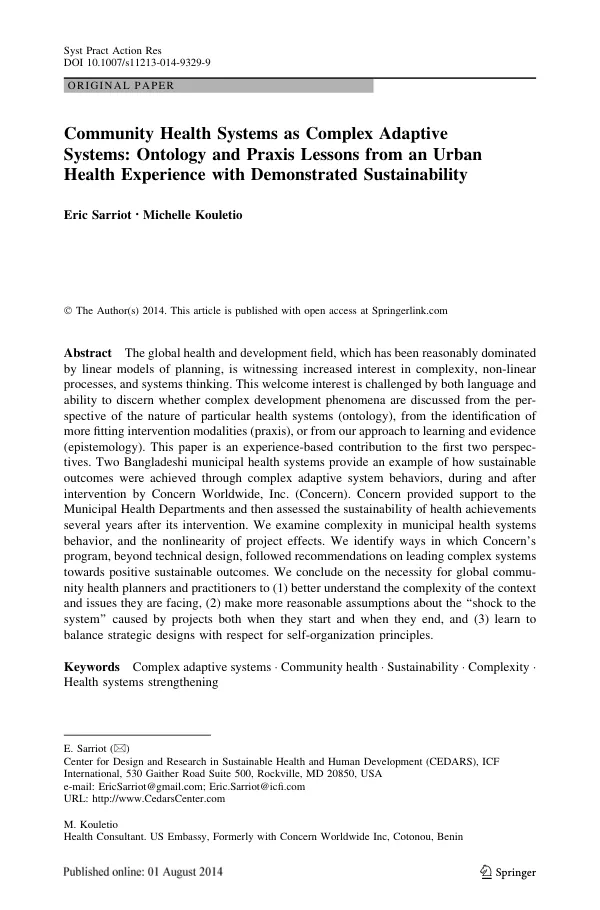
Community Health Systems as Complex Adaptive Systems: Ontology and Praxis Lessons from an Urban Health Experience with Demonstrated Sustainability
Sign inCONCERN WORLDWIDE INTERNATIONAL
Community Health Systems as Complex Adaptive Systems: Ontology and Praxis Lessons from an Urban Health Experience with Demonstrated Sustainability
Global health and development have traditionally been dominated by linear models of planning, which have been increasingly questioned by private sector organizations.
2014 · 18 pages
Sign in to readA free account is required to download.
Abstract
This has widened the gap between actual practices and the rhetoric of initiatives aiming to improve them, including effectiveness, institutional reform, participation, and local ownership, empowerment. Complexity science has explored and articulated a contrasting world of understanding, explaining complex dynamic phenomena in diverse settings using insights and concepts such as non-linearity, edge of chaos, self-organization, emergence, and coevolution. The global health field has been characterized by a traditional, linear input-output-outcome logic, manifested through strategic plans, results frameworks, and different types of logic models. However, a growing interest in complex, non-linear models of intervention has emerged, driven by the recognition that health and development programs face complex and disorderly patterns. This interest is also fueled by repeated failures in sustaining achievements due to vexing problems and the increasing attempts of global health interventions to deliver discrete results, strengthen entire systems, build capacity, and achieve ownership and sustainability. The science of sustainable development has been emerging for a generation, and global health is facing the same challenges as development. Complexity theory has been applied to international development and international development policies, highlighting the importance of ignoring complexity has led to significant failures of development policies and programs by limiting adaptive capacity. Recent case studies and conceptual reframing have articulated how complexity and adaptability play a central part in capacity building in development. The World Health Organization has attempted to address 'systems thinking' in two publications, focusing on defining sub-systems within a health system. A review of complex phenomena affecting efforts to scale up health systems has emphasized path dependence, feedback mechanisms, scale-free networks, emergence, and phase transition as key features of complex adaptive systems. These perspectives may better reflect the complex and changing nature of health systems, creating new opportunities for understanding and scaling up health services. The global health practice and research fields have not yet adapted the inventory of tools familiar to organizational systemic practitioners, such as the viable systems model of Stafford Beer or Checkland's soft systems methodology. New efforts have come with new language, sometimes using simple language of 'strategic planning' instead of systemic approaches. A clarification of language is necessary to facilitate understanding of complex adaptive systems. This paper draws on experience-based lessons from two municipal health systems in Bangladesh, which demonstrated sustainable outcomes after a capacity-building intervention by Concern Worldwide, Inc. The two municipal health systems of Saidpur and Parbatipur, Bangladesh, serve as an example of a complex adaptive health system's behavior during and after a project. The paper clarifies the perspective of the authors and provides context for the example, which will be built upon. The authors' perspective is focused on understanding health systems as complex adaptive systems and drawing lessons from the project's experience with the two municipal systems. The paper aims to contribute to the theoretical discussion about health systems as complex adaptive systems, highlighting the importance of understanding the nature of the phenomena, developing practice from this understanding, and evaluating the results of efforts. The project of Concern Worldwide, Inc. was implemented in the municipalities of Saidpur and Parbatipur, starting in 1998, with a USAID-funded Child Survival Program. Concern selected the two Municipal Health Departments (MHDs) as partners for the project, which aimed to strengthen the health systems and improve population health indicators. The project's experience with the two municipal health systems serves as an example of a complex adaptive health system's behavior during and after the intervention.
Related documents
Documents in this collection
 2014
2014USAID DEC
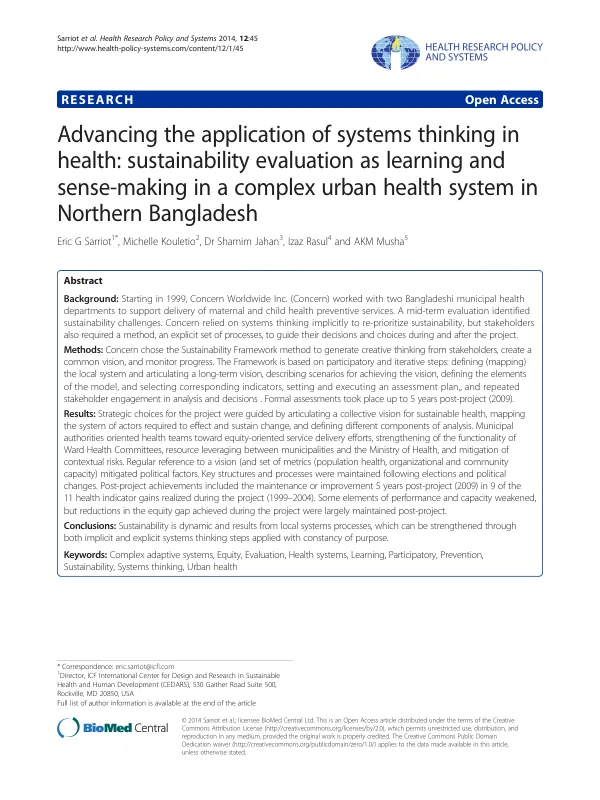
Advancing the application of systems thinking in health: sustainability evaluation as learning and sense-making in a complex urban health system in Northern Bangladesh
Open record 2015
2015USAID DEC