USAID DEC
Advancing the application of systems thinking in health: sustainability evaluation as learning and sense-making in a complex urban health system in Northern Bangladesh
Sign inCONCERN WORLDWIDE INTERNATIONAL
Advancing the application of systems thinking in health: sustainability evaluation as learning and sense-making in a complex urban health system in Northern Bangladesh
The concept of sustainability in health systems has gained significant attention in recent years.
2014 · 12 pages
Sign in to readA free account is required to download.
Abstract
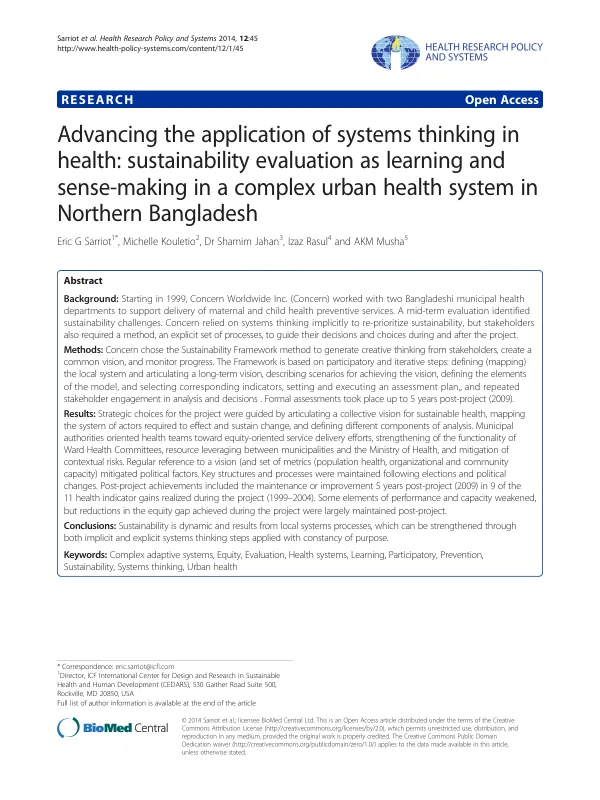
Systems thinking has been increasingly applied to address the complexities of health systems, particularly in low-income countries. In Northern Bangladesh, Concern Worldwide Inc. implemented an urban health project in two municipalities, starting in 1999. The project aimed to improve maternal and child health preventive services, but a mid-term evaluation identified sustainability challenges. Concern chose the Sustainability Framework method to guide their decisions and choices during and after the project. The Framework is based on participatory and iterative steps, including defining the local system, articulating a long-term vision, describing scenarios for achieving the vision, and selecting corresponding indicators. Formal assessments took place up to 5 years post-project (2009). The Sustainability Framework views sustainability as resulting from processes taking place in a local system where a wide array of stakeholders share responsibility to generate and maintain positive health outcomes for their community. It offers an interactive model for assessing progress on critical dimensions, such as health outcomes, characteristics of health services, institutional capacity, and socio-ecological conditions. Bangladesh is a low-income country with poor health indicators. The under-five mortality rate decreased rapidly in the 1990s, but slower in the 2000s. The infant mortality rate decreased from 72/1,000 live births in 2004 to 57/1,000 in 2007. The urban population grew from 23% of the total population in 2001 to 28% by 2010. Municipalities are legally tasked with ensuring the delivery of primary health care services to the population but had developed almost no capacity to do so at the onset of Concern's project. Concern's urban health model in Saidpur and Parbatipur aimed to improve health outcomes for the urban population. The model focused on strengthening the functionality of Ward Health Committees, resource leveraging between municipalities and the Ministry of Health, and mitigation of contextual risks. Regular reference to a vision and set of metrics (population health, organizational and community capacity) mitigated political factors. Key structures and processes were maintained following elections and political changes. Post-project achievements included the maintenance or improvement of 9 of the 11 health indicator gains realized during the project (1999–2004). Some elements of performance and capacity weakened, but reductions in the equity gap achieved during the project were largely maintained post-project. Sustainability is dynamic and results from local systems processes, which can be strengthened through both implicit and explicit systems thinking steps applied with constancy of purpose.