FHI 360
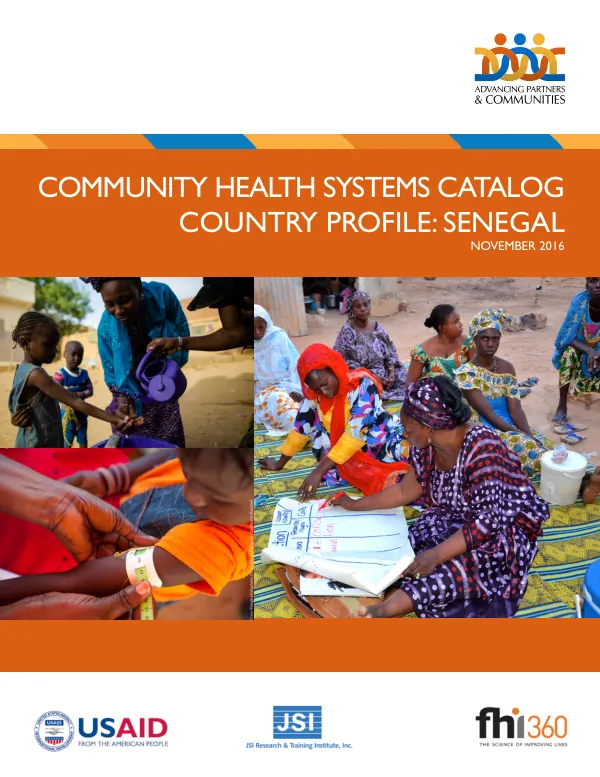
Community Health Systems Catalog Country Profile: Senegal
The Senegalese community health system is guided by the National Community Health Policy and Strategic Plan, which aim to improve coverage and quality of community health services, strengthen community participation in problem-solving of health issues, and ensure sustainability of community health interventions.
2016 · 24 pages
Sign in to readA free account is required to download.
Abstract
The policy and strategic plan outline key information about the financing approach, a monitoring and evaluation framework, and the roles and relationships of various community health actors. The plan also details a package of preventive, promotional, and curative community health services and includes a set of annexes describing seven innovative community health projects. Senegal's community health strategy aims to overcome challenges including poor health service coverage, inequity in access, insufficient harmonization of service packages, poor integration of community health in the overarching health system structure, a lack of community health actor motivation, and ineffective supply systems for essential medicines and products. The strategy separates community health providers into two categories. The first category includes matrones, agents de santé communautaires (ASC), and dispensateurs de santé à domicile (DSDOM), who provide promotional, preventive, and curative services. The second category comprises relais communautaires (relais) and bajenu gox, who conduct promotional and preventive interventions exclusively and refer clients to ASC and matrones for services they cannot provide. There are five main community health provider cadres in Senegal. The recommended number of community health providers is 4,200 ASC and matrones, 3,406 bajenu gox, and 15,000-23,069 relais. The estimated number of community health providers is 3,748 ASC and matrones, 7,500 bajenu gox, and 1,992 DSDOM. The recommended ratio of community health providers to beneficiaries is 1 ASC: 3,000 people, 1 bajenu gox: 100 households, 1 DSDOM: 1 home-based care site, and 1 matrone: 3,000 people. Community-level data collection is a key aspect of the Senegalese community health system. Data is collected at the national, regional, health district, and community levels. The levels of management of community-level service delivery are also outlined in the policy and strategic plan. The key community health programs in Senegal include the Community Health Program (PSSC), the Bajenu Gox Program, and other programs in health-specific areas such as tuberculosis, malaria, and HIV and AIDS. The National Community Health Policy and Strategic Plan provide guidance across different health areas, including tuberculosis, malaria, and family planning. The policy and strategic plan detail key elements of community health provider roles and processes, such as selection criteria, training, supervision, reporting, referrals, relationships with community groups, and incentives. However, there are policy gaps, including an absence of guidance about community health provider selection processes, unclear direction for community data use and decision making, and little mention of the private sector's role in delivering community services. The community health system in Senegal is designed to provide a range of basic health services, including promotional, preventive, and curative services. The system relies on a network of community health providers, including ASC, matrones, DSDOM, relais, and bajenu gox, who work together to deliver health services to the community. The system also includes a monitoring and evaluation framework to ensure that the services are delivered effectively and efficiently.