FHI 360
Community-Based Provision of Emergency Contraceptives in Uganda
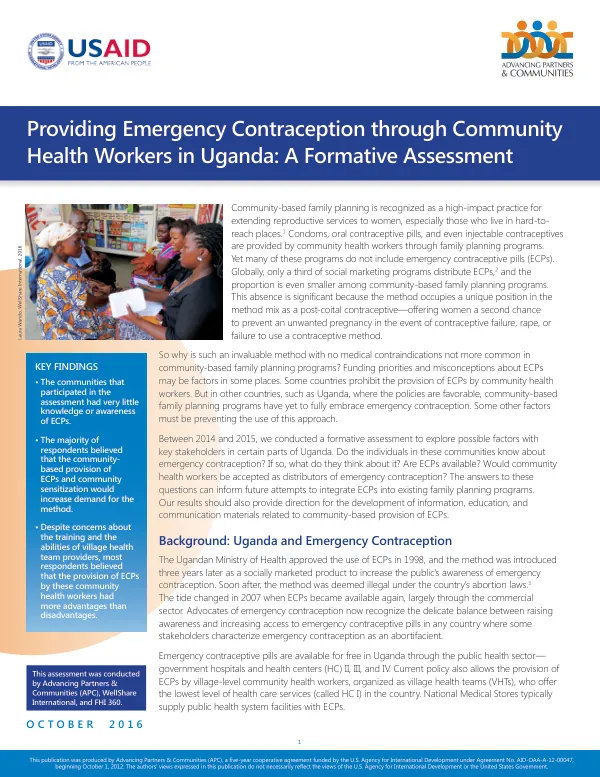
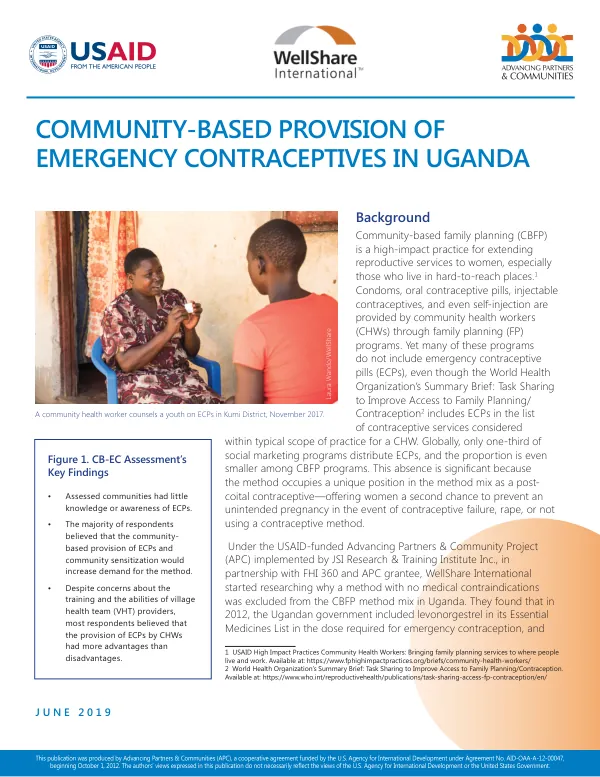
Community-based provision of emergency contraceptives in Uganda is a high-impact practice for extending reproductive services to women, especially those living in hard-to-reach places.
2019 · 6 pages
Sign in to readA free account is required to download.
Abstract
Community health workers (CHWs) provide a range of family planning services, including condoms, oral contraceptive pills, and injectable contraceptives. However, emergency contraceptive pills (ECPs) are often excluded from these programs, despite being a post-coital contraceptive that offers women a second chance to prevent an unintended pregnancy in the event of contraceptive failure, rape, or unprotected sex. The Ugandan government included levonorgestrel in its Essential Medicines List in 2012, and the National Policy Guidelines and Service Standards for Reproductive Health Services permitted provision of ECPs by CHWs. However, rollout was hampered by misinformation, limited training, and commodity shortages at the health center level. By 2015, available units of levonorgestrel had expired, and the community-level provision of ECPs had not been institutionalized in the public sector in Uganda. A formative assessment conducted by FHI 360 and WellShare International in 2014-2015 explored CHW provision of ECPs across communities in four districts. The assessment found that communities had little knowledge or awareness of ECPs, and the majority of respondents believed that the community-based provision of ECPs and community sensitization would increase demand for the method. Despite concerns about training and the abilities of village health team (VHT) providers, most respondents believed that the provision of ECPs by CHWs had more advantages than disadvantages. WellShare International incorporated specific activities into its community-based family planning program in response to the findings and recommendations from the assessment. These activities included advocating at the national level to strengthen provision of ECPs through the CHW CBFP program, convening partner meetings to review assessment findings and share experiences, and updating ECP training materials, including creating a job aide and fact sheet on ECPs for CHWs. WellShare also helped make sure that the community-level supply chain includes ECPs, built capacity of district staff, health workers, and CHWs on how to integrate ECPs into their FP service delivery program, and conducted demand-creation and social and behavior change activities to promote ECPs. WellShare's advocacy process involved formulating a rights-based approach to advocate provision of ECPs at the community level, while addressing concerns about VHT member competence through capacity building and development of an ECP fact sheet and job aide. A key component of WellShare's advocacy effort was a series of strategic meetings with various decision makers and stakeholders tailored to each audience. These meetings included initial advocacy meetings with the Ministry of Health Reproductive Health Division, national-level meetings with the Family Planning Working Group, and implementing partners meetings to discuss the integration and scale-up of ECPs into community-based family planning programs.