FHI 360
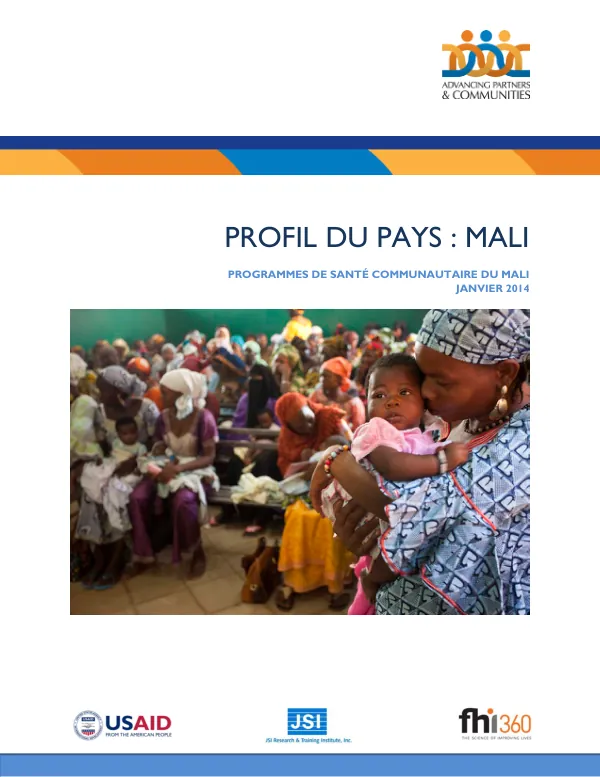
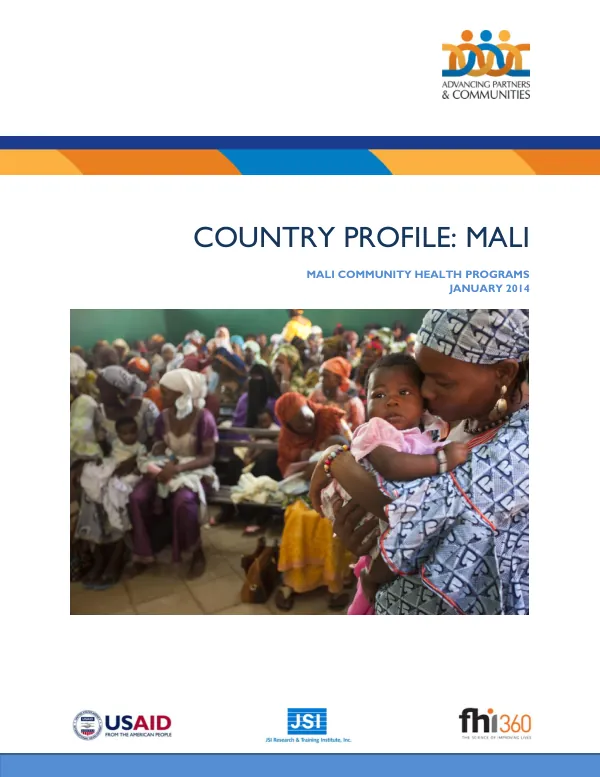
Country Profile: Mali Community Health Programs
The community health system in Mali is incorporated into the national health policy, Programme du Développement Sanitaire et Social (PRODESS) II.
2014 · 21 pages
Sign in to readA free account is required to download.
Abstract
The community health aspect is managed by the Association de Santé Communautaire/Association of Community Health (ASACO) at the District level. The ASACO oversees community health centers and community health workers (CHWs) that provide outreach within the community. Community health centers, centres de santé communautaire (CSCOM), are the first level of the formal health system; various cadres of CHWs provide linkages between the community and the health center. The Ministry of Health (MOH) has ultimate responsibility for community-level services. The use of CHWs was first implemented in 2002 by the MOH and partners. Currently, efforts are underway to expand the role of CHWs in regards to health services provided. The program operates nationwide and serves both urban and rural communities. Community services are offered both through community-based health facilities and outreach. Health facility services are provided out of CSCOMs and outreach services are provided by CHWs who conduct home visits and outreach activities in their catchment areas. The ASACO program is based on a defined package of services known as paquet minimum d'activités or PMA. These services are offered in the community as a whole, and may be provided by health professionals at CSCOMs as well as CHWs. The package of services offered by CHWs is referred to as la stratégie avancée du PMA or outreach PMA. CHWs provide an essential package of preventative and curative services. Specifically, a PMA provides basic preventative and curative services in maternal and child health. These include treatment of uncomplicated malaria and acute respiratory infection (ARI), referral and accompaniment of severe cases of malaria and ARI, treatment of diarrhea, diagnosis and management of malnutrition, and provision of family planning services. The program is working to expand health services provided through ASACO. Currently, integrated community case management (iCCM) services are implemented nationwide. However, scale-up plans include the expansion of iCCM services provided by CHWs to communities more than 15 km from a health center. Overall, the goal of scale-up for the ASACO program is to increase access to essential services for the entire country. The community health system in Mali has been in operation since 1994, with the use of CHWs first implemented in 2002. The program has been working to expand the role of CHWs in regards to health services provided. The program operates nationwide and serves both urban and rural communities. The ASACO program is based on a defined package of services known as paquet minimum d'activités or PMA, which includes basic preventative and curative services in maternal and child health. The program is working to expand health services provided through ASACO, with a focus on increasing access to essential services for the entire country. The goal of scale-up for the ASACO program is to expand iCCM services provided by CHWs to communities more than 15 km from a health center. The program is working to increase access to essential services for the entire country, with a focus on maternal and child health.