USAID DEC
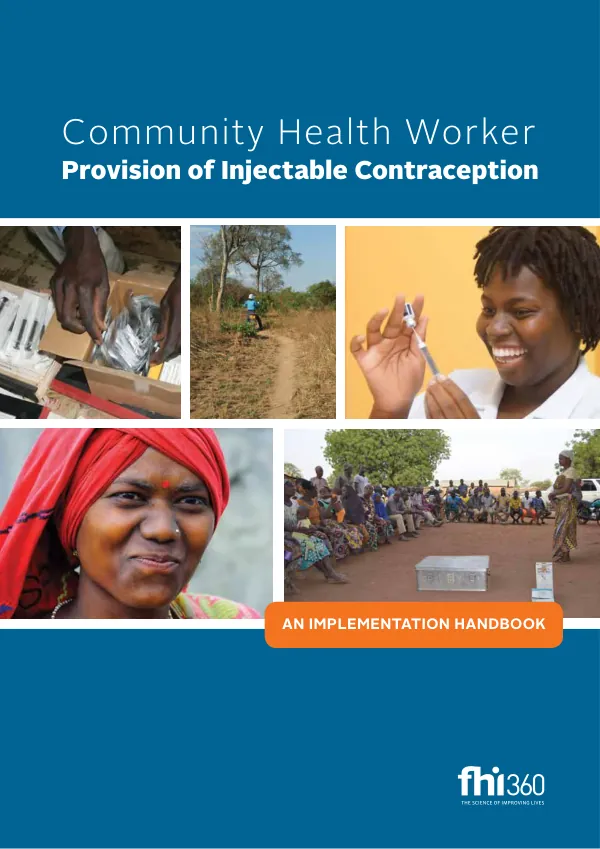
Community Health Worker Provision of Injectable Contraception: An Implementation Handbook
Sign inFHI 360
Community Health Worker Provision of Injectable Contraception: An Implementation Handbook
The community health worker provision of injectable contraception is a widely implemented best practice in family planning programs.
2018 · 140 pages
Sign in to readA free account is required to download.
Abstract
This approach has been used to expand the method mix at the community level since the 1970s, with programs in Latin America, Asia, and Africa consistently showing its safety and effectiveness. In Bangladesh, depot-medroxyprogesterone acetate (DMPA) was first offered in 1977 in the Matlab subdistrict. Research findings and programmatic evidence demonstrate that trained community health workers (CHWs) can provide injections safely, using proper techniques to prevent infection, refer clients to a clinic, maintain their supplies, safely dispose of needles and syringes, counsel their clients about side effects, and administer injectables on a regular schedule. Sub-Saharan Africa's first documented effort to expand community-based access to injectables began in Uganda's Nakasongola district in 2004. The majority of developing countries face critical shortages of doctors, nurses, and midwives, with health professionals concentrated in urban areas, leaving rural health facilities severely understaffed and under-resourced. In both rural and urban underserved areas, the supply of modern contraceptive methods and health personnel to provide them are often limited, making access to family planning extremely difficult. Injectables are the most preferred family planning method in many parts of the world, yet accessing them remains a major challenge. To meet the demand for injectables, programs that expand community-based access to injectables through community health workers (CHWs) have been used. CHW provision of injectable contraception has been shown to be an effective way to provide family planning services, particularly in areas with limited access to healthcare. The approach has been used in various countries, including Bangladesh, where DMPA was first offered in 1977. The provision of injectable contraception by CHWs requires a well-planned and implemented program. The program should include the nine basic components outlined in this handbook, which are: determining the feasibility of and need for CHW provision of injectables, evaluating the potential costs of adding injectables to a community-based family planning program, integrating CHW provision of injectables into national policy and service guidelines, mobilizing the community and raising awareness of the service, ensuring a logistical system that supports proper waste management and a steady provision of supplies, training community health workers to provide the service, establishing systems for supportive supervision, documenting and sharing processes and outcomes, and ensuring successful scale-up. The handbook provides program managers, policy makers, and those interested in expanding access to family planning with insight to prepare, initiate, and scale up the provision of injectable contraception by CHWs. The lessons presented in this handbook were gleaned from research studies, programmatic reports, international medical guidance, and subject matter experts. The appendices contain a collection of checklists, training materials, sample forms, and other resources that can help introduce and scale up CHW provision of injectable contraceptives.
Related documents