MERCY CORPS INTERNATIONAL
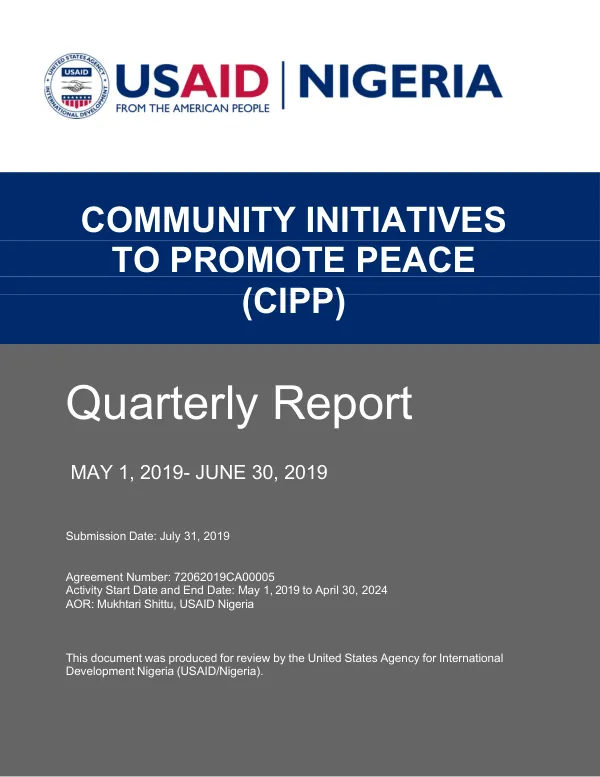
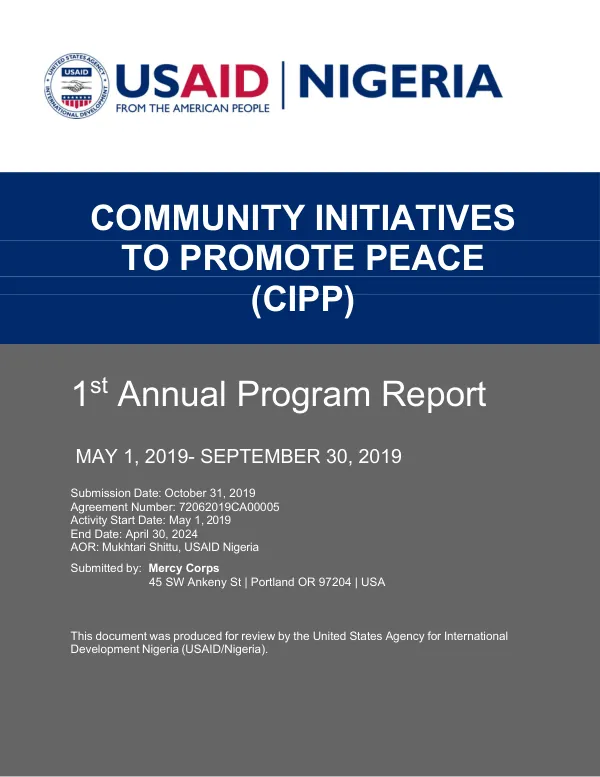
Community Initiatives to Promote Peace (CIPP) 1st Annual Program Report
The Community Initiatives to Promote Peace (CIPP) program is a 60-month cooperative agreement with the United States Agency for International Development (USAID) worth $14,988,607 USD.
2019 · 49 pages
Sign in to readA free account is required to download.
Abstract
Implemented by Mercy Corps, in partnership with Pastoral Resolve (PARE), Interfaith Mediation Centre (IMC), Savannah Centre for Diplomacy, Democracy and Development (SCDDD), and the African Radio Drama Association (ARDA), CIPP aims to promote peaceful coexistence and collaboration in Nigeria by mitigating violent conflict in at-risk communities in six states. CIPP is an integrated, multifaceted program that empowers communities to prevent and respond to violence and violent extremism by strengthening key skills and relationships. The program fosters an enabling environment for peace through policy advocacy, media outreach, and linkages to development programs. CIPP will build the skills and relationships required for violence-prone communities to mitigate and manage conflict, resist rising violent extremism, and proactively address root causes of conflict. The program approach is centered on empowering local stakeholders and government officials, the private sector, and development partners in 24 Local Government Areas (LGAs), and at state and federal levels to prevent the outbreak of violence. Stakeholders are also empowered to respond in a timely and effective way to mitigate and de-escalate violence when it does erupt. CIPP uses an intentional approach to engage women through skill building, knowledge, and support of women-led initiatives. During the reporting period, CIPP reached 4,000 people through various activities, organized eight events, and formed four new groups dedicated to resolving conflicts or addressing the drivers of conflict. The program also engaged 67 senior state and federal government officers and six influential traditional leaders to generate buy-in and created a stakeholder register with 478 individuals and institutions. A participatory conflict analysis and baseline survey were completed, and required program equipment was procured. The CIPP program has made significant progress in its start-up activity areas, including operations, community engagement, and assessments. A total of 48 staff across the five implementing partner agencies have been recruited, and Mercy Corps signed sub-grant agreements with IMC, SCCDD, PARE, and ARDA in June 2019. Offices in Kaduna housing PARE, IMC, and Mercy Corps are operational, and in Abuja, the program management office is fully equipped, staffed, and operational. Community engagement has been a key focus area, with the program reaching 67 senior state and federal government officers, engaging six influential traditional leaders, creating a stakeholder register with 478 individuals and institutions, and identifying 144 communities across the 24 LGAs considered hotspots. The program's policy analysis and radio magazine programs kicked off, even as the reconstituting of Conflict Mitigation & Management Regional Councils (CMMRC) and community peace observers (CPOs) began. The CIPP program has also created several opportunities for discussing concerns that has allowed people to seek clarity on program intentions and what the program is and is not. The effort has seen a gradual building of trust with community members, state government officials, CSOs, and other ongoing programs in the region. This effort is improving communication and understanding and helping program team members to learn what government, community members, and their leaders, and local strategic organizations want. The team conducted a partner's kick-off meeting, selected program intervention sites, facilitated stakeholder advocacy visits, and completed a rapid assessment, baseline survey, and community reconnaissance. The radio and policy analysis activities began in earnest, and the dormant Conflict Mitigation and Management Regional Councils (CMMRCs) and Community Peace Observers (CPOs) were reconstituted in three states. Modalities for Interest-Based Conflict Resolution (IBCR) were developed, and a training of trainers was conducted for CMMRCs and CPOs.