USAID DEC
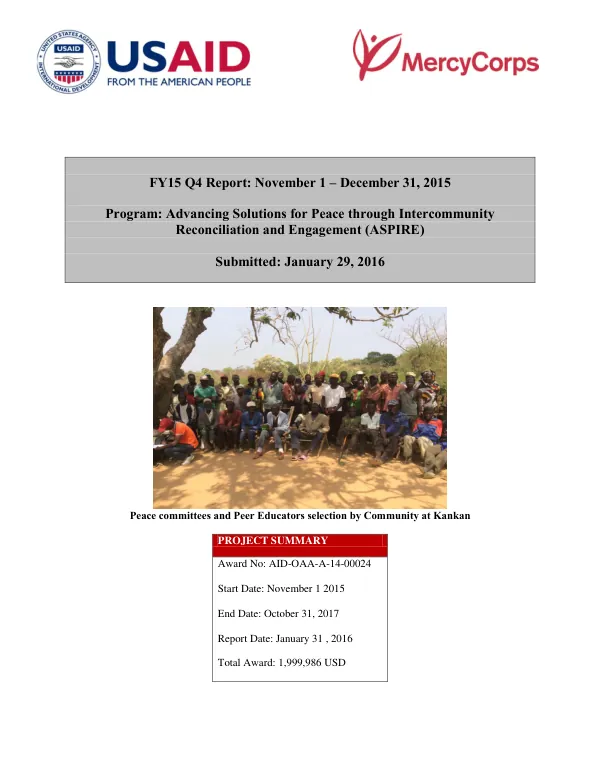
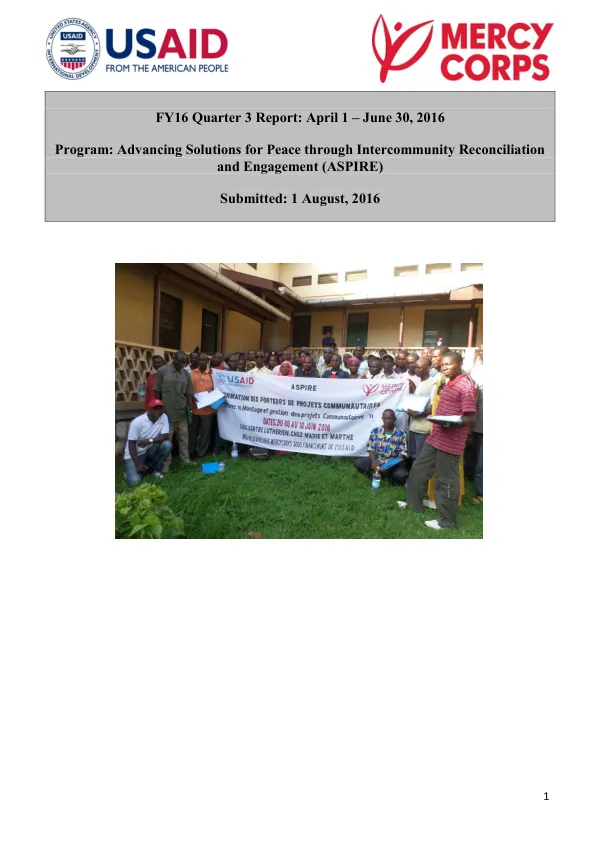
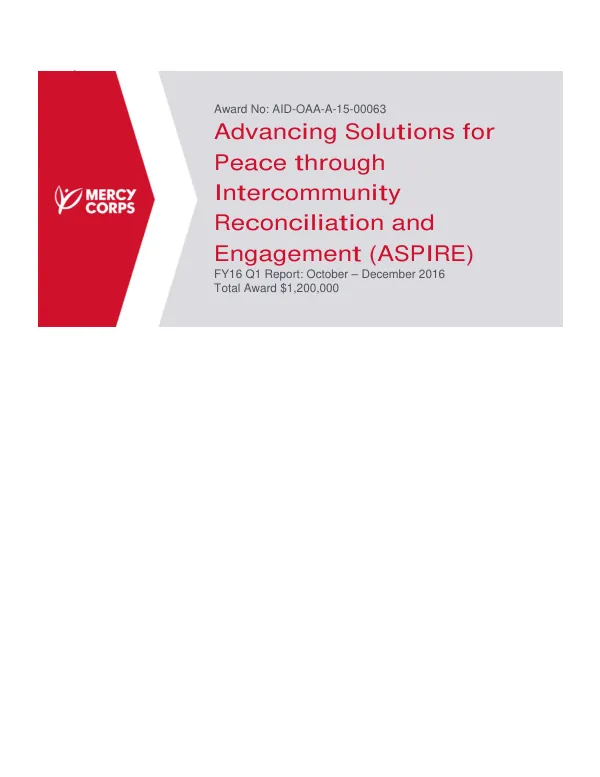
FY16 Q1 Report: Advancing Solutions for Peace through Intercommunity Reconciliation and Engagement (ASPIRE)
Sign inCATHOLIC RELIEF SERVICES ORGANIZATION
FY16 Q1 Report: Advancing Solutions for Peace through Intercommunity Reconciliation and Engagement (ASPIRE)
The ASPIRE program, funded by USAID, aims to promote peace and reconciliation in the town of Bouar through community-led processes.
2016 · 9 pages
Sign in to readA free account is required to download.
Abstract
The program's goal is to enable community leaders and marginalized young people to work together to manage inter-group tensions and rebuild community cohesion. To achieve this, Mercy Corps uses a holistic people-to-people approach that focuses on facilitating inclusive peace processes, increasing economic cooperation, and promoting positive attitude changes in favor of tolerance and non-violence. In the reporting period of October to December 2016, Mercy Corps continued to work with Peace Committees, local authorities, religious authorities, and NGO actors at the operational and cluster level. The Peace Committees, comprising community leaders and youth, identified 17 conflicts in Bouar and the surrounding areas, with two related to disputes between farmers and pastoralists over land and resource use. The committees helped to resolve 11 conflicts through constructive dialogue and communication, while six conflicts remain unresolved. Capacity building workshops for community conflict mitigation and citizenship were conducted for 179 community leaders, including 38 women and 96 men, and 45 young people, of which 16 were women and 29 men. The workshops focused on mediation techniques, facilitation, litigation resolution, and community dialogue. The community leaders demonstrated their ability to manage conflict mitigation effectively in their communities. An early warning system was established in Bouar and the surrounding areas to identify rising tensions. The system operates through two tools: regularly updated communication plans and weekly reports. Members of the Peace Committees write the reports and send them to Mercy Corps to alert them if there is a need to follow up. The communication plan organizes a chain of contact that starts at the Peace Committee and goes all the way up to the prefect. The security context in Bouar and surrounding localities was characterized by overall calm, but with volatile spikes in the number of security incidents. Many attacks between armed groups were observed during the reporting period. However, in general, life is gradually regaining a sense of normalcy. The conflict centered around Bambari is a flashpoint of intercommunal tension and shows how quickly the security situation can deteriorate. The intercommunal dialogue between the villages of Nièm and Yéléwa, which was scheduled to take place in early December 2016, did not occur after several key attendees withdrew from the meeting. Dialogue organizers have arranged for travel expenses and assurances of personal security for government authorities, but a date has not yet been set for the dialogue. The ASPIRE program has made significant progress in facilitating inclusive, community-led processes to mitigate current and future conflicts. The Peace Committees have identified and resolved conflicts, and community leaders have demonstrated their ability to manage conflict mitigation effectively in their communities. The early warning system has been established to identify rising tensions, and capacity building workshops have been conducted to promote peaceful resolution of inter-group disputes and dialogue.