GOVERNMENT OF THE ISLAMIC REPUBLIC OF AFGHANISTAN
Community Overcomes Tragedy to Finish Road
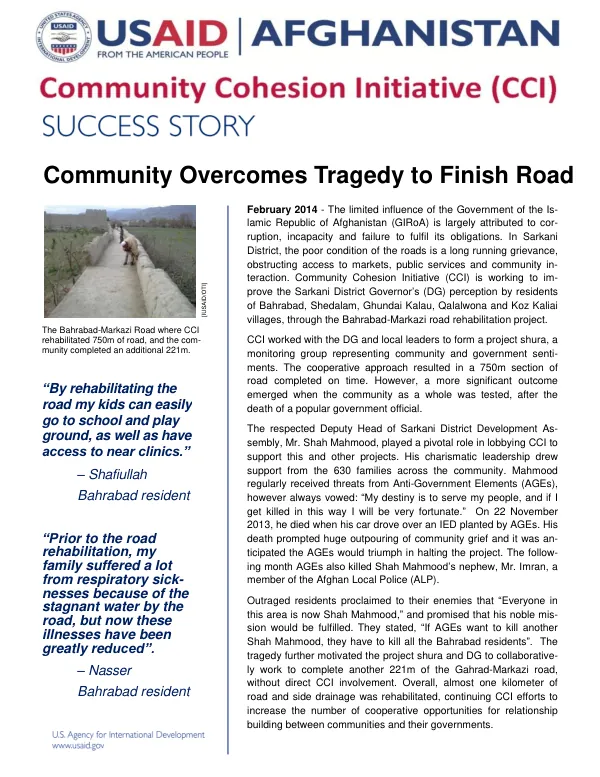
The Bahrabad-Markazi Road rehabilitation project in Sarkani District, Afghanistan, aimed to improve access to markets, public services, and community interaction.
2014 · 1 pages
Sign in to readA free account is required to download.
Abstract
The project was part of the Community Cohesion Initiative (CCI) efforts to increase the number of cooperative opportunities for relationship building between communities and their governments. CCI worked with the Sarkani District Governor and local leaders to form a project shura, a monitoring group representing community and government sentiments. The cooperative approach resulted in a 750-meter section of road completed on time. However, a more significant outcome emerged when the community as a whole was tested after the death of a popular government official, Mr. Shah Mahmood, the Deputy Head of Sarkani District Development Assembly. His charismatic leadership drew support from the 630 families across the community, and he regularly received threats from Anti-Government Elements (AGEs). Despite these threats, Mahmood vowed to continue serving his people, stating that his destiny was to serve his community. The death of Mr. Shah Mahmood on November 22, 2013, prompted a huge outpouring of community grief, and it was anticipated that the AGEs would triumph in halting the project. However, the community responded with outrage, proclaiming that "Everyone in this area is now Shah Mahmood," and promising that his noble mission would be fulfilled. They stated that if AGEs wanted to kill another Shah Mahmood, they would have to kill all the Bahrabad residents. This tragedy further motivated the project shura and the District Governor to collaboratively work to complete another 221 meters of the Gahrad-Markazi road, without direct CCI involvement. The completion of the road rehabilitation project marked a significant achievement for the community, with almost one kilometer of road and side drainage rehabilitated. The project demonstrated the community's resilience and determination to overcome adversity and achieve their goals. The cooperative approach between the community, the District Governor, and CCI resulted in a successful project that improved access to markets, public services, and community interaction. The Bahrabad-Markazi Road rehabilitation project serves as an example of the power of community cohesion and determination in the face of adversity. The project's success was a testament to the community's ability to come together and work towards a common goal, despite the challenges and threats they faced. The project's outcome highlights the importance of building relationships between communities and their governments, and the potential for positive change when these relationships are fostered.