USAID DEC
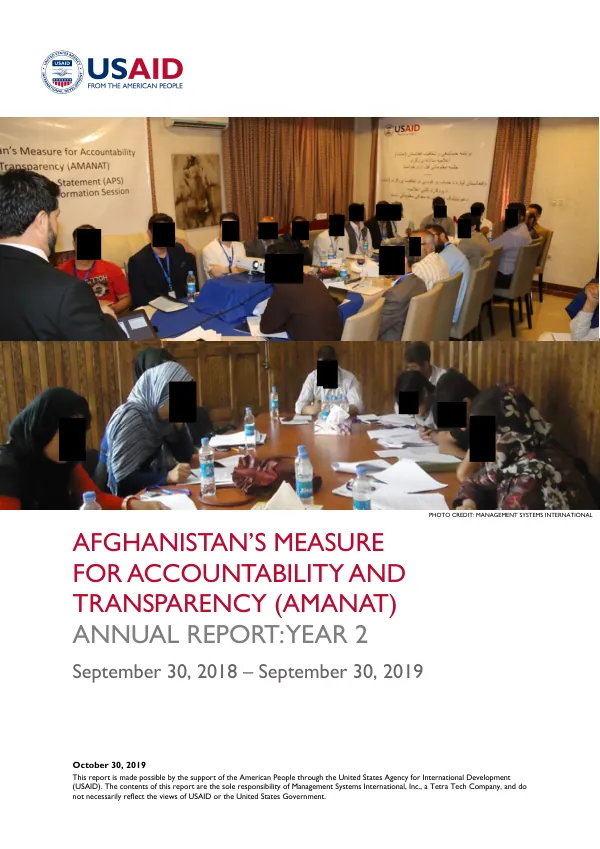
Afghanistan's Measure for Accountability and Transparency (AMANAT) Annual Report: Year 2
Sign inGOVERNMENT OF THE ISLAMIC REPUBLIC OF AFGHANISTAN
Afghanistan's Measure for Accountability and Transparency (AMANAT) Annual Report: Year 2
Afghanistan's Measure for Accountability and Transparency (AMANAT) is a five-year anti-corruption initiative designed to support the Afghan government's efforts to reduce and prevent corruption in government public services.
2019 · 54 pages
Sign in to readA free account is required to download.
Abstract
The project engages with both government and nongovernmental organizations to strengthen transparency and accountability mechanisms and build civil society's ability to advocate for reform. The project conducts activities in two components. Component 1 seeks to enhance the capacity of government institutions to identify vulnerabilities to corruption in their processes and functions, and to strengthen their capacity to implement anti-corruption reforms. Component 2 is a special programming mechanism by which USAID will be able to issue task orders to the AMANAT project under an indefinite IDIQ mechanism to address tasks that are not covered in Component 1. During the second year, the project provided substantive and technical support to five ministries and the Supreme Audit Office through corruption assessments, audit trainings, and business process re-engineering support at the national level. The project also provided subnational support to local school management shuras. However, some challenges were faced due to the attack on the Ministry of Martyrs and Disabled, which put a hold on several program activities. The project cooperated significantly with local and regional civil society organizations (CSOs) and conducted several focused training sessions for CSOs on social audit, watchdog activities, and legislative processes. The grants program was fully operational, and more than 200 concept papers and proposals were received in response to two active Annual Program Statements (APS). Five proposals received funding, and several others are in the pipeline to be awarded early in Year 3. AMANAT's objectives are to improve the performance, legitimacy, and legitimacy of the Government of the Islamic Republic of Afghanistan (GIRoA) in preventing corruption, and to reduce corruption in public services and functions. To accomplish this, AMANAT works at the national and subnational levels to strengthen Afghan government institutions and CSOs, support select government institutions with technical assistance, and strengthen local CSOs' capacity to test and monitor the effectiveness of reforms. The project's approach focuses on willing institutions and applies innovative and tested methods to facilitate stakeholder buy-in and commitment, progress, sustainability, and sustainability. Once reforms are implemented, the project will monitor functions and processes to ensure they are sustainable before moving on to additional institutions and services. Key accomplishments include conducting a political economy analysis (PEA) of corruption in Afghanistan, carrying out five ministry-level PEAs, enabling 265 healthcare workers to refer patients to medical specialists and reduce favoritism and corruption, and creating a public health anti-corruption communications action plan and communications products. The project's second year was marked by increased project activities and significant progress in implementing reforms. The project's focus on willing institutions and innovative methods has facilitated stakeholder buy-in and commitment, and the project's monitoring and evaluation efforts will ensure that reforms are sustainable before moving on to additional institutions and services.