GOVERNMENT OF THE REPUBLIC OF ZAMBIA
Community Rising Project FY15 Third Quarter Report
The Community Rising Project FY15 Third Quarter Report highlights the progress made in strengthening and improving the efficiency of OVC service delivery systems in selected districts.
2015 · 6 pages
Sign in to readA free account is required to download.
Abstract
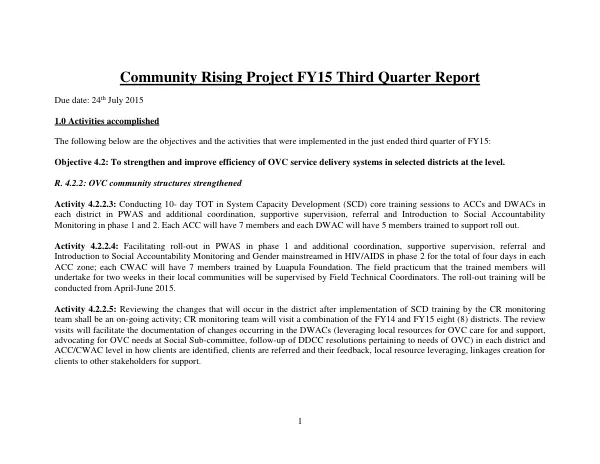
Objective 4.2 aimed to strengthen OVC community structures, with a focus on training and capacity building. The report notes that 637 DWAC/ACC/CWAC members were trained in various areas, including system capacity development, core training sessions, and social accountability monitoring. The training and practicum sessions were conducted in 10 districts, with a total of 1,062 participants. The report also highlights the importance of community-based networks, where referrals are initiated by ACC structures. The referral model was introduced to 192 community structures, with a focus on building on existing models and avoiding duplication. The report also emphasizes the need for standardized approaches to referrals and coordination of care for OVC. A referral form was introduced to be used by CWAC/ACC, which outlines the client's background and reasons for referral. The form incorporates the Child Status Index categories used by the STEPS-OVC program. In terms of results, the report notes that 14 districts have capacities built to plan, implement, and monitor OVC programs. Additionally, 500 CWACs have been trained in client identification, linking, and referring to local stakeholders for support. The report also highlights the importance of joint plans being implemented in liaison with Zambia Rising and Data Rising, with a focus on developing a work plan and M&E plan. The report also notes that major changes have been made at district, ward/area, and community levels. Ward/Area committees (ACCs) have continued to map up new local stakeholders, facilitating the delivery of OVC services. In some cases, OVCs have continued education even when they were unable to pay school fees. Local institutions and NGOs have also adapted the client identification matrix from PWAS guidelines, facilitating the identification of clients in need. However, the report also highlights several challenges encountered, including the lack of reporting forms to capture and submit developmental issues related to children and OVCs. The training materials, written in English, are not user-friendly for community members. The report emphasizes the need for standardized approaches to referrals and coordination of care for OVC. In terms of geographic focus, the report notes that the project is operating in 14 districts, with a focus on Southern Province. The report also highlights the importance of community-based networks and the need for standardized approaches to referrals and coordination of care for OVC. Overall, the Community Rising Project FY15 Third Quarter Report provides an update on the progress made in strengthening and improving the efficiency of OVC service delivery systems in selected districts. The report highlights the importance of community-based networks, standardized approaches to referrals, and coordination of care for OVC. However, it also notes several challenges encountered, including the lack of reporting forms and user-friendly training materials.