ABT ASSOCIATES
USAID ICAN FY21 Q1 Quarterly Performance Report
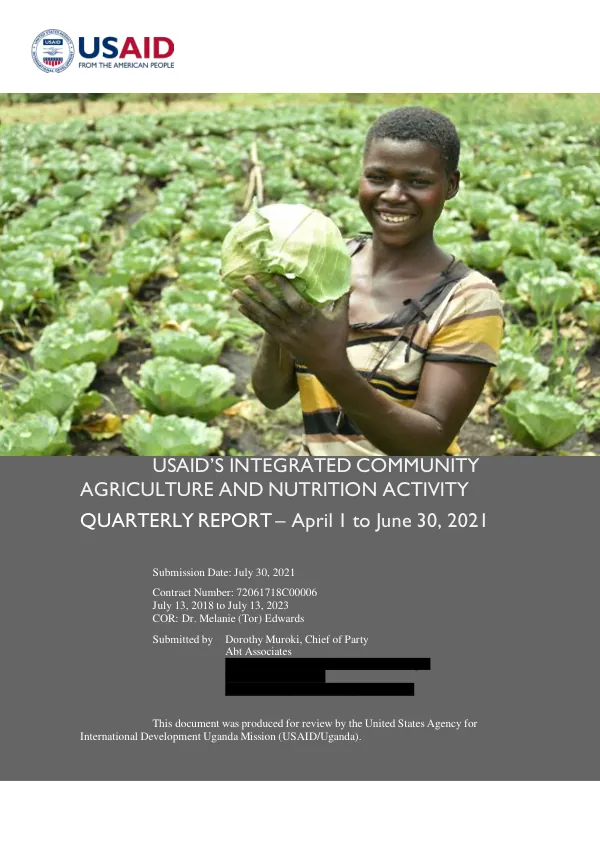
The Integrated Community Agriculture and Nutrition Activity (ICAN) is a flagship USAID resilience program aimed at improving economic activities for poor households while enhancing nutrition for women and children, strengthening community and local governance, and increasing school enrollment and retention.
2021 · 39 pages
Sign in to readA free account is required to download.
Abstract
ICAN operates in eight target districts in Uganda, including Kisoro, Kanungu, Rukungiri, Nwoya, Gulu, Lamwo, Kaabong, and Kotido. ICAN's flagship program focuses on building the next generation of resilient Ugandans by addressing major facets of resilience, including economic activities, nutrition, community and local governance, and school enrollment and retention. The program works within cultural structures to confront gender and power imbalances that undermine women's economic opportunities and community influence. In Quarter 1 (Q1) of FY21, ICAN intensified efforts to increase coverage of its interventions, reaching over 155,000 beneficiaries with U.S. government support for food security programming. Close to 54,000 beneficiaries, many of whom were women, received access to economic livelihoods interventions, reaching 64% of the annual target. ICAN also directly reached over 36,300 caregivers, including pregnant or lactating women and those within the 1,000 days window of opportunity for nutrition. ICAN's beneficiaries are predominantly female, with over 77% of them being women. The program used the 16 days of activism to have important conversations on gender-based violence (GBV) and practical ways in which communities can address it. Community members across regions signed pledge cards to signify their commitment to ending GBV, and their leaders pledged to follow up on these commitments. ICAN's We Can Do 5 targets include ending GBV, better family health and nutrition, sanitation, a clean and healthy environment, diversifying income-generating activities, and having smaller, manageable families. The program made progress in these areas during the quarter, with many communities making ending GBV one of their We Can Do 5 targets. ICAN also participated in the Child Health Days (CHD) Plus in November, reaching 24,914 pregnant and lactating women with nutrition intervention, 47% of the annual target. The program assessed more children for acute malnutrition (54,293) and increased the annual target to 118,000 as it expects to mobilize more children from its communities to participate in the April/May CHD Plus. Adolescent girls and young women (AGYW) remained an important group of beneficiaries, with 568 of them in Kanungu completing the first module as part of the mentorship camps that kicked off during the quarter. In Nwoya, the 16 mentors identified 480 girls and young women to start the training in Q2. The demand for the AGYW program was evident in these two districts, as well as in the Phase I districts of Kisoro and Lamwo. ICAN has had several partnership requests from organizations and businesses that want to work with young women. The program has strengthened its relationship with the private sector to provide more opportunities and build the capacity of Business Service Providers and community members. ICAN has also worked on water, sanitation, and hygiene (WASH) and the creation of model villages to inspire others. In the next quarter, ICAN looks forward to further strengthening community structures so that it can reach even more targets through its facilitative approach, ensuring that the communities own the interventions and will sustain them.