UNICEF
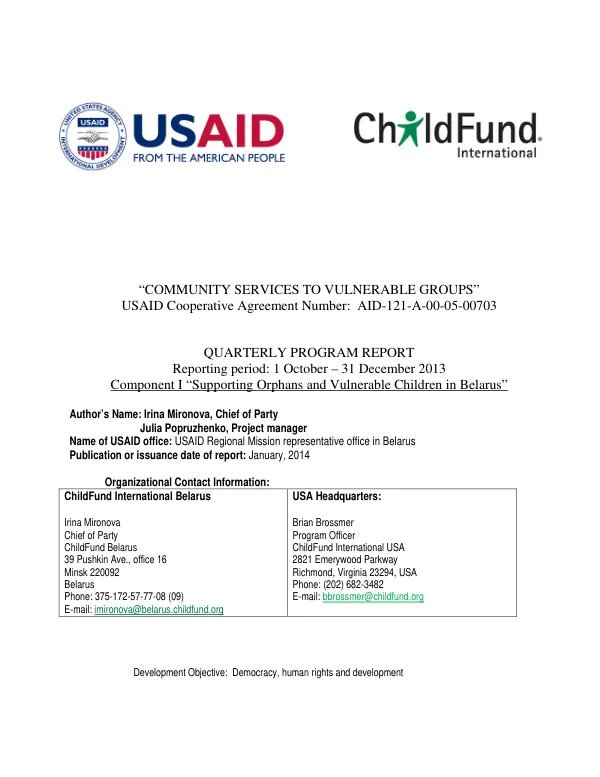
Community Services to Vulnerable Groups
The Orphans and Vulnerable Children component in Belarus aims to reduce the number of children institutionalized in state-administered orphanages and boarding schools by supporting at-home family care and moving children out of institutions.
2014 · 18 pages
Sign in to readA free account is required to download.
Abstract
The project targets "social orphans," children whose parents are living but unable to provide proper care, or children of parents who have been denied parental rights. The project's activities focus on working with families and social service professionals to maintain and reintegrate children within their original family units. The project has three main objectives: improve access to and further develop an integrated system of community-based prevention and services for families with institutionalized and at-risk children; improve the quality of training and education available to social service providers; and provide technical assistance to social service providers through policy development, methodology consultations, and advocacy efforts. To achieve these objectives, the project has implemented various interventions, including the Family-centered approach, which aims to reform the child protection system. By the end of December 2013, 168 communities from all over Belarus had specialists trained on the Family-centered approach, and 41 (60%) of these communities had begun child protection system reforms and had multidisciplinary teams trained by alumni of ChildFund training programs. Additionally, a new type of service for abused and neglected children and their families was successfully piloted, and 50% of children attending these centers were removed from the register of the child protection system due to an improved family environment. The project has also made significant progress in improving the quality of training and education available for social service providers. A group of university faculty who were trained on the Family-centered approach in the previous project year developed and approved new training courses on the Family-centered approach in child protection services, which were approved by the university authorities for implementation this academic year. Furthermore, an innovative in-job support service for child protection specialists was piloted by the country's first Resource Center on Child Protection in Minsk, which was created within a sub-grant provided by ChildFund to Minsk City Re-training institute. The project has achieved several key outputs during the period between October 1 and December 31, 2013, including 1415 parents and 121 children accessing community-based prevention and rehabilitation services, 1299 child protection specialists and local authorities participating in capacity building events, and 114 specialists supported with targeted consultations and methodological and informational materials. The project has also covered 168 geographic locations with project interventions and completed several training programs, including a training program on volunteer management and a training program on the Family Type Care Development for orphans.