DEVELOPMENT ALTERNATIVES, INC. (DAI)
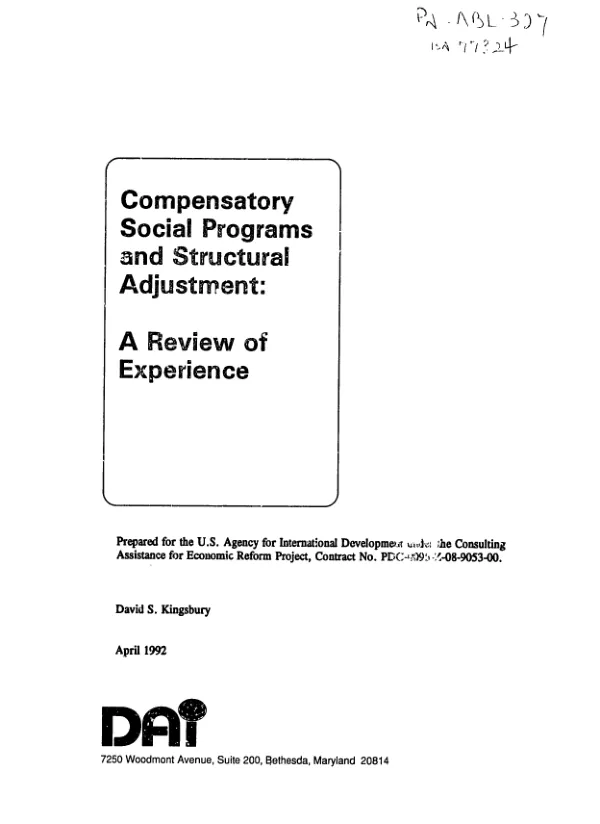
Compensatory social programs and structural adjustment : a review of experience
To ease the burden of austerity measures required by structural adjustment programs, donors and developing country governments have implemented a variety of compensatory programs.
Kingsbury, David S. · 1992
Sign in to readA free account is required to download.
Abstract
These fall under three broad categories: employment creation through public works; assuring access of the most vulnerable to social services (health, education, and community development); and targeting subsidies to the most vulnerable. This paper uses case studies from Bolivia, Ghana, Chile, Senegal, and Mexico to identify lessons learned from such compensatory programs and to examine the different institutional structures -- multisectoral or sector by sector -- used to implement them. The report concludes that many of the programs are not really "compensatory" in nature, but are really aimed at alleviating poverty and should be designed and evaluated as such. In many instances, they have attempted to resolve problems that require medium- or long-term efforts. In addition, program design has paid too little attention to opportunity-cost implications or to the effect of adjustment measures on income distribution. There is also strong reason to doubt the efficacy of multisectoral programs in providing integrated short-term poverty relief. On the positive side, compensatory programs can increase the legitimacy of economic reform in the eyes of the people. The most successful are those enacted by governments committed to economic reform and to broad participation in the development process. If properly designed and implemented, such programs allow fledgling governments to display an ability to govern and respond to people"s needs. Policy implications for A.I.D. are discussed briefly in conclusion.