INSTITUTE FOR CONTEMPORARY STUDIES. INTERNATIONAL CENTER FOR ECONOMIC GROWTH
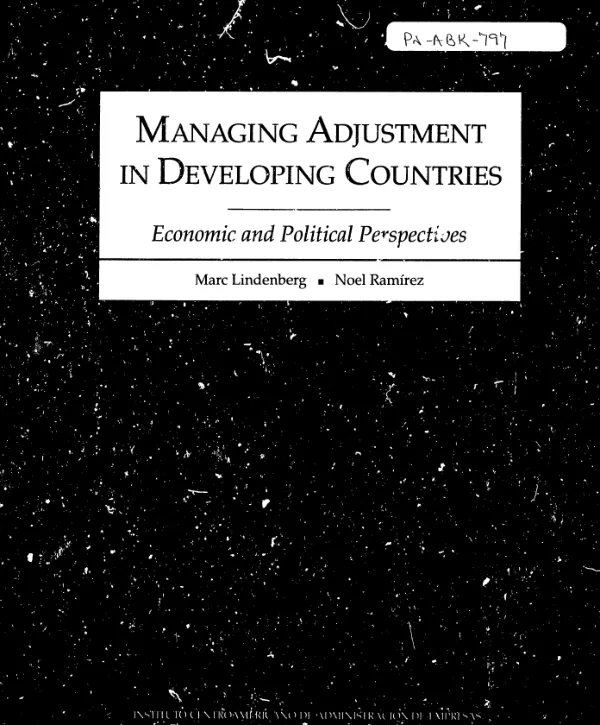
Managing adjustment in developing countries : economic and political perspectives
The purpose of this book is to help future international managers and policymakers understand and participate in the definition of national economic strategies in developing countries.
Lindenberg, Marc; Ramirez, Noel · 1970
Sign in to readA free account is required to download.
Abstract
This is not a work for economic theorists; rather, its chapters and case studies, collected from the experiences of a variety of developing countries throughout the 1980"s, are intended to serve as a learning device to help Central American Presidents, their cabinets, business leaders, labor organizations, political parties, and others to practice their skills in the analysis of national economic policies. The cases are intended to be used as a basis for class discussion, not to illustrate the correct or incorrect administrative handling of an economic or political situation. The book proceeds from principle to practice in four parts. In Part I, "Understanding National Strategy," conceptual frameworks are presented for organizing economic and political information about past policies, performance, and problems. Typologies for understanding the benefits and risks of new strategies are introduced, along with methodologies for determining which groups might perceive themselves to be winners or losers should governments attempt to implement these strategies. Part II, "Analyzing Short- and Medium-Term National Strategy," uses cases from Costa Rica, Chile, Bolivia, Taiwan, and Indonesia to help readers study the dynamics and consequences of short-term strategies such as stabilization, and of medium-term strategies such as liberalization and structural adjustment. The cases permit the reader to apply the frameworks from part I in order to understand policy packages and speculate about their economic and political implications. Part III, "Formulating Industrial Strategy," provides formats for evaluating key choices for the industrial sector, such as import substitution and export promotion, and the policies often associated with those choices. It uses cases from Singapore, Central America, Malaysia, and Taiwan to help readers understand different aspects of industrial policy and their consequences. Finally, Part IV, "Designing Agricultural Strategy," presents opportunities to review product and market choices in the agricultural sector. Through the use of cases from Latin America, it allows the reader to learn about policy options such as reducing agricultural subsidies and changing the agricultural product mix. (Author abstract)
Related documents