FHI 360
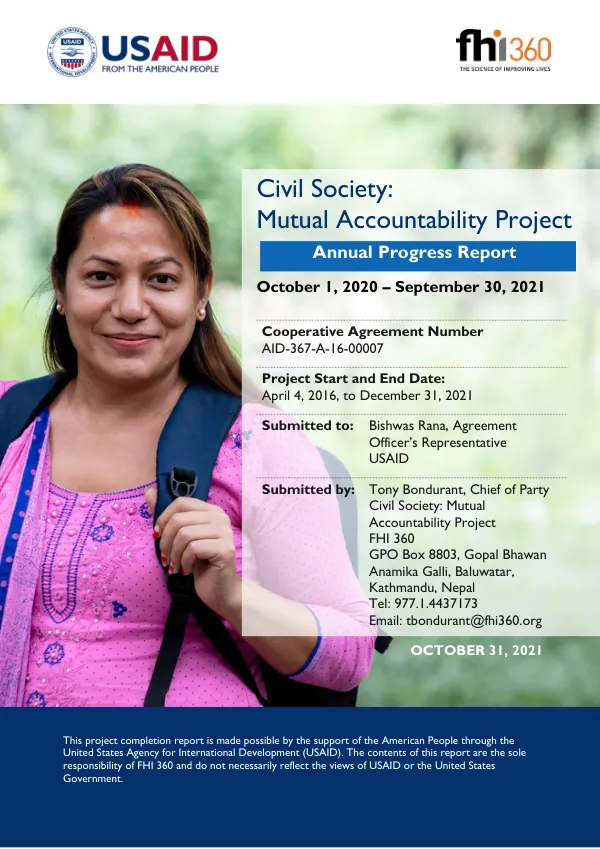
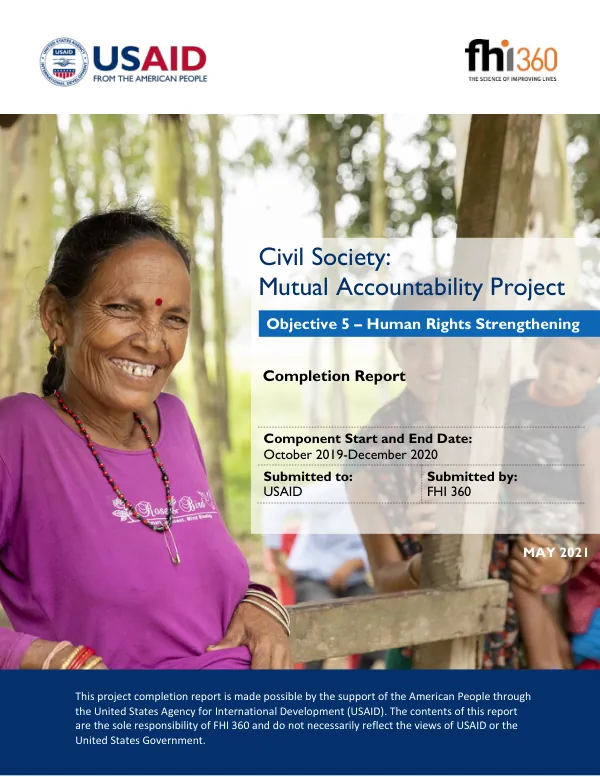
Completion Report: Human Rights Strengthening Component of CS:MAP in Nepal
The Human Rights Strengthening (HRS) component of CS:MAP was implemented from October 1, 2019, to December 31, 2020, with additional USAID funding in 2019-2020.
2021 · 16 pages
Sign in to readA free account is required to download.
Abstract
The HRS component was incorporated into the existing CS:MAP project as Objective 5, focusing on the duty-bearer and rights-holder sides of human rights accountability in five municipalities. The objective aimed to improve the ability of human rights organizations to advocate and engage with government at the federal and subnational levels and to sub-national governments' knowledge and understanding about how to incorporate the protection of rights into their planning. To accomplish these objectives, CS:MAP-HRS assessed the Government of Nepal's (GON) implementation of human rights commitments and human rights laws mandated by the Constitution. The project built the capacity of civil society organizations (CSOs) to monitor and report on these commitments and laws. Through tailored technical assistance and workshops, CS:MAP-HRS also built the sub-national government's capacity to use a rights-based approach when creating policies and strengthened the relationship between CSOs and the government. The project engaged in activities with authorities aimed at sensitization, provision of knowledge, and development and strengthening of law and policy tools on the duty-bearer side. On the rights-bearer or demand side, activities focused on raising awareness, strengthening technical knowledge and advocacy skills, and facilitating the formation and enhancement of networks among constituencies for change. The organizational forms supported on the demand side were CSOs, networks, and coalitions, consistent with the CS:MAP approach more generally. Across CS:MAP programming and reporting, human rights vulnerabilities are understood to be at the center of Nepal's three core governance challenges: discriminatory social norms; an elite-driven pattern of public decision-making; and the lack of effective remedies when rights are violated. The CS:MAP-HRS pillar, like the other four CS:MAP objectives, has its own mini-theory of change, which assumes that the institutionalization of human rights protections depends on more and better advocacy by civil society organizations combined with greater awareness by government actors along with the needed legal and policy instruments and resources. The project was implemented at federal and subnational levels, with CS:MAP working with four national level partners at the federal level and existing implementing partners at the subnational level. The period coincided with chronic paralysis in national politics and the disruption caused by successive lockdowns and restrictive measures due to COVID-19, which undermined the trust-building required at local level. The project's first result, Improved Ability of Human Rights Organizations to Advocate and Engage with Government at the Federal and Subnational Levels, describes the discrete but inter-connected areas of activity undertaken to achieve this objective. These areas include the review of national human rights situation, advocacy on the rights of gender and sexual minorities, collaboration with independent human rights commissions, international HR advocacy, constitutional rights advocacy, evidence-based rights advocacy, defending human rights during a pandemic, and statutory rights protections. The review of national human rights situation involved assessing the GON's implementation of human rights commitments and human rights laws mandated by the Constitution. Advocacy on the rights of gender and sexual minorities focused on raising awareness and strengthening technical knowledge and advocacy skills among CSOs and government actors. Collaboration with independent human rights commissions aimed to build the capacity of these commissions to monitor and report on human rights commitments and laws. International HR advocacy involved engaging with international human rights mechanisms to promote Nepal's human rights obligations and commitments. Constitutional rights advocacy focused on promoting the implementation of constitutional rights and freedoms. Evidence-based rights advocacy aimed to strengthen the use of evidence in human rights advocacy and policy-making. Defending human rights during a pandemic involved responding to the human rights implications of the COVID-19 pandemic. Statutory rights protections focused on promoting the implementation of statutory rights and freedoms. The project's activities in these areas aimed to improve the ability of human rights organizations to advocate and engage with government at the federal and subnational levels and to sub-national governments' knowledge and understanding about how to incorporate the protection of rights into their planning.