THE ASIA FOUNDATION
Conflict Mitigation through Community Mediation Program
Conflict Mitigation through Community Mediation Program in Dhanusha, Mahottari, Siraha, Saptari, Sarlahi, and Rautahat districts began in 2014 with the support of USAID.
2015 · 25 pages
Sign in to readA free account is required to download.
Abstract
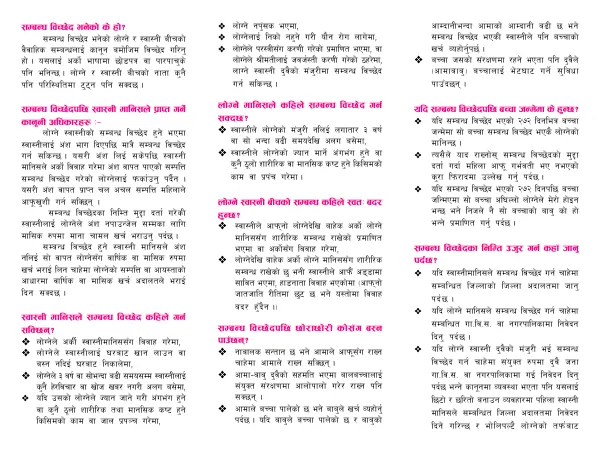
The program aims to improve mediation services for marginalized community people, increase participation of youth and women in local government planning and peace building processes, and increase community awareness on conflict management and mitigation. The program targets poor and marginalized people from the community to achieve the goal of sustaining a peaceful environment in the community with local level conflict mitigated. The main objectives of the program are to improve mediation services to marginalized community people, increase participation of youth and women in local government planning and peace building processes, increase community awareness on conflict management and mitigation. Mandwi, the implementing partner, selected 36 masters' trainers from the project districts and provided training on basic community mediation for 8 days to the community mediators through a transparent selection process. The 648 community mediators (27 community mediators in each working VDCs) were selected and trained by the masters' trainers. Out of them, 263 were female, 385 male, 100 Dalit, 100 Janjati, and 29 Muslims. In total, 24 community mediation centers were established at VDC offices with basic equipment support. Those centers are currently offering mediation services to the local people through the trained community mediators. In addition to the community mediation services, women advocacy platforms (WAP) and youth advocacy platforms (YAP) were established to increase the participation of youth and women in the community mediation, local resources mobilization, and planning processes. Moreover, as an awareness campaign, Mandwi developed Information, Education Communication (IEC) materials, such as brochures and pamphlets, with the information on community mediation related services, benefits, mediation centers, and contact persons. These IEC materials were distributed in the project VDCs through PNGOs, mediation centers, community mediators, YAP, WAP, and local level other institutions. Nepal has been undergoing a drastic transformation: politically and socially. After the successful completion of the second constituent assembly election, things are returning to normalcy, and the common people are optimistic about the drafting of the new constitution, which everyone believes will be inclusive, progressive, and will lead Nepal towards development. In the meanwhile, the agreement reached on June 8, 2015, between rival parties, the ruling alliance of Nepali Congress and Communist Party of Nepal (Unified Marxist Leninist, UML), and the combined opposition, Unified Communist Party of Nepal (Maoist), and Madhesi Janadhikar Forum (Democratic), based on which they agreed to federate the country into eight provinces and promulgate a constitution, leaving the issues of names to be decided later by two-thirds majority of the state assembly of respective provinces. However, dozens of small parties rejected the deal saying that it is a blow to federalism. As political parties are unanimous on many other issues, the 16-point deal that includes the structure of provinces, judiciary, forms of government, and electoral process, promulgation of new constitution, and formation of national consensus government and position of president and vice president. Given the opposition from Madhesh and ethnic-based parties, it is yet to see how Madheshi and ethnic groups within three major parties respond to the agreement in the time of voting and whether it will pave the way for the promulgation of the new constitution. In this context and from the security point of view, in spite of agitation by the political parties within the project districts, there are no security challenges or other disturbances in the program areas. In addition, concerned stakeholders are cooperative, which is expected to be a positive environment in the implementation of the program. During the Organizational Capacity Assessment (OCA), all local project-implementing partners received weak scores in terms of their capacity in managing conflict mitigation and management (CMM) related activities as they all are new to this area. Therefore, Mandwi facilitated developing local partner's policy, guidelines to implicate the CMM part in their mission, and vision. The challenges faced by the program include difficulty in convincing VDC secretaries to plan and allocate the budget for community mediation programs due to their own mindsets and practices of expending resources in hardware like tent materials, tailoring machines to targeted groups. To address these challenges, Mandwi has taken actions such as facilitating the development of local partner's policy, guidelines to implicate the CMM part in their mission, and vision, and providing training to community mediators on basic community mediation. The program has made significant progress in establishing community mediation centers, training community mediators, and increasing community awareness on conflict management and mitigation. However, there are still challenges to be addressed, such as convincing VDC secretaries to allocate budget for community mediation programs.