USAID DEC
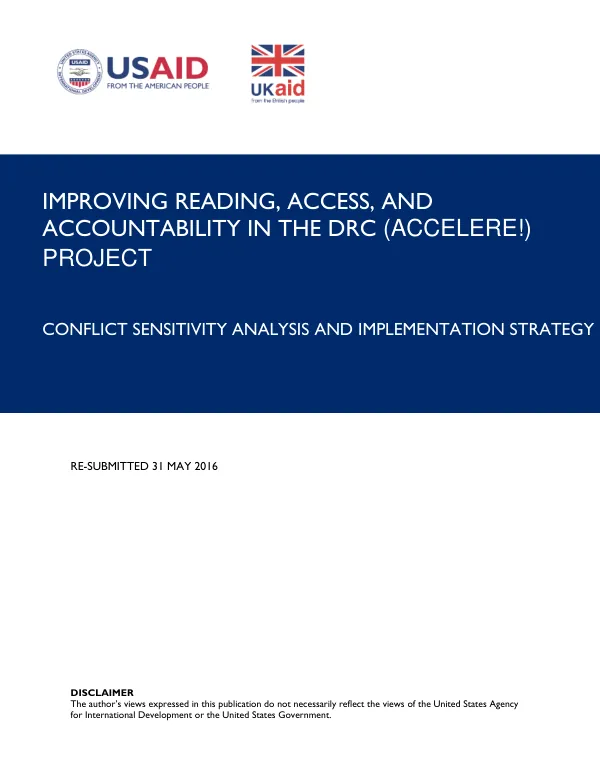
Conflict Sensitivity Analysis and Implementation Strategy: Improving Reading, Equity, and Accountability in the DRC (ACCELERE!) Project
Sign inUNITED NATIONS CHILDREN'S FUND
Conflict Sensitivity Analysis and Implementation Strategy: Improving Reading, Equity, and Accountability in the DRC (ACCELERE!) Project
The Improving Reading, Equity, and Accountability in the DRC (ACCELERE!)
2016 · 84 pages
Sign in to readA free account is required to download.
Abstract
project is a primary education initiative implemented by USAID in collaboration with the United Kingdom Department for International Development (DFID). The project aims to improve equitable access to education and learning outcomes for girls and boys in the Democratic Republic of the Congo (DRC). A conflict-sensitive analysis was conducted to inform the project's implementation strategy. The analysis identified several key conflict dynamics at the national and community levels. At the national level, the report highlights the presence of various armed groups, including the Allied Democratic Forces (ADF) and the Forces Démocratiques de Libération du Rwanda (FDLR), which pose a significant threat to the stability and security of the region. The report also notes the presence of internally displaced persons (IDPs) and refugees, who are often vulnerable to exploitation and violence. At the community level, the report identifies several conflict connectors and dividers, including ethnic and linguistic differences, land disputes, and competition for resources. The report also highlights the importance of community-level connectors, such as local leaders and traditional authorities, who can play a crucial role in promoting peace and stability. The analysis also examined the specific context of several provinces in the DRC, including Katanga, Equateur, Kasai Oriental, Kasai Central, North and South Kivu. The report notes that each province has its unique conflict dynamics, and that the project must be tailored to address the specific needs and challenges of each region. Based on the conflict analysis, the report provides several key recommendations for the project's implementation strategy. These include the need to engage with local communities and stakeholders to build trust and promote peace and stability, the importance of addressing the root causes of conflict, and the need to develop a flexible and adaptive implementation plan that can respond to changing conflict dynamics. The report also highlights the importance of conflict sensitivity in the project's implementation, and provides several tools and resources to support this effort. These include a conflict sensitivity framework, a set of focus group discussion guides, and a set of key informant interview guides. Overall, the conflict sensitivity analysis and implementation strategy for the ACCELERE! project provides a comprehensive framework for addressing the complex conflict dynamics in the DRC and promoting peace and stability in the region. The project's implementation will focus on several key areas, including the development of a conflict-sensitive implementation plan, the engagement of local communities and stakeholders, and the provision of training and support to project staff. The project will also work to address the root causes of conflict, including poverty, inequality, and lack of access to education and other basic services. The project's geographic focus will be on several provinces in the DRC, including Katanga, Equateur, Kasai Oriental, Kasai Central, North and South Kivu. The project will work to engage with local communities and stakeholders in these regions, and to develop a tailored implementation plan that addresses the specific needs and challenges of each region. The project's timeframes will be phased, with the first phase focusing on conflict analysis and stakeholder engagement, and the second phase focusing on project implementation and monitoring and evaluation. The project will also establish a monitoring and evaluation framework to track progress and identify areas for improvement. The project's recommendations include the need to engage with local communities and stakeholders to build trust and promote peace and stability, the importance of addressing the root causes of conflict, and the need to develop a flexible and adaptive implementation plan that can respond to changing conflict dynamics. The project will also work to address the root causes of conflict, including poverty, inequality, and lack of access to education and other basic services.