FAMILY HEALTH INTERNATIONAL
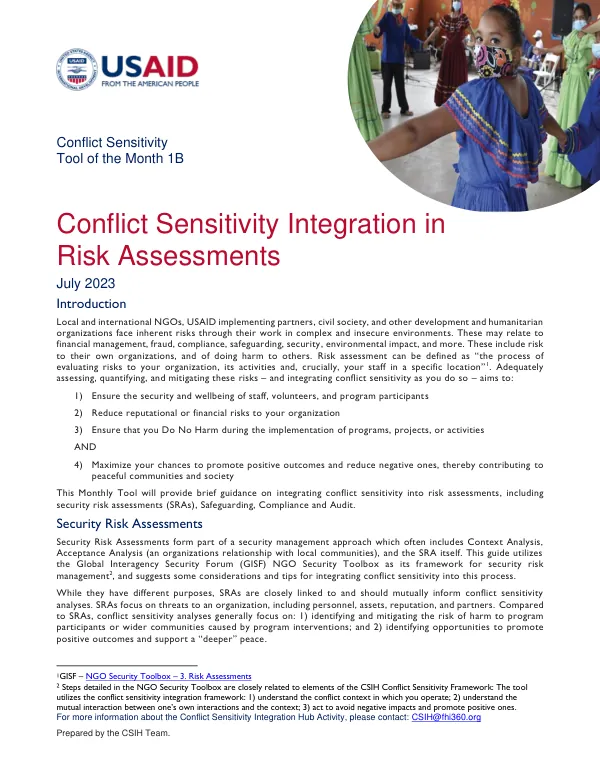
Conflict Sensitivity Tool of the Month: Indicators for Conflict Sensitivity
Conflict Sensitivity Tool of the Month: Indicators for Conflict Sensitivity Conflict sensitivity is a crucial aspect of project implementation, ensuring that projects do not exacerbate existing conflicts and maximize their contribution to conflict prevention outcomes.
2023 · 4 pages
Sign in to readA free account is required to download.
Abstract
Monitoring and evaluation (M&E) for conflict sensitivity involve tracking the positive and negative interactions between the project's activities and the context. Three types of indicators are used in conflict-sensitive M&E: context indicators, intervention indicators, and interaction indicators. Context indicators monitor key changes in the context, including drivers of conflict and violence, connectors, and dividers. These indicators help identify potential risks and opportunities that may impact the project's performance. Intervention indicators measure the project's objectives and progress against set targets. They are essential for understanding the effectiveness of the project's activities and identifying areas for improvement. Interaction indicators provide information on the interaction between the project and its context, requiring reflection on qualitative aspects of project implementation and exploring questions linked to staff and community perceptions. Good practice in identifying indicators for conflict sensitivity involves robust analysis, including data from Peace and Conflict Assessments or other conflict assessments, and references to existing research and program evaluation. Indicators should be developed in a participatory way, incorporating different perspectives and experiences to ensure that all stakeholders are represented. It is also essential to consider the risks of violence and conflict when identifying indicators. This involves monitoring medium to long-term conflict trends and dynamics, such as incidents of violent crime, accountability, and transparency. Indicators should be developed to address these risks and provide a comprehensive understanding of the conflict context. Combining qualitative and quantitative indicators is also crucial for monitoring conflict sensitivity. Quantitative indicators provide a numerical representation of changes, while qualitative indicators help contextualize the data and explain the underlying reasons for these changes. Indicators should be gender-sensitive and inclusive, addressing the specific needs and interests of different groups, including LGBTQI+ individuals. This involves developing both gender-specific and gender-disaggregated indicators to ensure that all stakeholders are represented. The following table provides examples of context indicators, intervention indicators, and interaction indicators for a conservation project with a focus on gender and inclusion: Context Indicator: Percentage of community members actively involved in conservation cooperatives (disaggregated by sex, age, ethnicity, and location) How this is useful for conflict sensitivity: Low levels of community engagement, especially among women and indigenous communities, can ferment grievances and deepen inequality. Intervention Indicator: Number of women actively involved in leading conservation initiatives How this is useful for conflict sensitivity: Evidence shows that environmental pressures can increase incidents of gender-based violence, and projects with 50% female representation in decision-making groups tend to conserve more and distribute ecosystem services more equitably. Interaction Indicator: Perceptions of male decision-makers towards women's leadership of conservation efforts How this is useful for conflict sensitivity: Projects addressing gender-based power imbalances may face backlash from existing decision-makers who perceive they are "losing out". Monitoring data can identify conflict sensitivity risks and inform adaptations to the project implementation plan. For example, a curriculum aimed at preventing violence in schools inadvertently created more bullying among students. Reviewing the curriculum and adapting it to address this issue can help minimize adverse effects and achieve progress. In conclusion, conflict sensitivity is a critical aspect of project implementation, and monitoring and evaluation play a crucial role in identifying and addressing potential risks and opportunities. By developing and using effective indicators, projects can ensure that their activities do not exacerbate existing conflicts and maximize their contribution to conflict prevention outcomes.