USAID DEC
Conservation Agriculture Saves Irrigation Water in the Dry Monsoon Phase in the Ethiopian Highlands
Sign inWATER MANAGEMENT INSTITUTE
Conservation Agriculture Saves Irrigation Water in the Dry Monsoon Phase in the Ethiopian Highlands
Conservation agriculture has been identified as a key strategy for improving water productivity and reducing soil degradation in sub-Saharan Africa.
2019 · 16 pages
Sign in to readA free account is required to download.
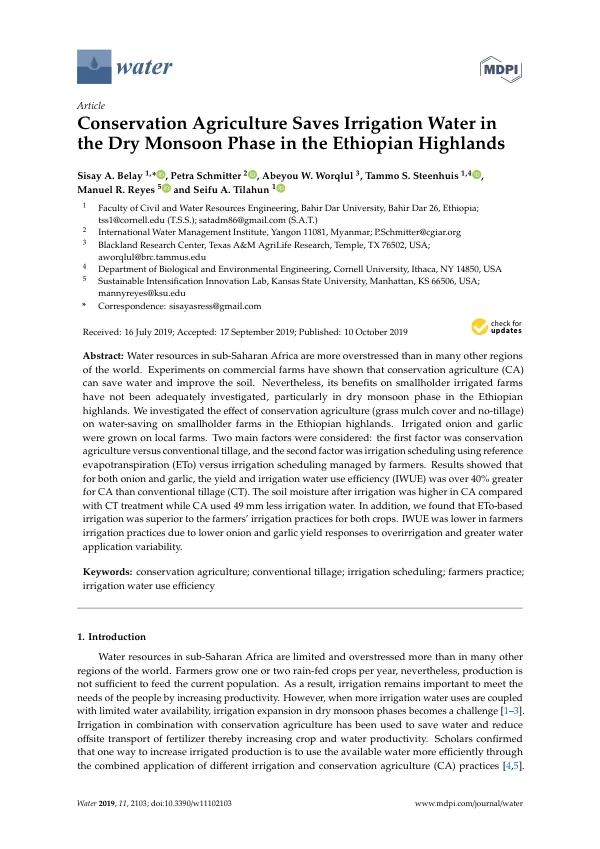
Abstract
In the Ethiopian highlands, where water resources are overstressed, conservation agriculture has been shown to increase water productivity and promote soil health. However, the benefits of conservation agriculture on smallholder irrigated farms in the dry monsoon phase have not been adequately investigated. A study conducted in the Dengeshita experimental site in the Northern Ethiopian highlands investigated the impact of conservation agriculture and irrigation water management practices on water-saving, soil water dynamics, and related variables. The study involved 34 plots of 10 m by 10 m, with 17 plots assigned for conservation agriculture and 17 for conventional tillage. Onion and garlic were grown during the dry phase, and the plots were selected based on the availability of a productive shallow well adjacent to the irrigable land and farmers' willingness to participate. The results showed that conservation agriculture resulted in higher soil moisture after irrigation compared to conventional tillage, while using 49 mm less irrigation water. The yield and irrigation water use efficiency (IWUE) were over 40% greater for conservation agriculture than conventional tillage for both onion and garlic. Additionally, the study found that irrigation scheduling using reference evapotranspiration (ETo) was superior to farmers' irrigation practices for both crops, resulting in lower IWUE due to lower onion and garlic yield responses to overirrigation and greater water application variability. The study highlights the potential of conservation agriculture to save water and improve soil health in the Ethiopian highlands. The findings suggest that combining conservation agriculture with irrigation practices can increase water productivity and reduce soil degradation. The results also emphasize the importance of using reference evapotranspiration (ETo) for irrigation scheduling to optimize water use and minimize waste. The study area is located in the Dengeshita experimental site in the Northern Ethiopian highlands, with an average rainfall of 1300 mm during the main phase and 360 mm during the dry phase. The soil texture is a loam soil, and the plots have slopes ranging from two to five percent. The study used a randomized complete block design with two main factors: conservation agriculture versus conventional tillage and irrigation scheduling using reference evapotranspiration (ETo) versus irrigation scheduling managed by farmers' practices. The results of the study have implications for smallholder farmers in the Ethiopian highlands, who can benefit from adopting conservation agriculture and using reference evapotranspiration (ETo) for irrigation scheduling. The study also highlights the need for further research on the impact of conservation agriculture on smallholder irrigated farms in the dry monsoon phase.