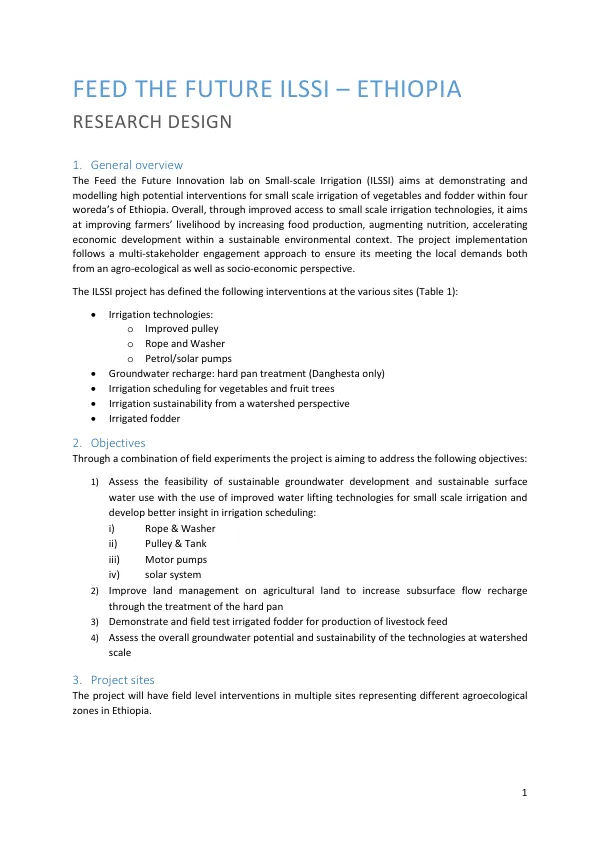
USAID DEC
Suitability mapping framework for solar photovoltaic pumps for smallholder farmers in sub-Saharan Africa
Sign inWATER MANAGEMENT INSTITUTE
Suitability mapping framework for solar photovoltaic pumps for smallholder farmers in sub-Saharan Africa
Irrigation is a key pathway for smallholder farmers to build resilience towards climate change.
2018 · 17 pages
Sign in to readA free account is required to download.
Abstract
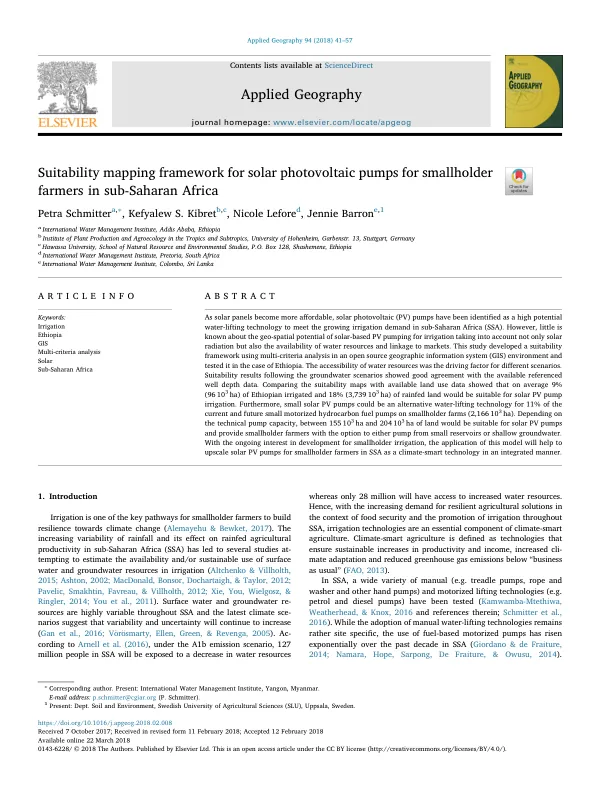
The increasing variability of rainfall and its effect on rainfed agricultural productivity in sub-Saharan Africa (SSA) has led to several studies attempting to estimate the availability and/or sustainable use of surface water and groundwater resources in irrigation. Surface water and groundwater resources are highly variable throughout SSA, and the latest climate scenarios suggest that variability and uncertainty will continue to increase. The use of motorized pumps could increase small-scale irrigable land by 30 million hectares, benefiting 180 million people and resulting in an annual net revenue of USD 22 billion. However, the access to hydrocarbon fuel remains a challenge in several SSA countries, and the use of hydrocarbon energized motorized pumps would not fulfill the climate-smart criteria of reducing emissions in agriculture. Furthermore, rural electrification is particularly poorly developed in SSA, which significantly reduces the potential of electricity-based pumps as an alternative to hydrocarbon pumps. As solar panels become more affordable, solar photovoltaic (PV) technologies have been identified as high potential solutions for rural electrification as well as water extraction for both domestic and irrigation purposes in SSA. Solar PV pumps for smallholder farmers have become an emerging technology in SSA, and a review shows that solar PV-based pumping can be more economically viable in urban and rural areas compared to both hydrocarbon energized and electrical pumps. However, the economic viability is highly dependent on water supply meeting the water demand. A geographic information system (GIS)-based mapping has been used effectively to assess suitability and feasibility of renewable energy, water resources, or specific crop systems. Multi-criteria decision making (MCDM) offers a variety of techniques and practices to uncover and integrate decision makers' preferences into "real-world" GIS-based planning and management solutions. Various applications of MCDM have been used to assess the potential of agricultural water management strategies for smallholder farmers. The existing suitability analysis methodologies can be adapted for the suitability analysis of solar PV pumps for smallholder irrigation. However, a multi-criteria GIS-based platform has not yet been developed to assess the suitability of solar-based PV pumps for smallholder irrigation in Africa taking into account available water resources. Therefore, this study sought to develop a GIS-based methodology utilizing open source software to evaluate the potential of solar-based PV pumps using shallow groundwater and surface water, and to test the performance of the model in Ethiopia.