BAHIR DAR UNIVERSITY
Feed the Future ILSSI – Ethiopia Research Design
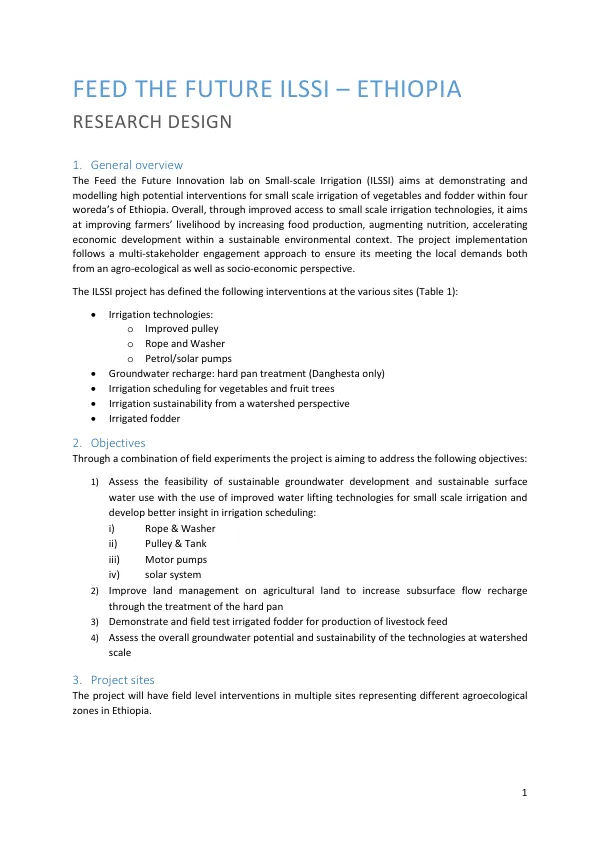
The Feed the Future Innovation Lab on Small-scale Irrigation (ILSSI) aims to demonstrate and model high-potential interventions for small-scale irrigation of vegetables and fodder within four woredas of Ethiopia.
2016 · 13 pages
Sign in to readA free account is required to download.
Abstract
The project focuses on improving farmers' livelihoods by increasing food production, augmenting nutrition, and accelerating economic development within a sustainable environmental context. A multi-stakeholder engagement approach is employed to ensure the project meets local demands from an agro-ecological and socio-economic perspective. The ILSSI project has defined several interventions at various sites, including irrigation technologies, groundwater recharge, irrigation scheduling, and irrigated fodder. The project aims to assess the feasibility of sustainable groundwater development and surface water use with improved water lifting technologies for small-scale irrigation. Field experiments will be conducted to develop better insights into irrigation scheduling and improve land management on agricultural land to increase subsurface flow recharge. The project will have field-level interventions in multiple sites representing different agro-ecological zones in Ethiopia. IWMI will work with national partners, including universities and non-governmental organizations, in the different sites. Bahir Dar University will work on two woredas in Amhara, while Arba Minch University will work on two woredas in Oromia and the Southern Nation Nationalities People Region. Send a Cow Ethiopia will support activities in the southern sites, and two local level savings and loans cooperatives will support activities in the Amhara sites. The project will focus on four woredas: Dangila, Robit-Bata Kebele, Bahir-Dar Zuria Woreda, and Adami Tullu Woreda. Dangila is located in the Amhara regional state and has a sub-tropical climate with average annual rainfall of 1600 mm. Robit-Bata Kebele is located in Bahir-Dar Zuria Woreda and has a sub-tropical climate with a high potential for groundwater development. Adami Tullu Woreda is located in East Shoa Zone and has a high altitude with average annual rainfall varying between 600-1000 mm. The project will assess the feasibility and suitability of water lifting technologies for vegetables and fodder. The hypothesis is that design of suitable and sustainable irrigation technologies and practices should take into account the amount of groundwater available and annual amount of recharge. The project will also identify and use appropriate technologies suitable to the landscape, water resource, agro-ecology, and gender needs to improve water use efficiency, labor and land productivity, household income, nutrition, and female participation in small-scale irrigation. The project will implement and field test various water lifting technologies, including Rope and Washer, improved pulley, and motorized pumps, in different woredas. The project will also provide irrigation pumps on credit to demonstrate the ability of households to pay back loans for this technology. The information gathered will reduce the financial risk to micro-credit institutions and banks for providing loans and enable them to continue financing and expanding the adoption of such technologies.