PATRIMONIO NATURAL
Conservation Landscapes Program - CLP Dry Ecosystem Conservation in the Caribbean
The Conservation Landscapes Program - CLP Dry Ecosystem Conservation in the Caribbean is a project aimed at improving governance in the tropical dry forest ecosystem (TDFE) in Colombia.
2016 · 14 pages
Sign in to readA free account is required to download.
Abstract
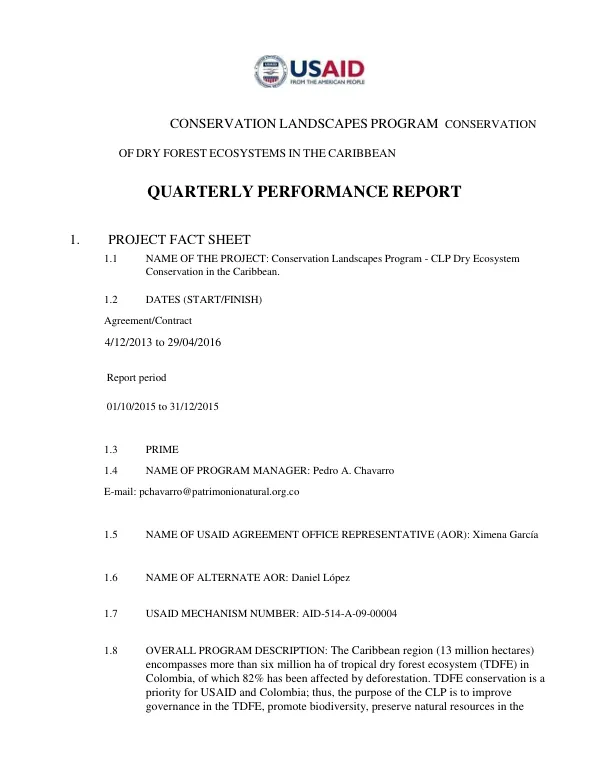
The program's overall goal is to promote biodiversity, preserve natural resources, and strengthen environmentally sustainable livelihoods for associated communities. The focus is on implementing land use management tools at the landscape level, restoring connectivity with a biodiversity-friendly productive matrix and ecological corridors. The program's geographic focus is on the Caribbean region of Colombia, which encompasses more than six million hectares of TDFE, of which 82% has been affected by deforestation. The program's implementation is centered on four nodos (Cesar, Colorados, El Salado, and Hibacharo), where community feedback and engagement are key components of the conservation efforts. During the quarter, a series of contracts and agreements were signed for a total amount of COP 1.072,6 million pesos. These agreements included partnerships with organizations such as Sociedad Audubon, F. para la Inversión Social (FIS), Minka-Dev, and BBD Americas, among others. The agreements aimed to promote rural economic development, conservation of priority ecosystems, and sustainable land use practices. One of the main achievements of the program was the strengthening of nine public and private institutions in Nodo Colorados, which improved their capacity on effective environmental resource management. In Nodo El Salado, 50 farming families increased their economic benefits by adopting sustainable production systems, which offered more productive crops per unit area and reduced threats to the TDFE. In Nodo Cesar, 59.5 additional hectares were included as Civil Society reserves, and 252 beneficiaries were recorded with improved energy services as a result of the implementation of the efficient stoves program. The Efficient Stoves Program was a key component of the program's efforts to reduce the use of wood as fuel and promote sustainable energy options. The program worked in coordination with F. Carboandes to prepare training processes on the installation and operation of the efficient stoves, which benefited 63 families in the Department of Cesar. The program also conducted specialized laboratory tests to improve the prototype stoves. The program's alliance with Crepes & Waffles, a main chain of restaurants in Colombia, aimed to increase revenues by more productive crops per area unit. As a result of this alliance, the company introduced a new product in their Christmas Menu, which used the "Agra Salad" recipe that promotes sustainable agriculture practices. The program's geographic focus is on the Caribbean region of Colombia, where the tropical dry forest ecosystem is a priority for conservation. The program's implementation is centered on four nodos, where community feedback and engagement are key components of the conservation efforts. The program's achievements demonstrate its commitment to promoting biodiversity, preserving natural resources, and strengthening environmentally sustainable livelihoods for associated communities.
Related documents