USAID DEC
Conservation Landscapes Program - CLP Dry Ecosystem Conservation in the Caribbean: Quarterly Performance Report
Sign inPATRIMONIO NATURAL
Conservation Landscapes Program - CLP Dry Ecosystem Conservation in the Caribbean: Quarterly Performance Report
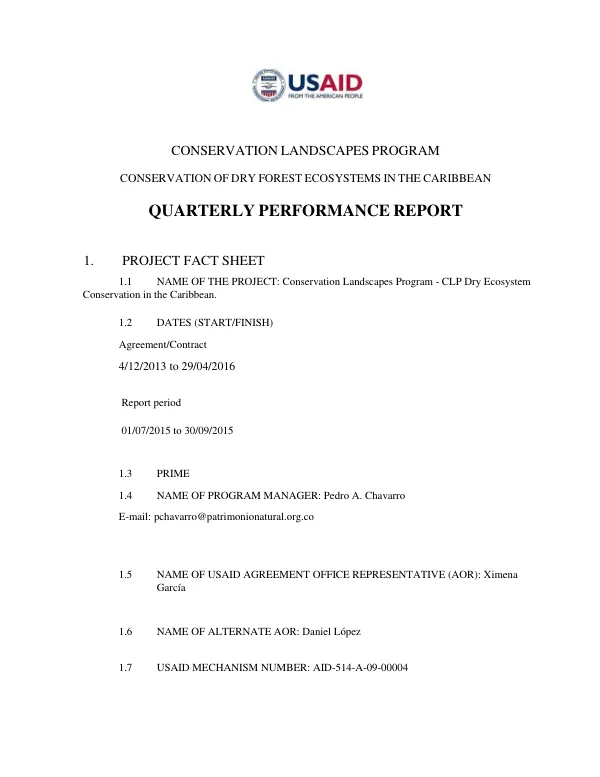
The Conservation Landscapes Program (CLP) Dry Ecosystem Conservation in the Caribbean is a project aimed at improving governance in tropical dry forest ecosystems (TDFE) in Colombia.
2016 · 14 pages
Sign in to readA free account is required to download.
Abstract
The program's primary goal is to promote biodiversity, preserve natural resources, and strengthen environmentally sustainable livelihoods for associated communities. The CLP focuses on implementing land use management tools at the landscape level, restoring connectivity with a biodiversity-friendly productive matrix and ecological corridors. Key achievements during the quarter include the signing of a new agreement with F. Semana and F. Crecer en Paz, which will contribute COP $177,91 million to the project. This agreement will involve the participation of 37 new families from three townships in Nodo El Salado. The program also made significant progress in the implementation of production-conservation corridors, including the construction of 22 kilometers of conservation-production corridor in Nodo Colorados. This corridor has contributed to the connectivity of dry forest relicts, reducing pressure on fauna and flora populations. In addition, the program achieved a total of 1,292 hectares with better management in Nodo El Salado, through farm planning processes carried out with 51 families linked to the agreement with F. Semana. The program also completed the project in Nodo Gaira, providing 962 hectares with best management practices thanks to farm planning actions in 50 properties located in the Gaira River Basin. Furthermore, the program contributed to the improvement of the dry forest and the restoration of degraded areas through the propagation and planting of 6,000 trees of timber species typical of the TDFE. The program also made progress in the implementation of business ventures that have an impact on the mitigation or reduction of threats to biodiversity. The results of the strategy to lower the impact on the TDFE through the reduced use of wood as fuel and the promotion strategy aimed at increasing revenues by more productive crops per area unit were notable. The program also launched the campaign "Cosecha de Mi Tierra" (Harvest of my Land) in several points of sale, offering the product "cuarentano red bean" in their salad bar. However, the program faced challenges due to the drought in the Caribbean region, which affects the nodos currently carrying out activities to promote conservation and sustainable production activities in the TDFE. In response, the CLP has identified the need to implement hydrological designs for the 81 families involved in the project in Nodo El Salado, seeking to optimize the use of water resources in the area and thus facilitate the implementation of sustainable production systems.