USAID DEC
Conservation Landscapes Program - CLP Dry Ecosystem Conservation in the Caribbean: Quarterly Performance Report
Sign inPATRIMONIO NATURAL
Conservation Landscapes Program - CLP Dry Ecosystem Conservation in the Caribbean: Quarterly Performance Report
The Conservation Landscapes Program aims to conserve dry forest ecosystems in the Caribbean region.
2014 · 14 pages
Sign in to readA free account is required to download.
Abstract
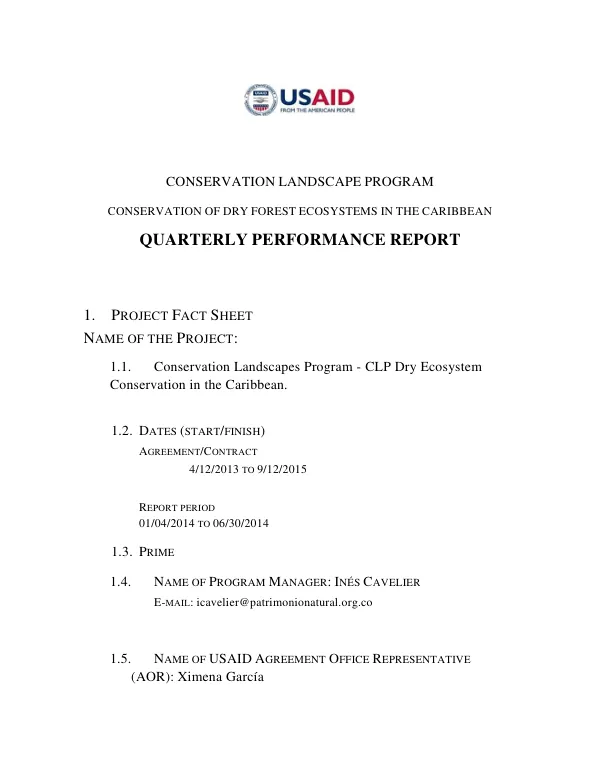
The program's objective is to improve the governance, biodiversity, and preservation of natural resources in the region, while strengthening environmentally sustainable livelihoods for associated communities. The focus is on implementing land use management tools at the landscape level, restoring connectivity with a biodiversity-friendly productive matrix and ecological corridors. Implementation of the program is taking place in five locations: Nodo Colorados, Nodo Guajira, Nodo Kankuamos, Nodo Piojó, and Nodo Magdalena. In Nodo Colorados, farm planning has started after careful farm characterization, and 25.6 hectares of connectivity corridor have been isolated. In Nodo Guajira, farm plans have been formulated with 50 beneficiary families, and 23 conservation pre-agreements have been reached. Infrastructure implementation includes the completion of three water reservoirs and the construction of four water harvest systems. In Nodo Kankuamos, minor advances have been made in isolation, production systems, and farm planning. A field evaluation will be conducted next quarter to analyze agreement goals and progress. At Nodo Piojó, a connectivity map has been completed, showing 58.44 hectares of corridors that require 11,345 lineal meters of isolation. On-ground verification of the corridors has identified diversity threats such as desertification, land farm burning, and coal production. The program has also strengthened CAR technical staff through a workshop on the design and implementation of connectivity corridors. An online tool for conservation and connectivity projects in the Caribbean TDFE has been developed for regional authorities. Prototypes of clean cook stoves have been codesigned with communities to increase the adoption of this new technology. The main challenge in this reporting period is the high probability of El Niño in the second half of the year, which may require changes to be made to achieve the objectives in each agreement. The program is working to address this challenge through careful consideration and planning in each location. The program's components include Improved Licit and Sustainable Livelihoods, which focuses on production-conservation corridors as the main conservation strategy. This approach uses production and improved livelihoods as an incentive to free space for conservation, resulting in pressure reduction to the ecosystem. The program is working to develop production-conservation corridors in the five locations, with a focus on isolating corridors, implementing infrastructure, and training communities. The program has made significant progress in the reporting period, including the isolation of 25.6 hectares of connectivity corridor in Nodo Colorados, the completion of three water reservoirs in Nodo Guajira, and the formulation of farm plans with 50 beneficiary families in Nodo Guajira. The program continues to work towards its objectives, addressing challenges and adapting to changing circumstances.
Related documents