COASTAL RESOURCES CENTER
Conservation of Coastal Eco-Systems in Tanzania: The PWANI Project
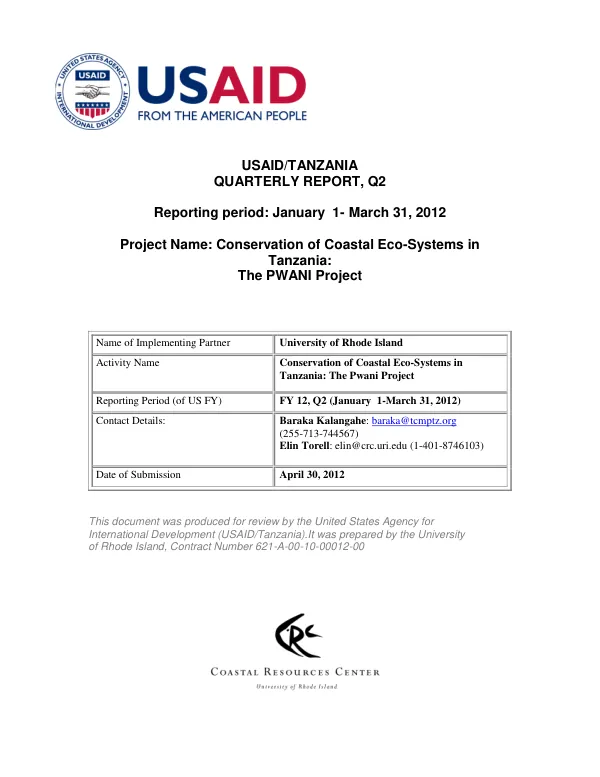
The Conservation of Coastal Eco-Systems in Tanzania: The PWANI Project is a USAID-funded initiative implemented by the University of Rhode Island's Coastal Resources Center.
2012 · 42 pages
Sign in to readA free account is required to download.
Abstract
The project aims to conserve and manage coastal ecosystems in Tanzania, with a focus on the Bagamoyo, Pangani, and Zanzibar regions. The project period spans from December 15, 2009, to December 14, 2013, with a budget of $4,377,061. The project's primary target beneficiaries include coastal districts, government departments and institutions, coastal communities, NGOs, and CBOs. Major counterpart organizations involved in the project include the National Environmental Management Council (NEMC), the Vice President's Office (VPO), government departments and institutions, coastal districts, local ICM programs, and NGOs. The project has made significant progress in achieving its targets. In terms of hectares of biological significance under improved management, the project has achieved 168,731 new hectares, exceeding the target of 102,046. Additionally, 25% of the targeted areas have shown improved biophysical conditions for selected parameters. The project has also made notable progress in addressing climate change and biodiversity conservation. Eleven laws, policies, strategies, plans, agreements, or regulations addressing climate change and/or biodiversity conservation have been officially proposed, adopted, or implemented as a result of USG assistance. Furthermore, the project has leveraged $333,208 in funds, exceeding the target of $14,128. In terms of energy efficiency, the project has supported the implementation of energy-efficient measures in 523% more households than the target. The project has also increased the capacity of 3% more stakeholders to adapt to the impacts of climate variability and change. The project has also made progress in improving access to finance for households, with 25% more households receiving community credit and start-up grants than the target. Additionally, the project has increased the proportion of females participating in USG-assisted programs designed to increase access to productive economic resources. The project has also achieved notable results in terms of HIV prevention interventions, with 25% more individuals reached with individual and/or small group level interventions than the target. The project has also reached 43% more fishermen with preventive interventions than the target. The project has also made progress in terms of condom service outlets, with 107% more outlets reached than the target. Additionally, the project has trained 4% more individuals than the target. The project has also supported 5% more person-hours of training in natural resources management and/or biodiversity conservation than the target. The project's success can be attributed to the strong partnership between the University of Rhode Island's Coastal Resources Center and the Tanzania Coastal Management Partnership, as well as the effective coordination with NEMC. The project's achievements demonstrate its commitment to conserving and managing coastal ecosystems in Tanzania, and its impact will be felt for years to come. The project's results are a testament to the effectiveness of the PWANI Project in achieving its goals and targets. The project's success has been made possible through the hard work and dedication of the project team, as well as the support of the USAID and the Tanzanian government. The project's achievements in terms of hectares of biological significance under improved management, climate change and biodiversity conservation, energy efficiency, access to finance, HIV prevention interventions, condom service outlets, and training in natural resources management and/or biodiversity conservation demonstrate its commitment to conserving and managing coastal ecosystems in Tanzania. The project's success has also been recognized through the achievement of several indicators, including the number of hectares in areas of biological significance showing improved biophysical conditions for selected parameters, the number of laws, policies, strategies, plans, agreements, or regulations addressing climate change and/or biodiversity conservation, and the number of individuals trained in natural resources management and/or biodiversity conservation. The project's achievements have also been recognized through the support of several major counterpart organizations, including NEMC, VPO, government departments and institutions, coastal districts, local ICM programs, and NGOs. The project's success has also been recognized through the effective coordination with NEMC, which has enabled the project to achieve its targets and make a significant impact in conserving and managing coastal ecosystems in Tanzania. The project's achievements demonstrate its commitment to conserving and managing coastal ecosystems in Tanzania, and its impact will be felt for years to come. The project's success has been made possible through the hard work and dedication of the project team, as well as the support of the USAID and the Tanzanian government.