AVENIR HEALTH
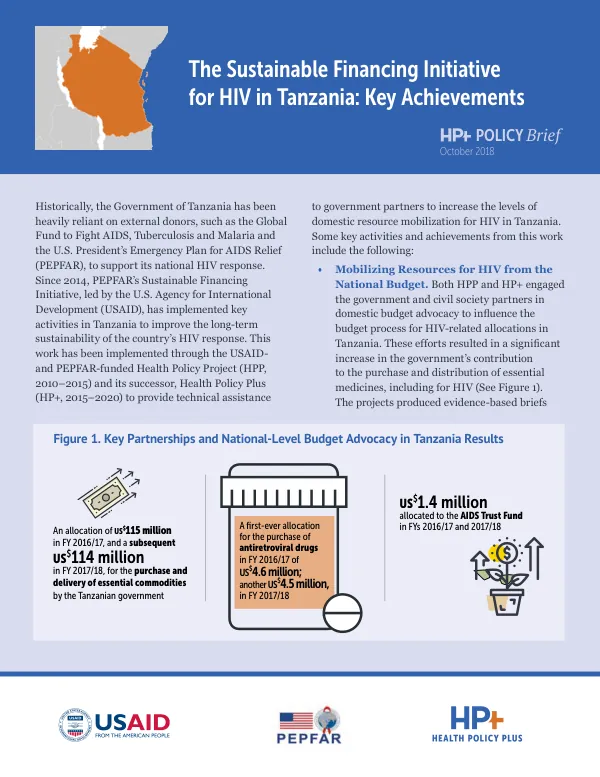
The Sustainable Financing Initiative for HIV in Tanzania: Key Achievements
The Government of Tanzania has historically relied on external donors to support its national HIV response.
2018 · 2 pages
Sign in to readA free account is required to download.
Abstract
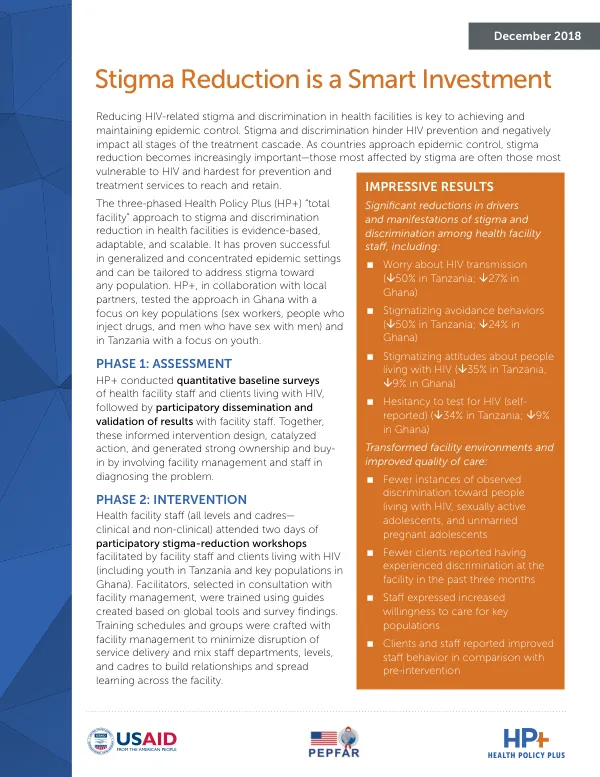
Since 2014, the U.S. Agency for International Development's Sustainable Financing Initiative, led by the U.S. President's Emergency Plan for AIDS Relief (PEPFAR), has implemented key activities to improve the long-term sustainability of the country's HIV response. This work has been implemented through the Health Policy Project (HPP, 2010-2015) and its successor, Health Policy Plus (HP+, 2015-2020), to provide technical assistance to government partners to increase domestic resource mobilization for HIV in Tanzania. Mobilizing resources for HIV from the national budget has been a key focus of HPP and HP+. The projects engaged the government and civil society partners in domestic budget advocacy to influence the budget process for HIV-related allocations in Tanzania. These efforts resulted in a significant increase in the government's contribution to the purchase and distribution of essential medicines, including for HIV. In FY 2016/17, the government allocated US$115 million for the purchase and delivery of essential commodities, and in FY 2017/18, it allocated US$114 million. Additionally, the government allocated US$4.6 million for the purchase of antiretroviral drugs in FY 2016/17 and US$4.5 million in FY 2017/18. Health Policy Plus (HP+) is a five-year cooperative agreement funded by the U.S. Agency for International Development under Agreement No. AID-OAA-A-15-00051, beginning August 28, 2015. The project's HIV activities are supported by the U.S. President's Emergency Plan for AIDS Relief (PEPFAR). HP+ is implemented by Palladium, in collaboration with Avenir Health, Futures Group Global Outreach, Plan International USA, Population Reference Bureau, RTI International, ThinkWell, and the White Ribbon Alliance for Safe Motherhood. The project's work includes improving technical efficiency of HIV service delivery, exploring innovative financing mechanisms, and increasing local ownership by building capacity of civil society organizations. Improving technical efficiency of HIV service delivery is a key component of HP+'s work. The project has supported the government of Tanzania to increase value for money from HIV resources by helping to deliver the same scale of services using fewer health system resources. HP+ completed an analysis of efficiency gains for antiretroviral therapy (ART) at the facility level, which showed that using multi-month scripting and a differentiated laboratory management algorithm could potentially reduce the total economic cost of ART services by US$258 million over a five-year period. The project is currently conducting an efficiency analysis on shifting a subset of HIV services intended to improve ART adherence and retention from facility to community levels. Exploring innovative financing mechanisms is another key area of focus for HP+. The project is engaging the government in a study that analyzes whether financing HIV services through national health insurance schemes is a viable option in Tanzania. HP+ has projected the proportion of people living with HIV that could potentially be enrolled and forecasted the incremental costs to the scheme for select HIV services to assess sustainability. Results show that the National Health Insurance Fund could absorb US$24 million in incremental costs for HIV services, covering 96,000 people living with HIV in year one within the scope of its existing pooled resources.