USAID DEC
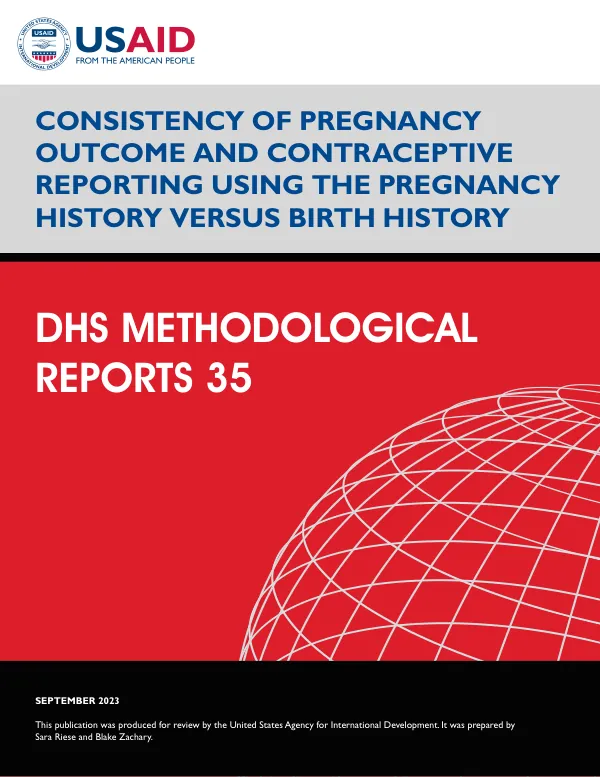
Consistency of Pregnancy Outcome and Contraceptive Reporting Using the Pregnancy History Versus Birth History
Sign inICF
Consistency of Pregnancy Outcome and Contraceptive Reporting Using the Pregnancy History Versus Birth History
The study examines the consistency of pregnancy outcome and contraceptive reporting using the pregnancy history versus birth history.
2023 · 135 pages
Sign in to readA free account is required to download.
Abstract
Reproductive histories in DHS surveys are a crucial component of the data collection process, providing information on pregnancy outcomes and contraceptive use. Prior analyses of reproductive histories have focused on the consistency of birth reporting, but the current study expands on this by examining the consistency of termination reporting. The study utilizes data from DHS surveys, which includes birth and termination reporting data, as well as contraceptive use reporting data. The data is analyzed using various measures and methods, including terminations, contraceptive use, and other measures. The results of the analysis are presented in several tables and figures, which provide insight into the consistency of birth and termination reporting and contraceptive use reporting. The study finds that the consistency of birth and termination reporting varies by region and survey characteristics. The results also indicate that the consistency of termination reporting is higher in some regions, such as Eastern Africa and West and Central Africa, compared to other regions. Additionally, the study finds that the consistency of contraceptive use reporting is higher in some surveys, such as those with a higher proportion of women aged 15-44. The study discusses the implications of the findings, including the potential biases in reproductive history data and the importance of considering these biases when analyzing DHS data. The study also highlights the need for further research on the consistency of reproductive history data and the development of methods to improve the accuracy of these data. The study concludes that the consistency of pregnancy outcome and contraceptive reporting using the pregnancy history versus birth history is a complex issue, and that further research is needed to fully understand the factors that influence the consistency of these data. The study provides a comprehensive analysis of the current state of reproductive history data and highlights the importance of considering the consistency of these data when analyzing DHS data. The study was conducted with support provided by the United States Agency for International Development (USAID) through The DHS Program. The views expressed are those of the authors and do not necessarily reflect the views of USAID or the United States Government. The study was carried out by ICF, a global consulting and technology services company, with the assistance of several authors and editors. The study's findings have implications for the analysis and interpretation of reproductive history data in DHS surveys. The study's results highlight the importance of considering the consistency of reproductive history data when analyzing DHS data, and the need for further research on the factors that influence the consistency of these data. The study's conclusions also emphasize the importance of developing methods to improve the accuracy of reproductive history data. The study's discussion highlights the importance of considering the consistency of reproductive history data when analyzing DHS data. The study also emphasizes the need for further research on the factors that influence the consistency of these data, as well as the development of methods to improve the accuracy of these data.
Related documents