USAID DEC
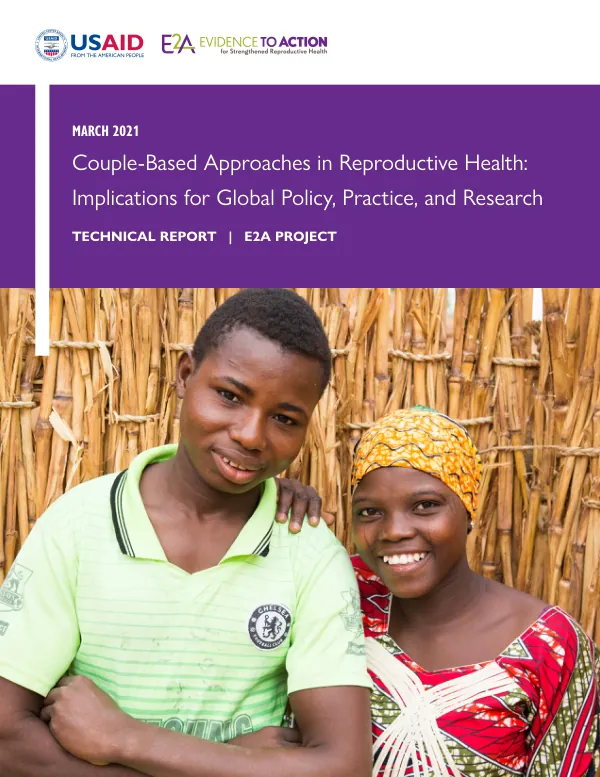
Couple-Based Approaches in Reproductive Health: Implications for Global Policy, Practice, and Research
Sign inINTRAHEALTH
Couple-Based Approaches in Reproductive Health: Implications for Global Policy, Practice, and Research
Couple-Based Approaches in Reproductive Health: Implications for Global Policy, Practice, and Research The Evidence to Action (E2A) Project, a global flagship for strengthening family planning and reproductive health service delivery, has been working to address the reproductive health care needs of girls, women, and underserved communities worldwide.
2021 · 88 pages
Sign in to readA free account is required to download.
Abstract
The project aims to increase support, build evidence, and lead the scale-up of best practices that improve family planning services. A key focus of the E2A Project is couple-based approaches (CBAs), which conceptualize the couple as the basic unit of intervention to achieve a reproductive health outcome. Couple-based approaches encompass a range of policies, research, and practices that target the couple as a unit to achieve reproductive health outcomes. These approaches can be categorized into couple-focused interventions (CFIs), which are public health practices that seek to change one or more elements of the relationship to achieve an explicit couple-focused or individual reproductive health outcome. CFIs can be conducted wholly with the couple as a unit or working with each member of the couple toward the intervention goal, but not necessarily at the same time. The E2A Project has been working to strengthen the capacity of health systems to deliver couple-based approaches. This includes building the skills of health care providers to deliver couple-focused interventions, as well as strengthening the health information system to track and monitor the implementation and impact of these interventions. The project has also been working to promote the use of couple-based approaches in global reproductive health policies, through documentary analysis of global reproductive health policies and engagement with key stakeholders. The E2A Project has identified several key benefits of couple-based approaches, including improved reproductive health outcomes, increased access to family planning services, and enhanced gender equality. The project has also identified several challenges to the implementation of couple-based approaches, including the need for increased funding and resources, as well as the need for stronger health systems and more effective policies. The E2A Project has been working to address these challenges through a range of strategies, including the development of new tools and resources, the provision of technical assistance to countries, and the engagement of key stakeholders in the global reproductive health community. The project has also been working to promote the use of couple-based approaches in global reproductive health policies, through documentary analysis of global reproductive health policies and engagement with key stakeholders. The E2A Project's work on couple-based approaches has been informed by a range of research and evidence, including the work of the London School of Hygiene and Tropical Medicine and the World Health Organization. The project has also been working to build an epistemic community around couple-based approaches, which includes a transnational network of professionals with recognized expertise and competence in the field. The E2A Project's work on couple-based approaches has several implications for global policy, practice, and research. First, it highlights the importance of targeting the couple as a unit to achieve reproductive health outcomes. Second, it emphasizes the need for stronger health systems and more effective policies to support the implementation of couple-based approaches. Finally, it underscores the need for increased funding and resources to support the scale-up of couple-based approaches. The E2A Project's work on couple-based approaches has also identified several key recommendations for global reproductive health policy and practice. First, it recommends that countries prioritize the implementation of couple-based approaches in their reproductive health policies and programs. Second, it recommends that health systems be strengthened to deliver couple-focused interventions. Finally, it recommends that increased funding and resources be allocated to support the scale-up of couple-based approaches. Overall, the E2A Project's work on couple-based approaches has significant implications for global reproductive health policy, practice, and research. It highlights the importance of targeting the couple as a unit to achieve reproductive health outcomes, emphasizes the need for stronger health systems and more effective policies, and underscores the need for increased funding and resources to support the scale-up of couple-based approaches.