FHI 360
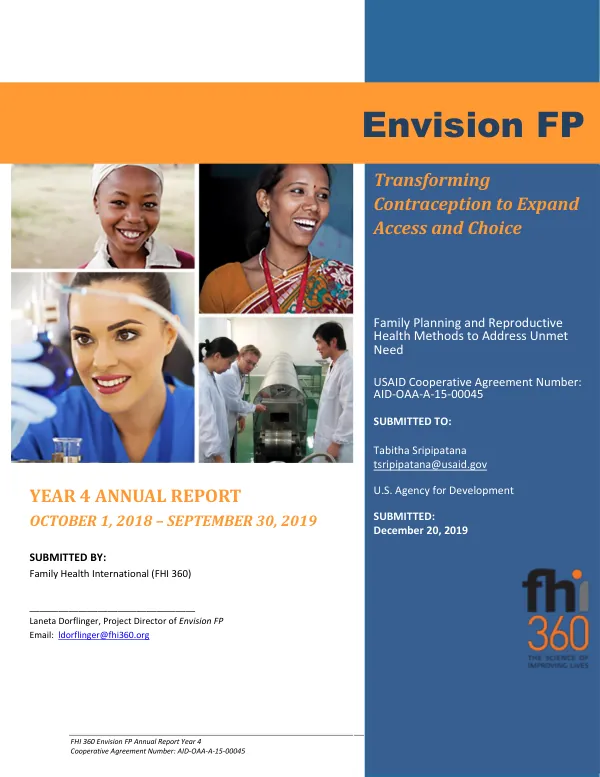
FHI 360 Envision FP Semi-Annual Report Year 4
The Envision FP initiative aims to develop, introduce, and expand understanding of contraceptive technologies and approaches to enhance choice and reduce unmet need.
2019 · 28 pages
Sign in to readA free account is required to download.
Abstract
The research agenda aligns with three specific aims: refine existing methods, respond to product-related issues, and develop new methods to fill gaps. Envision FP focuses on key challenges and opportunities significant for users and programs in an effort to achieve the overall goal of broadening choice of and access to quality, affordable, and acceptable contraceptives to meet the changing needs and desires of women and girls throughout their reproductive lives. The initiative is led by Family Health International (FHI 360) and is funded by the United States Agency for International Development (USAID) under Cooperative Agreement Number AID-OAA-A-15-00045. The project has three main aims: refine existing contraceptive methods, respond to product-related issues, and develop new methods to address method-related nonuse or fill gaps. AIM 1: Refine existing contraceptive methods focuses on developing and refining existing contraceptive technologies. One of the key objectives is to develop a lower-dose injectable contraceptive, which would offer a highly effective and safer contraceptive option for women. The team is using a marketed DMPA IM formulation to develop a lower-dose SQ product, and a partially-blinded randomized trial will be conducted to assess pharmacokinetics and pharmacodynamics of three doses of Pfizer's current DMPA formulation compared with Depo-subQ 104. The study aims to determine the effectiveness, safety, and acceptability of extending the reinjection interval for Sayana Press (SP) and to determine the appropriate grace period for re-injection. Evidence suggests that SP is effective for four months or longer but is currently indicated for three months. Extending SP duration by one month would reduce commodity costs for a year of protection by 25% and would allow countries to serve 33% more women annually. AIM 2: Respond to product-related issues with existing contraceptive methods focuses on addressing product-related issues that arise from the field and impact provision. The team is conducting a rapid response and proactive risk mitigation for contraceptive programs, and a study on access to implant removal is underway. The team is also working on extending the duration of LARC methods and addressing contraceptive drug-drug interactions. AIM 3: Develop new methods to address method-related nonuse or fill gaps focuses on developing new methods to address method-related nonuse or fill gaps in existing contraceptive technologies. The team is working on developing a contraceptive microneedle patch, which would provide a new and innovative method for women to access contraception. The team is also working on developing biodegradable contraceptive implants and female non-surgical contraception by focus ultrasound. The Envision FP initiative has made significant progress in the first half of Year 4, including the completion of data cleaning and the development of the first draft of the clinical study report for the FDA. The team plans to complete the final data analysis, finalize the clinical study report, and submit the main manuscript to an open access journal in the next six months.
Related documents