USAID. MISSION TO INDONESIA
Construction completion report
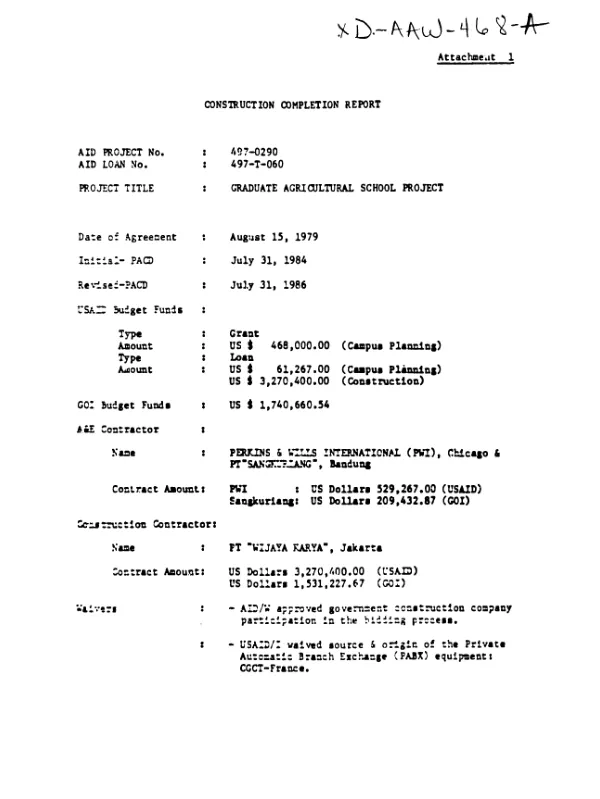
Final Mission Report on a project component (8/79-7/86) to develop a campus master plan and to construct an Information Resources Center (IRC) and Environmental Studies Center (ESC) at the Institut Pertanian Bogor (IPB) campus in Darmega, Bogor, Indonesia.
Sign in to readA free account is required to download.
Abstract
The planned outputs were achieved: the campus master plan (to the year 2000), following the requirement of the Directorate General of Higher Education, can accomodate 25,000 students and was completed satisfactorily, as was construction of the IRC and ESC buildings, which total approximately 10,000 sq. m. Construction quality was excellent and the buildings were finished within the planned budget. Building designs proposed by the contractor, Perkins and Wills, Int. (PWI), as accepted by USAID/I, were adequate, except that review revealed that the traditional red clay tile to be used for the roof would leak badly and should be replaced by another material, and that provisions for gutters, downspouts, and protection for stairwells were insufficient. Other issues in building design centered around air conditioning costs (ultimately only the IRC recieved a full air conditioning system) and the addition of emergency exits with remote control electromagnetic locks (the latter was vetoed by IPB). Construction was delayed due to a disagreement over which regulations were to be enforced (the Mission wanted the project to conform with A.I.D. Handbook 11, while the IPB wanted to comply with Kepres 14 and 18), and problems in qualifying Indonesian construction companies through A.I.D. regulations for participation in the project. As a result, the project was extended two years, from 7/84 to 7/86. Further delays, caused by problems getting imported construction equipment through customs, resulted in the completion of the construction in 1/87. Despite the design problems and delays, this project is a good example of how A.I.D. can effectively monitor and control a project using A.I.D. Handbook 11. These problems did point up the need for the project officer to be familiar with the procurement procedures of both the USG and the host government, however. The project also served to illustrate the advantages of contracting the two buildings as one complete package, rather than having the Government of Indonesia (GOI) prefinance the project according to the Fixed Amount Reimbursement system, which has consistently resulted construction delays and poor quality.